
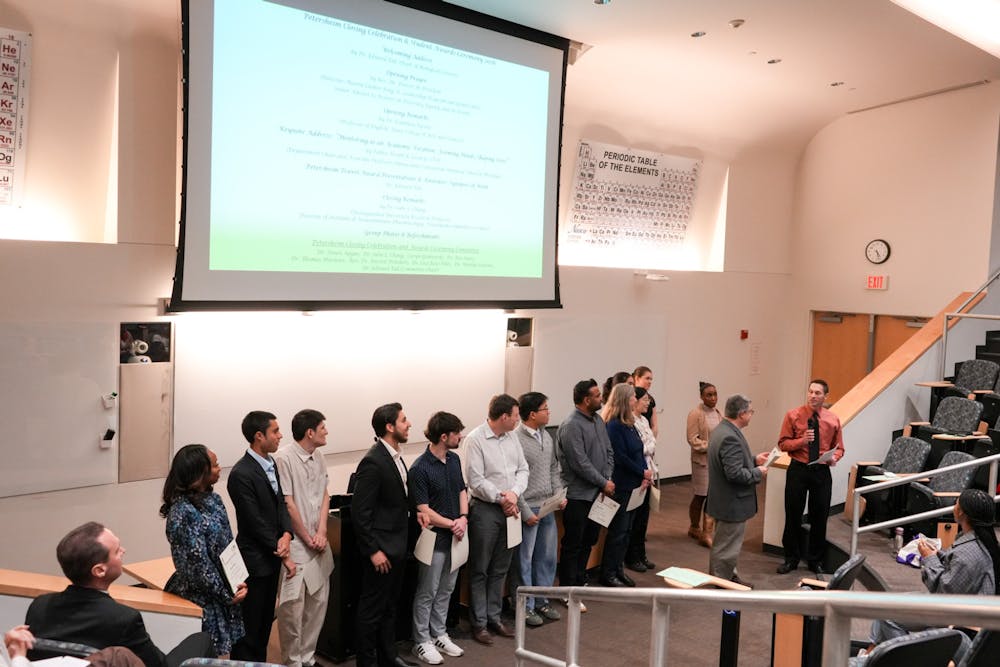
The 30th annual Petersheim Academic Exposition took place last week, kicking off with an opening ceremony on April 13 and concluding with an awards ceremony on Friday.
Dr. Jose Lopez, director of university research and a physics professor, served as the organizing committee co-chair alongside Dr. Sulie Chang. They delivered the keynote address at the opening ceremony.
Lopez said he became interested in the exposition when he joined the SHU community 15 years ago, calling it a celebration of learning.
“I saw how great it was, and the experience students had participating in it, and I thought, ‘This is one of the best things we do at the university,’” Lopez said. “During the academic year, this is my favorite week.”
Originally focused on chemistry and other hard sciences for undergraduate students, the exposition has since expanded to include research from all disciplines and members of the SHU community.
More than 200 projects were submitted this year, one of the largest turnouts ever, Lopez said.
“My favorite event is usually the closing ceremony,” Lopez said. “That’s when we recognize the best research of the expo, and some of the stuff people are working on just blows your mind. It’s the best of the best.”
At the closing ceremony, over a dozen presenters received awards recognizing their outstanding research, along with a travel voucher to further showcase their projects.
Alyssa Housley, a senior psychology major and data analysis minor, used functional neuroimaging, computational modeling and behavioral tasks to look at how decision-making processes are affected by concussions in college students.
Gabriella DeGuzman, a senior psychology major and chemistry minor, examined brain stem-mediated reflexes in individuals with a history of concussions, focusing on response times to auditory stimuli as a benchmark.
Both students conducted their research with Dr. Meghan Caulfield in the SHU Cognition and Neuroscience Laboratory as part of their senior theses. They have already presented their work at the Eastern Psychological Association Conference, the Big East Academic Conference and a neuroscience competition at Quinnipiac.
“One of the cool things [about] conferences is having a dialogue about your research,” Housley said. “You get so many perspectives looking at your research, and it is interesting to see people relate to it outside of academia.”
DeGuzman echoed that sentiment, emphasizing the broader applications of their work.
“Getting new ideas how the research can translate to different patient populations and how it can best make a wide impact,” DeGuzman said. “These opportunities allow our research to impact more people.”
With their travel vouchers, they hope to attend the Society for Neuroscience conference in Washington, D.C., later this year.
“We’re the ones receiving the award but it’s not just our efforts,” Housley said. “It feels more validating on behalf of the lab and Dr. Caulfield.”
Not all who received an award at Petersheim are experienced presenters.
Stefan Gregory, a junior biology major, worked with Ammar Mujtaba, a sophomore biology major, to research metal phthalazines by manipulating the symmetries, surrounding elements and charges of central ions in copper and zinc.
Their research began in February 2025 after they reached out to their General Chemistry II professor, Dr. Stephen Kelty, to do research under him.
For Gregory, he said Petersheim was his first exposition and first time presenting his own research to people walking by in a setting like that.
“At first I was nervous, but as we presented to more people and fine-tuned our speech with each person, it got easier,” Gregory said.
Not expecting an award, Gregory said he was surprised by the recognition.
“We are very grateful for the opportunity and the prestige that comes with it,” Gregory said.
Their end goal is to find a stable compound that labs can create and apply to fields such as cancer treatment, but this is the first of many milestones. “We have a long way until then,” Gregory said.
Another first-time presenter and award winner, Aakash Arumugam, a sophomore biology major, presented two projects at the expo this year.
First, Arumugam built on the research of Wenfei Huang, a doctoral student in molecular bioscience who also received an award at Petersheim this year. He looked at how molecules such as chlorine affect glioblastoma progression through ethanol modulation.
His independent research consisted of an in vitro experiment using human cells, focusing on the effects of ethanol on wound healing and whether cold plasma could reverse the effects.
“I want to make an impact that is applicable to many,” Arumugam said. “We’re in college, ethanol is very common and everyone’s had wounds, and glioblastoma is prevalent in many populations, but it is understudied.”
For Arumugam, he views symposiums like Petersheim as the prime opportunity to propel your research forward.
“I’ll start here at Petersheim and then go expand my horizons at national level conferences,” Arumugam said, with the ultimate goal of becoming a doctor to further impact people with his research.
Something Arumugam said he took away from Petersheim was his gratitude for the process and his ability to persist through difficult times.
“Same time last year I submitted my project and it got rejected,” Arumugam said. “It shows that you have to keep persisting, because a year ago I got rejected but now I came away with an award.”
Huang said in her research with Arumugam, they used datasets from the National Institute of Health that were open to the public, which helped with the accessibility of their project.
For her second project, Huang looked into spleen atrophy, the responsible immune cells and binge ethanol exposure, which is the rapid increase of blood alcohol levels that Huang said is common in college students.
Unlike most, as a postgraduate student, Huang said she began her research about five years ago, and while her project is done for now, she does see next steps.
At Petersheim, Huang said she has seen it improve her communication and presentation skills.
“Before, I could not imagine doing something like this, but I’ve been able to do it every year now,” Huang said.
Events like Petersheim are especially helpful for undergraduate students, Huang said.
“You can’t know how to improve without presenting,” she said. “I even learn a lot when I’m preparing to present.”
With her award, Huang said she will use it to attend a Society for Neuroimmune Pharmacology conference in Annapolis, M.D., where she was invited to give a talk about the research presented at Petersheim.
Some other winning projects dealt with research into type two diabetes, pandemic response and antibiotics in soil.
Not all winners had STEM-related research, as some projects included research on Black women presidents at predominantly white institutions and LGBTQ+ support in social work services.
Watch the closing ceremony livestream, and rewatch some of the events through the week.
Submissions for the Petersheim Research Exposition are open to all members of the Seton Hall community, and Lopez said he encourages everyone to look into it.
“You aren’t restricted,” Lopez said. “Learning outside the class has become super important; it’s not just an assignment you need to hand in, but it’s something they are passionate about and Petersheim provides them a platform to showcase their research.”
All research presented at the expo is kept and published in the library archives.
“It is a great thing for the future, whatever it may be, to show others that you are applying what you are learning into the real world,” Lopez said.
Additional award winners include:
Simone Taylor
Marsha Philemon
Brysen Pfingsten
Musab A. Siddiqui
Endian Li
Akshay Patel
Jamil Albanna
Garrett Yohananov
Jay Jethva
Kenneth Tomkovich
Leo Chu
Matthew Wilson
Gianna Sanchez
Sade Parsons
Michael Veronsky
Solomon Lee is the advertising manager for The Setonian. He can be reached at solomon.lee@student.shu.edu.


