
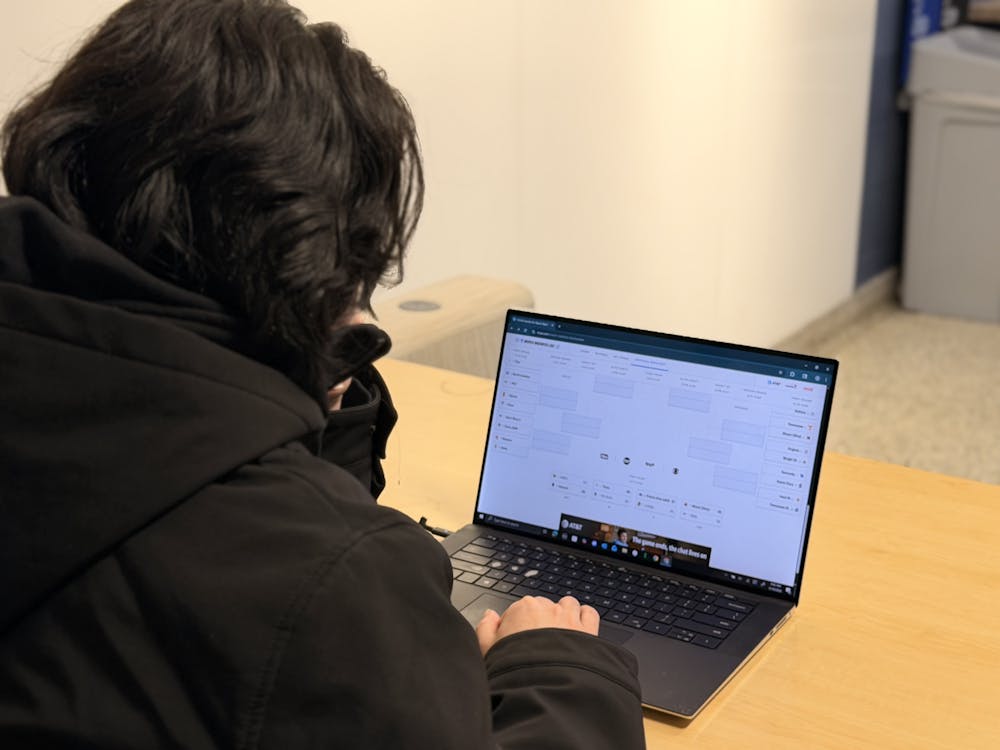
Every year, an estimated 60-100 million NCAA Tournament brackets are filled out, and while most will be sitting at the bottom of the trash can by the tournament’s first weekend, it doesn’t stop anyone from attempting to flex their ball knowledge.
Whether it’s by creating an online group with friends and family on one of several platforms, or by filling out an old-fashioned paper bracket, there is room for everyone to get in on the pinnacle of the college basketball season.
The first step for many when creating a bracket is research. Whether it’s watching games, following counting stats, or keeping up with one of the various advanced stats models available, there are countless ways to calculate a winner.
"I typically utilize statistics provided on the March Madness app," said junior sports media major Jay Costa. "I utilize offensive and defensive efficiency, Kenpom, and a whole bunch of other advanced statistics to help me make my bracket."
Freshman business major Wesley Schlachter took a different approach.
"I like experience over everything [else]," Schlachter said. "When looking at previous winners they were very experienced groups, so that is a huge factor when picking a winner for me."
While some people rely on stats to choose their winners, others decide to go with their heart—or even their hatred—to choose winners and losers.
"There’s always a bit of an anti-Purdue bias when picking my brackets," said freshman economics and finance major Henry Summers. "I just know that they will lose in the second-round like every year so I never have them going far."
Freshman business major Caden Lazzor, on the other hand, went with a more positive approach.
"I have [one-seed] Arizona winning the whole thing because my cousin goes there and I think they have an exciting team," Lazzor said.
Heading into the tournament Duke currently has the highest betting odds to win it all at +360, with Michigan and Arizona not far behind at +370 and +380. All three of these teams earned the one-seed in their respective regions (East, Midwest, and West, respectively.
"I have Arizona winning because they don’t have any bad losses and have played good competition," said junior business major Iggy Grynaviski. "The ESPN bracket metrics say good things about and I believe their schedule will carry them to a championship."
Others strayed away from these top contenders, picking somewhat lower-seeds who are nonetheless capable of making a deep run.
"The east side of the bracket is in my opinion very weak and Tom Izzo is a coach who has been here before so I’m taking [three-seed] Michigan State this year," said junior business management and philosophy major Aidan Smith. “There are a lot of guys who can’t get it done when they need to and Izzo isn’t one of those guys."
"I currently have [four-seed] Arkansas winning it all because they were super dominant in the SEC," said Costa. "Darius Acuff is a dog and they are one of the hottest teams in the country right now."
The women's tournament has also gained a lot of attention in the past few years, especially in 2024 when they amassed more viewers in the Final Four than that of the men’s. As a result, more brackets have been filled out in the following years than ever before for the women's tournament.
"Despite [one-seed] UConn’s undefeated season, I have [two-seed] LSU winning it all," said Costa. "When I sat down and looked at it deeper, I loved their numbers and advanced stats more and thought they could be a huge threat for them down the road."
But the most fun part of filling out a bracket is predicting the upsets. Whether it was 11-seed Loyola Chicago’s run to the Final Four in 2018, 15-seed Saint Peter’s trip to the Elite Eight in 2022 (led current SHU head coach Shaheen Holloway) or 16-seed Fairleigh Dickinson defeating then-one-seed Purdue in 2023, upsets are always a huge highlight of every tournament.
"What makes March madness so different is because it is so unpredictable," sophomore social and behavioral science major Kate Barada said. "Fans that don’t keep up with college basketball can still watch and get excited about the games."
"I love watching the Cinderella schools make deep runs in the tournament and rooting for the underdogs on teams I would have never watched if not for the tournament," Barada added. "I also love that most of the games are close no matter the ranking, each game can get really exciting."
Several students picked double-digit seeded teams to upset single-digit ones in the first-round of the tournament.
"I think [six-seed] BYU’s offense could get stifled by [11-seed] Texas," said Smith. "AJ Dybantsa is good, but strategies that rely on one guy aren’t very reliable, whereas Texas can rebound from one-through-five, be physical and make the shots they need in order to win the game."
"Caleb Wilson is a huge part of [six-seed] North Carolina’s team and won’t play in the tournament, so I think [11-seed] VCU has a good chance to upset them," said Grynaviski. "Also with Aden Holloway getting suspended, I think [13-seed] Hofstra is going to beat [four-seed] Alabama because they already haven’t looked good the past few games and this will just add to the chaos."
Costa was the biggest fan of this year’s underdogs, with a number of big upsets in his bracket.
"A big one that jumps out to me is [12-seed] High Point over [five-seed] Wisconsin," said Costa. "High Point to me feels like the better team overall according to a lot of statistical models and I think the Badgers will have a tough time with them."
In addition to that, Costa also has 11-seed University of South Florida (USF) and 12-seed Akron in his Sweet 16, 12-seed McNeese State and 10-seed Santa Clara in his Elite Eight, along with nine-seed Saint Louis going all the way to the Final Four.
Whoever ends up hoisting the trophy the first week of April, this should be an exciting tournament and one of the marquee events of the 2026 sporting calendar.
William Gilhooly is a writer for The Setonian’s Sports Section. He can be reached at william.gilhooly@student.shu.edu.


