
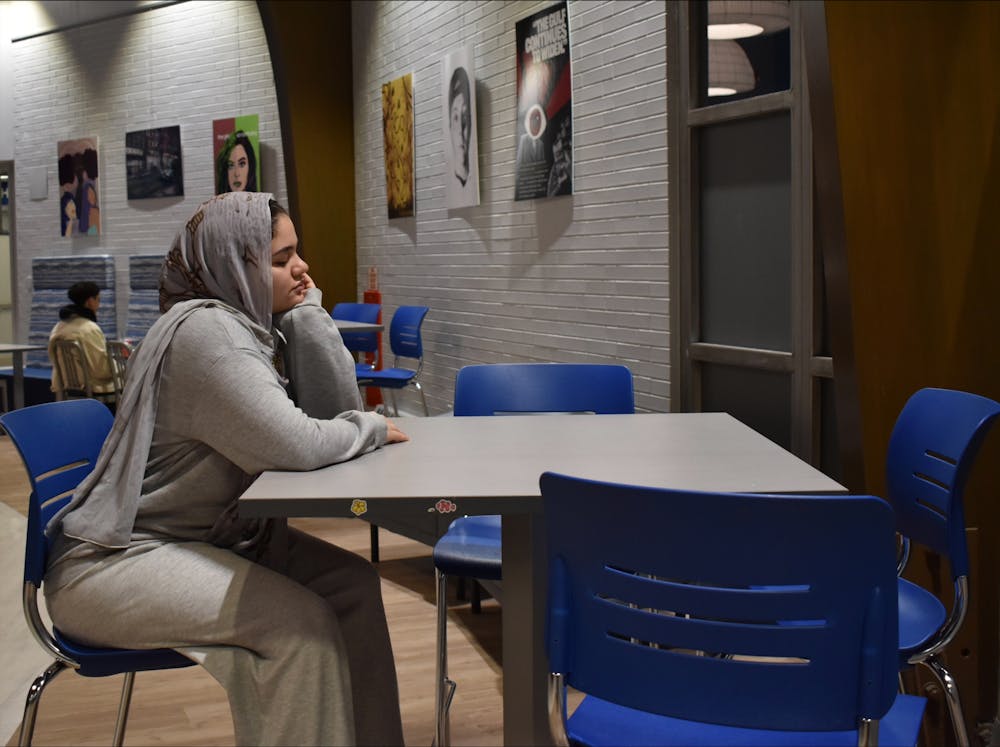
With the month of love just coming to a close, students are left to consider who will cuff them next season and how the journey to get there will be.
If you’ve been hit with the “I’m not looking for a relationship” or the “we’re supposed to be having fun in college” line, then buckle up—this is for you. Students spill their ups and downs with love at Seton Hall.
Perhaps you can find comfort in a shared experience with a student or grasp a glimmer of hope from their insights.
Expectations vs. Reality
Coming to college, there’s a hidden expectation for some that campus is going to be a real-life “Love Island.” But, for many students, this notion quickly fades as the realities of campus life set in.
Dakota Harrison, a freshman interactive media major, said he expected students, in particular freshmen, to make use of their newfound freedoms on campus.
“This is the first year that we're having this type of, like, privacy and responsibility,” Harrison said. “So I expected, you know, many people not to really look for more committed relationships, but rather look for different types of people that they may be interested in.”
Harrison believes these expectations were met. From his experience, he considers it easier to find someone looking for something casual rather than serious.
“It’s easy to find people more so focused on exploring different options, looking for different people…you’re more likely to find someone who's exploring,” Harrison said.
Others agree, like Mariana Soler, a senior diplomacy and economics major, who said freshmen are bound to experience their “college relationship canon event.”
“It's a big hookup culture freshman year, immediately,” Soler said. “Everybody's hooking up with everybody, and it’s just that, like, new freedom.”
When first arriving at SHU, Soler said media portrayals of what college is like shaped her expectations.
“I feel like movies portrayportrays college [as] where you find your love, your life, this and that, so I had very high expectations,” Soler said. “I thought there [were]was going to be a lot of people to meet.”
In reality, however, Soler found that the options at SHU were at various maturity levels, similar to high school, and that college was “just an extension of high school.”
“It's such a mix of so many different people; the maturity levels very much so differ,” Soler said. “A lot of people are still stuck in that young, ‘peaked-in-high-school’ vibe, or people are just not looking for [a serious relationship].”
Rather than having set expectations, Kristen Stringer, a junior visual and sound media major, was intrigued by the expanded dating pool when she was first exploring SHU.
“I was interested to see how it would differ from meeting someone from near my hometown and meeting someone on campus,” Stringer said.
However, Stringer now calls the dating scene at SHU a “zero out of 10.”
Concerns and Challenges
Not only is finding love difficult for many students, but maintaining love on a college campus proves to be challenging.
It’s no secret that everyone at SHU is connected. “I can’t believe he knows her,” or “I didn’t know we both know them,” are phrases that every student has likely said at least once.
Alexia Padilla, a freshman international relations and diplomacy major, believes that maintaining love at SHU is difficult largely because “everybody knows everybody.”
“It definitely is a lot more difficult, considering that it also is kind of a small school, so other people are going to know your business and your personal relationship and your person,” Padilla said. “It definitely kind of makes you not want to date…because if you date one person and that doesn't work out, then the entire school knows your personal history.”
What comes with a small campus is that people talk. People know people, and private matters can become public all too quickly. Caleb Jones, a senior finance and sports management major, said there are many “ups and downs” to finding a partner on campus, but publicity is the most difficult aspect.
“You don't want things to move too fast, and then it's like, people put you in a category, and it's like, well, we're not even together, and they’re in your business,” Jones said. “People just want their private business to be theirs.”
Another student, who requested anonymity so people would take his advice seriously, agreed with Jones and delved further into the matter.
“You don't want people to know where you're at, why you're doing what, and who you're with at all times because things can just get misconstrued,” the anonymous student said. “Because, like, campus is so small that if you're walking with another girl or another guy, people can just make stuff up even though it's not true.”
Additionally, the anonymous student feels as though there is a major trust factor involved not only in others talking, but also in the partner in question.
“You never know, like, if this person knows, who else knows?” the student said.
Soler echoed the student's thoughts and said that “word gets around real fast,” warning students to take note.
Not only do people talk, but sometimes they deliberately try to break people up, according to Stringer.
“They will make things up, especially with couples on campus, like, even posting on Fizz, they try to, like, break people up,” Stringer said. “Whether it's true or not, they'll say whatever it is to try to ruin something.”
Apart from the number of eyes on students’ personal business, Jones also considers the issue of future compatibility.
“I don’t think it's necessarily hard to find someone here that's serious, but I guess just the external factors with everything makes it harder,” Jones said, referencing post-graduation.
“You meet new people and experience different seasons of life…I feel like everyone's under a different journey,” Jones added. “It’s difficult finding someone to be with you alongside the journey.”
Harrison disagrees with Jones’ first statement, claiming that the hardest challenge is just that: finding someone who is “as committed to the relationship as you are.”
“I would also say finding someone who you're able to consistently, like, reside in consistently day in, day out,” Harrison said. “You guys are able to, like, you know, shape your schedules around and make sure you see each other, making sure, you know, you check in on each other.”
This lack of effort, Harrison believes, drives many students’ relationships apart.
“I feel like that consistent effort from both sides is probably the hardest thing due to, you know, academic reasons, living on your own, being on campus,” Harrison said.
Some students believe the issue runs deeper: the dating pool just isn’t good enough.
“I don't think it's hard to find someone on campus who's looking for something serious, but I think it's hard to find someone on campus who's worth being serious with,” the anonymous student said.
Another challenge students face with on-campus dating is the sheer number of options. Sometimes, a relationship can slip away because of the “what-ifs” a large dating pool brings, as Harrison alluded to.
“It’s definitely hard…there’s, like, so many people on the campus; people are exposed to different people every single day,” Harrison said. “Just being open to other perspectives and experiences and people in general definitely makes it harder for people to find more committed relationships.”
If both students live on campus, it’s easy to rush the relationship because of the proximity. Relationship prospects can see each other whenever they want, with minimal restrictions. Soler believes that while proximity can be a pro, it’s also a con for this reason.
“Because you are so close in proximity to me, you rush the relationship faster than I would like it to,” Soler said.
The anonymous student agrees that students tend to rush into things, but for another reason—they just want the label rather than taking the time to truly pour into getting to know one another.
“Either someone cheats, the guy or the girl, they're just not compatible, or they rushed into the relationship, and it doesn't work out,” the anonymous student said. “I think that's the number one, rushing into it too quickly.”
Pros and Perks
With many downsides, the negatives seem to overshadow the positives, but this is not the case for the anonymous student, who sees Soler’s negative view of proximity as a positive.
“The proximity and, I guess, just the closeness and the consistency, like you see a person every day, if you want to,” the anonymous student said. “Which I’d hope you want to, since you are together.”
Stringer reinforces the student’s opinion, adding that “since [she] commute[s], if someone lives on campus, it's definitely…a benefit to have someone that's really close by and you can hang out whenever.”
Campus benefits also include the environment. Although a negative to Harrison, the anonymous student believes that the campus fosters an environment where students are more likely to find others with similar interests.
“In terms of similarity…you meet people in, like, similar fields, or you have a relationship with someone you can go to the gym with a lot, or [meet someone in] a certain class or certain majors,” the anonymous student said.
Despite Soler believing the maturity levels compare to those of high school, Harrison has found the maturity level is “definitely higher.”
“When you gain a relationship with somebody in college, it's more likely, or at least it's more expected, that you'll get with somebody who knows themselves better…and they know what they want in a relationship,” Harrison said. “So when you're able to find someone who's committed, [you’re] able to be more stable in a strong relationship.”
Despite these attributes of on-campus dating, some students, like Soler, seem to have lost hope.
“Oh, there's no positives,” Soler said of dating on campus.
Tips and Takeaways
It’s easy to get caught up in a moment. For a brief time, students may feel like they’ve found “the one,” but, in reality, they’re just filling a void. The anonymous student alluded to this notion, stating that when someone becomes too reliant on the other, it all comes crashing down.
“We all want a partner, or we all want to be with somebody, but like, if that's your end-all be-all and they’re worth, like, crashing out over, I don't think you're ready, because you need personal fulfillment first,” the student advised. “If you forget who you are, or are reliant on somebody, like, in charge of your happiness, yeah, you've lost.”
Additionally, the student believes that to make a relationship work, both individuals must not only have a deep understanding of one another, but, more importantly, of themselves first.
“A lot of the times, these people don't even know what they want out of life or who they are…a lot of girls don't even understand guys and same thing with guys for girls,” the student said. “Just focusing on yourself, focusing on who you are, and gaining a basic understanding of what the opposite person needs [is important], that way you can bring something valuable to the team.”
And it’s not just about understanding oneself first; it’s about fulfilling oneself before jumping into something, as a second anonymous student said.
“I don't necessarily see a problem with, like, if I'm lacking something, I think a partner can 100% teach you stuff in a positive manner,” the second student said. “But, if they're filling a complete void in your heart, that's a problem where maybe I’m not as happy by myself, and I don't know what that feels like when they’re not around.”
To be of any substance, relationships require time and effort, but they also often require financial stability, according to the anonymous student, and students need to consider that before committing to a serious, long-term relationship.
“Not to say that you need to be making six figures tomorrow,” the student said. “But being able to take your girl out on a date, basic stuff like that, a lot of these guys, like, can't even do.”
If struggling with rushing into relationships, the anonymous student recommends “put your standards out there right away,” so that each individual will know sooner whether they are truly compatible.
“If you don't like something, make sure it's known, because then your…problem doesn't end up getting fixed [until] six months, a year later, and then baggage just builds,” the student said.
In addition to making likes and dislikes known early on, Soler said to ask the hard questions sooner rather than later.
“I think my biggest thing is to ask the hard questions and go at the pace that you need to go at,” Soler said. “People always are like, ‘Talking stage is over, we've been talking for two weeks. Let's start dating.’ No, know who you're talking to, then get something serious.”
Not all hope is lost, however. Jones said students who haven’t had luck with love yet should continue to be themselves.
“Put yourself out there, but also just be smart and reserved about how you do it,” Jones said.
Harrison would tell students not to “limit your chances” and that if it doesn’t work out with someone, that doesn’t mean you’re doomed to eternal loneliness.
“If it didn't work with somebody that you were interested in, continue to, you know, to talk to people, whether it's in a romantic way, in a platonic way, there's all sorts of people from different backgrounds, different upbringings, and…all types of identities that you can form relationships with,” Harrison said. “So if you don't work with one person, that doesn't mean that your opportunity to form a relationship just goes out the window.”
Padilla advises students that “time will tell” whether this person is the one.
“If that person isn't fitting what you want for yourself and what you want for a relationship, I think you definitely need to let it go,” Padilla said. “Just don't keep pursuing something and that person isn't giving anything back… Don't waste your time.”
Once the stars align, Aaron Lawrence, a senior economics and finance major, said to be ready for the responsibility.
“Let the love gravitate to you,” Lawrence said. “Don't let it overflow your mind to the point where you're burning out over it, but at the same time, if it does come, treat it as a priority.”
Lastly, simply don’t be delusional, the anonymous student said.
“We're more inclined to listen to that story that we've created in our head, rather than what's actually in front of us,” the student said. “Stop making up new excuses for your partners.”
Maybe next year, there will be less sulking on Valentine’s Day, avoiding Instagram stories at all costs, and more love in the air. Who knows? Maybe you will be the one posting those stories you swore not to check.
Lakyn Austin is the head editor for The Setonian’s Features section. She can be reached at lakyn.austin@student.shu.edu.


