
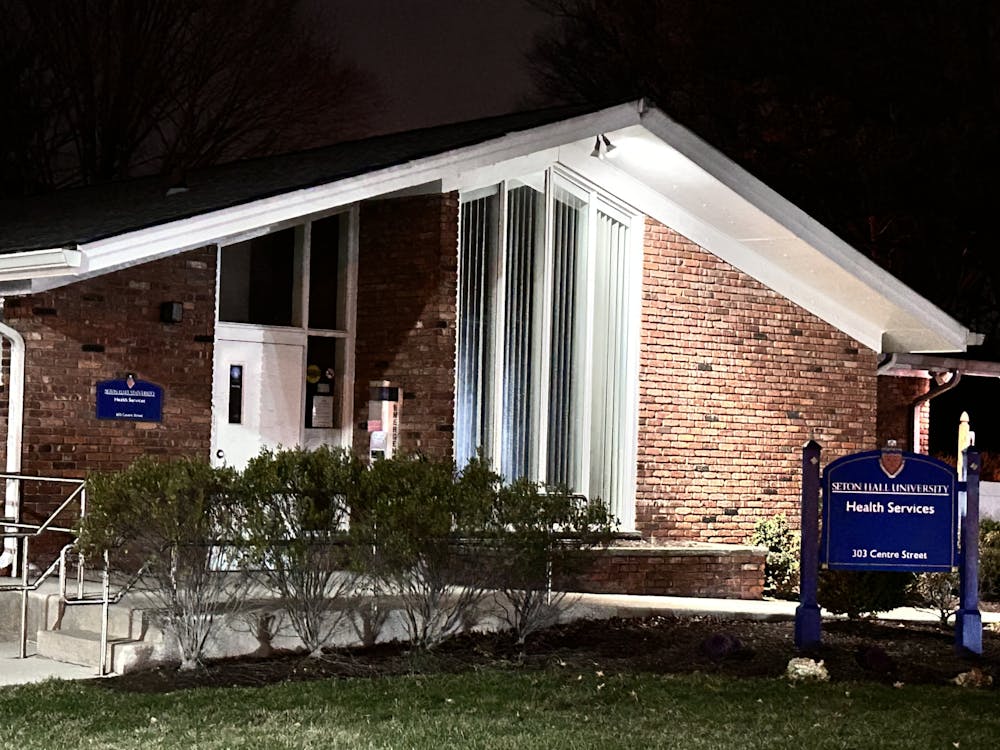
As the United States faces one of its most severe flu seasons in decades, Seton Hall students are turning to campus Health Services for medical care.
Student experiences at Health Services reflect a mix of praise and concerns, with many students highlighting positive interactions with staff while others note limitations in resources and accessibility.
Health Services, a university-operated clinic independent of outside health systems, is staffed by nurse practitioners and certified physicians. The office emphasizes accessible, student-centered care aimed at supporting the health and well-being of the campus community.
SHU’s Health Services is also one of four university health centers in New Jersey accredited by the Accreditation Association for Ambulatory Health Care, reflecting its adherence to nationally recognized standards for quality and safety.
“Health Services promotes health in its broadest sense by providing compassionate, comprehensive care, along with preventive education and wellness promotion, so students have the support they need to thrive,” University Relations wrote in an email statement to The Setonian.
Many students reported positive experiences at Health Services.
Sophia Turano, a sophomore computer science major, visited Health Services after suspecting she had strep throat and said her concerns were addressed by the staff.
“They offered two types of tests, one with faster result time and another where they could take it to their lab and test it,” Turano said. “Thankfully, the results came back negative, but the staff was very nice and understanding.”
Similarly, Collin Sardinha, a sophomore English major, sought care for an ear infection and described the staff’s communication as “clear and concise.”
“The doctor made sure to listen to what I [said], and he performed a very thorough examination,” Sardinha said. “My treatment plan was correct, and Health Services acted very professionally in making sure I got proper care.”
That sense of accurate diagnosis was echoed by Simran Shah, a sophomore finance major, who said Health Services helped identify her symptoms after she initially misjudged them.
“I originally went to Health Services due to pain in my throat, thinking I had a sore throat, and they told me it was just seasonal allergies,” Shah said. “I’m very grateful to the staff at Health Services for providing me with great communication and an accurate diagnosis.”
However, some students said the clinic’s limited resources can make it difficult to receive comprehensive care on campus.
Marianna Soler Jamenez, a senior international relations and economics major, visited Health Services for a sprained ankle and said she felt her concerns were not taken seriously.
“They gave me a medication as well as an ice pack. However, they were unable to make a diagnosis and just referred me to a different urgent care since they also don't have X-ray machines,” Jamanez said. “While that's very common in certain practices in general, I found the services offered didn't exceed much of what you would find in, say, a high school nurse office.”
Jamenez also described a situation in which a friend of hers received an incorrect diagnosis at Health Services.
“I had [referred her] to Health Services since she was experiencing some cold symptoms,” she said. “Whoever she spoke to had told her she just had a general cold where then she later went to urgent care and was told she actually had a sinus infection.”
Even in more positive experiences, some students noted room for improvement.
Rotem Divir, a sophomore biology major, visited Health Services for a blood test and for vaccinations and described her experience as “safe and timely,” though not without a minor issue.
“They made their best efforts to properly access my veins, and they called me back immediately when they realized one of the tubes they used was expired and had to draw more blood for the test,” Divir said. “The staff communicated pretty well, and got my results back in a timely manner.”
Despite these mixed experiences, university officials said student feedback plays a major role in evaluating and improving services.
“The University takes student feedback seriously and provides multiple ways for students to share their experiences,” University Relations said. “All patients receive a post-visit satisfaction survey, and students may also submit feedback through a comment box in the waiting area or by contacting the director of Health Services, Diane Lynch.”
According to university data, most students report positive experiences. University Relations said 99.4% of students said they felt listened to during their visit, while 97% reported a positive experience and would recommend Health Services to a friend.
Health Services also maintains a Quality Improvement Committee that regularly reviews feedback to identify areas for improvement.
“Through this ongoing review process, the office monitors trends, addresses concerns and works to ensure high standards of care,” University Relations said.
Still, some students said they hope to see improvements, particularly in accessibility and the scope of services.
Divir said that while her care was effective, she would like to see expanded resources and availability.
“I’d like to see Health Services be open for longer hours and have more NARCAN kits available,” Divir said.
Jamenez echoed concerns about the scope of care.
“Their treatment plans seem to be lacking,” Jamenez said. “From what I've experienced when I have come to services for various reasons, they mainly offer very select few services while advocating to be essentially a service such as urgent care for students on campus.”
Others pointed to accessibility concerns.
“It’s pretty far from campus,” Turano said. “That’s a lot of travel for someone if they’re really sick, especially since it’s across the street from the front entrance on a busy road. I’d feel better if they could be on campus somehow for constant care.”
Carmine Sortino is a writer for The Setonian’s News section. He can be reached at carmine.sortino@student.shu.edu.


