
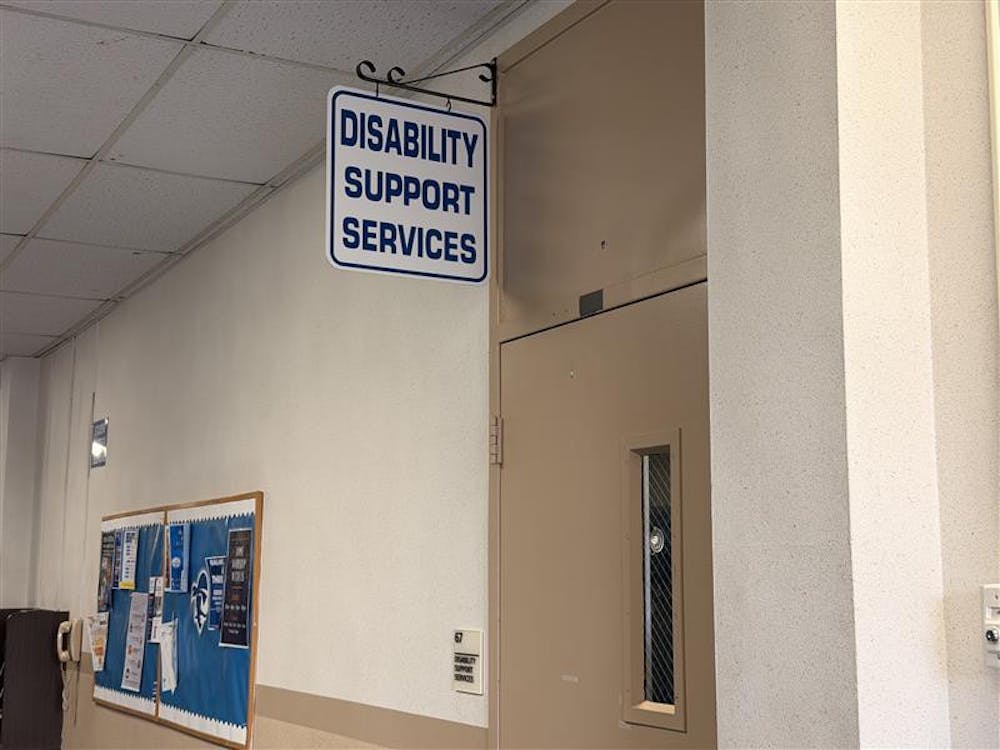
At the end of the dozens of pages in a Seton Hall class syllabus is a section that many may ignore, as the Statement of Disability Support Services does not apply to them. However, for many students, the Office of Disability Support Services (DSS) plays a crucial role in their learning.
Located in Duffy Hall, Room 67, DSS serves students with visual and hidden disabilities alike to ensure an equal opportunity for success in school. Around 1,000 SHU students receive aid from DSS, the university told The Setonian.
Among these students, personal experiences with DSS vary based on disability and provided accommodations. Some students detailed how their disabilities do not limit them from living the average college life with their accommodations.
Despite students having issues with DSS, SHU continues to claim that DSS “ensures” that students with disabilities have “equal access to University programs and services through individualized academic and housing accommodations and coordinated campus support.”
Accommodating a Physical Disability
Reydina Lawrence, a sophomore political science major, said her blindness is a disability she developed rather than was born with—only fully living with her blindness for two to three years.
Lawrence said her experience with accommodations at SHU so far has had a lot of ups and downs.
“My first semester specifically, they were very underprepared for someone with my type of disability,” Lawrence said. “And not all my professors were very cooperative. I actually had to drop a couple of classes because of their lack of preparedness.”
In her second semester, Lawrence said her experience was much better and credited it to the former director of DSS, Carolyn Corbran, and the assistant director, Samuel Shapiro.
“We had to figure out the bumps and things, but the director did all she could do to help,” Lawrence said. “And the assistant director—I miss him so much; he was absolutely incredible.”
One accommodation Lawrence said she had to fight for was a personal notetaker, which was difficult to convince the new DSS administration was a necessity.
“They offered a recorder, which is nice and all, but if my professor is writing on the board, I can’t see that,” Lawrence said.
Even as recently as this month, Lawrence said, due to the snowstorms, it was difficult to navigate sidewalks with her white cane due to the ice and snow, so she asked for an aide for a day until the ground cleared. Lawrence said this request was denied.
“They were like, ‘No,’ and I was like ‘Oh… okay,’ but they said it’s their policy that they can’t help me get to and from places,” Lawrence said.
University Relations wrote a statement to The Setonian, saying that SHU is committed to “ensuring” students with disabilities that they have “access to appropriate accommodations that enable full participation in academic and campus life.”
While University Relations said DSS works “closely with students to review accommodation requests and determine reasonable supports” as the law allows, personal assistance and mobility guides “fall outside the scope of accommodations typically provided by colleges and universities.”
This, Lawrence said, left her feeling unable to go to DSS and expect them to fully understand her disability and needs, even thinking of taking a gap semester for some time away.
“I am very open with my disability; it is not one that I can hide, so I like to educate others about my experience, but I am way more reserved when I speak to DSS because I don’t always feel heard,” Lawrence said. “Requests are shut down so fast that it’s like, why would I want to come with things like that if you shoot me down?”
The major issue, Lawrence said, is that DSS seemingly groups people with the same disability into the same accommodations, although most disabilities are a spectrum and therefore needs are not the same.
“A big thing with blindness is that it’s a spectrum, so some people may be blind but still be able to read large print, but someone else who’s blind, like me, per se, can only see on a great day, light,” Lawrence said.
“I think they kind of say, ‘This is what a blind person should be able to do,’ or ‘It works for them so why can’t it work for you,’ but not all people's disabilities and functions fit in the same box which is definitely something they could do better at,” Lawrence added.
University Relations wrote a statement to The Setonian, that the disability accommodation process is “highly individualized.”
“Each student who applies for accommodations meets one-on-one with a DSS staff member, who reviews documentation, discusses how the student’s disability affects their learning and daily activities, and considers any accommodations that have been effective in the past,” University Relations said. “DSS does not assign accommodations based solely on a diagnostic category; the process recognizes that disabilities exist along a spectrum and that students with the same diagnosis may require different supports.”
When it comes to equity, Lawrence said SHU does exceptionally well in the classroom and with everyday living.
“They definitely level the playing field when our accommodations actually are approved,” Lawrence said. “Some accommodations I have are early registration for classes, extra time on tests, and accessible textbooks.
“Also, for housing, I don’t have a roommate, which is great for me because when people move things, it’s very easy to trip,” Lawrence added. “And accommodations in the dining hall are great. They have this thing where you let them know what you want to eat and they put it together for you.”
However, Lawrence said on a social level, there are some steps she would like to see from SHU to help include people with disabilities like her.
“Seton Hall tends to post a lot of what’s going on on Instagram, which is pictures, or there’ll be flyers hanging around,” Lawrence said. “Not very accessible. So, when certain things are going on, if they’re not sent in an email or I hear it through word of mouth, I won’t know if it’s going on.”
University Relations told The Setonian that students are “encouraged to remain in communication with DSS throughout the semester,” if they feel as though their approved accommodations are not meeting their needs.
Despite her struggles with DSS, Lawrence said she encountered and befriended some of the most supportive and helpful people here at SHU.
“Just the sheer kindness of the professors and the students and the security, it’s extremely heartwarming to see the community that rallies behind me, which I definitely appreciate,” Lawrence said.
Some advice Lawrence offered students dealing with DSS for the first time is to reach out to others who previously received accommodations.
“They might have a lot of information you don’t know and won’t know,” Lawrence said. “Like with my human notetaker, I knew I had it, so when they offered me a voice recorder, I knew it wasn’t my only option, but if someone new came in and that’s all they offered, they’d never know that.”
Accommodating Hidden or Learning Disabilities
Not all students who use DSS are diagnosed with physical disabilities, with many who receive accommodations doing so to assist with their hidden or learning disabilities.
Marisa DeStefano, a sophomore environmental studies and elementary and special education major, said at a young age she received her diagnosis for dyslexia and inattentive ADHD (formerly known as ADD).
DeStefano said her experience with accommodations at SHU was an adjustment at first, but overall, a positive.
“Coming to college freshman year, I had to do it all by myself, whereas I had guidance counselors in the past help me out with my IEP and 504 in middle school and high school,” DeStefano said.
An Individual Education Program (IEP) is a legally mandated set of accommodations and services for students with disabilities. A 504 plan is another form of legal accommodations for those with disabilities in the classroom. Read about the differences here.
For DeStefano, she said her accommodations at SHU are similar to those received in high school. These include: extended time on testing, nixed grammar and spelling errors, extra annotations, separate room testing, and headphones while testing.
DeStefano said an early diagnosis and familiarizing herself with her disability accommodations over time helped her when she applied for DSS accommodations on her own.
“For the average person that’s coming in and might not have dealt with fighting for their own accommodations in high school, it might be a little hard to apply,” DeStefano said.
In class, DeStefano said there is some inconsistency with the accommodation application.
“A teacher wouldn’t let me go to a separate room and use my headphones for a test, which was annoying,” DeStefano said. “They preferred to be with me, which I guess is fine, but I prefer being in a separate room because when people tap their pencils or move their seats and noises like that easily pull my attention away from my test.”
Another issue DeStefano said she encountered was not knowing she had to declare her accommodations each semester.
“Education majors basically have the same professors all year long, so I didn’t think for second semester I needed to email them about my accommodations because they knew me well, but when the first test came around and I asked for my accommodations, she didn’t allow them,” DeStefano said.
“Which was on me, but it wasn’t really laid out for me to know that,” DeStefano added.
DeStefano also said there is a major difference in attitude and willingness to accommodate students based on the teacher.
“If my teacher had accommodations themselves or around them growing up, they are always the first ones to support me and go above and beyond to meet my accommodations,” DeStefano said. “But I also had older professors…they kind of only see learning one way.”
But DeStefano said her direct experiences with the DSS office are always positive, hands-on, and are always there to help.
“Ask as many questions as you can,” DeStefano said. “Even the silliest question you think shouldn’t be asked, ask it.”
Grace Buckley, a sophomore biology major, similarly said her experience with DSS is positive.
While her initial advisor has since moved schools, Buckley still finds that “they are very knowledgeable at DSS.”
Buckley said her experience with DSS started with an advisor meeting where she relayed previous accommodations she received in high school.
“They offer other accommodations that are similar to the ones you want, which was nice,” Buckley said. “They offered me accommodations I didn’t even know I could have.”
However, in one scenario, a lack of accommodations interfered with her performance in class. For context, Buckley said that one of her accommodations is separate-room testing, whether through DSS itself in Duffy Hall, or through the individual professor booking an adjacent room.
“[The professor] can come in and have a proctor there, or they can come in if you have any questions, which I like because at DSS you have to call your teacher and be like, ‘I don’t understand #23,’ which is kind of awkward,” Buckley said.
Another accommodation is extra time for testing, which Buckley said is 1.5x the usual testing time. But for one test session, the professor altered the usual testing time from 50 to 75 minutes, without informing the proctor in the room with the accommodated students, resulting in Buckley and others having the same amount of test time as the students with no accommodations.
“It was really frustrating, and I ended up needing to guess on four questions because I did not have enough time to answer them properly,” Buckley said.
This, Buckley said, was not an issue with DSS; it was an error with professor-planned accommodations.
According to SHU’s DSS website, faculty are required to complete an agreement with DSS for each course. “This agreement will provide all testing dates, times, and proctoring instructions and details for the entire semester,” the website reads. However, Buckley claims changes were made without the proper notification.
Buckley also said one of her former classmates, who transferred out of SHU, had a professor refuse to meet their test-day accommodations, and it created a legal dispute.
In a statement to The Setonian, University Relations said that DSS works directly with students and staff to “review the situation and address any concerns” if an accommodation is not being properly implemented.
“The University takes accessibility obligations seriously and remains committed to supporting students and working collaboratively with faculty to ensure accommodations are properly understood and implemented,” they said.
A word of advice Buckley said she has for those new to DSS is to get ahead of it.
“Before each test, you need to tell your teacher you want your accommodations, I think 10 days in advance,” Buckly said. “And those can pile up and get hard to manage if you fall behind, so if you see upcoming tests, make sure you remind yourself ahead of time to ask for your accommodations.”
Anna Vilinski, a sophomore elementary and special education and social and behavioral science major, said she does not receive DSS accommodations, but instead her involvement with the office comes through her club work for Disability Awareness and Accessibility at Seton Hall (DAASH) as their Public Relations (PR) Chair.
“We look to help expand accessibility at Seton Hall and help educate other students about accessibility and disabilities,” Vilinski said. “When people hear ‘disability,’ a lot of people think about the physical ones, but a lot of people don’t think about or see learning and invisible disabilities, which are probably more common here.”
While not partnered, Vilinski said DAASH and DSS often work hand in hand to promote services available to students via presentations and opportunities to contact DSS workers.
“It’s an opportunity for students to hear straight from DSS in person what some accommodations they offer are,” Vilinski said.
As a special education major, Vilinski said her passion for this pursuit began after reflecting on her own childhood as she went through speech therapy before kindergarten. Vilinski said that seeing her brother never receive a proper diagnosis for his learning disabilities, and seeing how he struggled with inadequate help, influenced her.
“Watching that unfold made me want to get into special education to help kids who need some extra accommodations and help with learning,” Vilinski said.
Vilinski said she and her brother attended a Catholic elementary school where the attitude and funding towards those with learning disabilities were not as high, but she believes SHU to be an institution that cares about accommodating students.
“Seton Hall, from what I’ve seen, has been a fairly accessible campus and the DSS office really cares about trying to help students,” Vilinski said.
One issue Vilinski said she noticed about SHU is the lack of accessibility in some buildings like Mooney Hall, where there are no elevators or ramps for those who cannot use stairs.
“A lot of offices for advisors and counseling and mental health are in there, so for students who have disabilities, it’s more difficult for them to get those resources they might need,” Vilinski said.
In her experience working with kids with disabilities, Vilinski said the best thing to do is to get tested as early as possible and to support others in their process.
“There’s a lot of parents who tend to shut down testing in order to negate the label on their child,” Vilinski said. But she warns that “when you don’t have accommodations and you don’t have support from teachers, it makes it so difficult to learn and go to school and do what all the other kids are able to do.”
If needing an accommodation or have any questions about their policy, DSS contacts are available online, and their office is located in Duffy Hall, room 67.
Solomon Lee is the advertising manager for The Setonian. He can be reached at solomon.lee@student.shu.edu.


