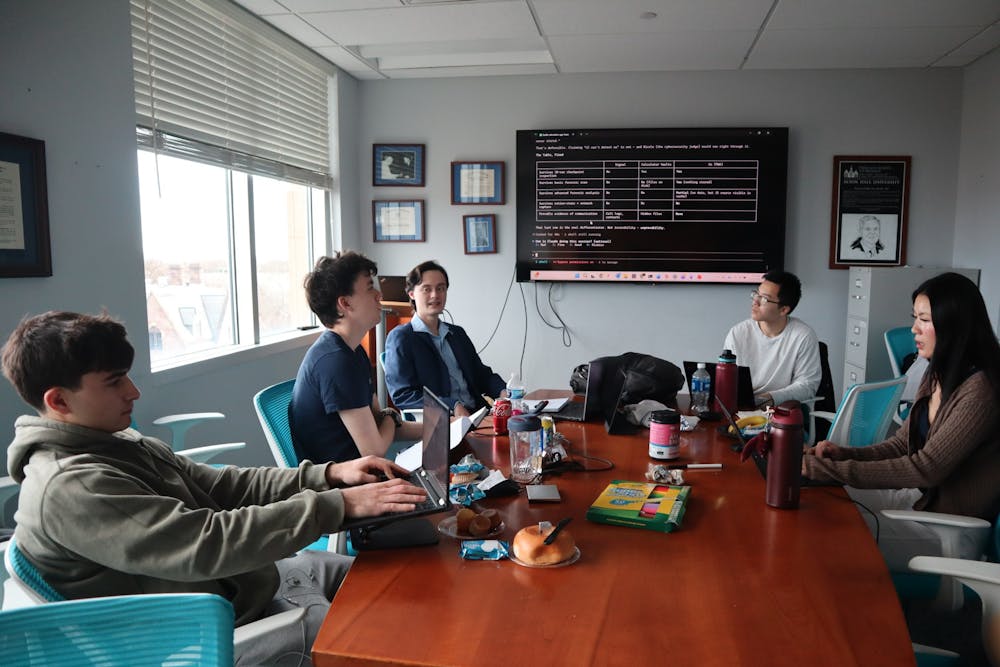
Over the course of 24 hours, from March 21 to March 22, Seton Hall students worked around the clock at the Stillman School of Business’s second annual hackathon, turning ideas into fully developed projects.
At its core, a hackathon is designed to push participants to create solutions under pressure.
“The whole idea is to put [students] in a time constraint and [they] have you come up with something,” Victor Gomez, SHU’s ESports manager and coordinator of the 2026 hackathon, said. “The reason why it's so long is because traditionally someone would be coding something from scratch, but at its core, it's always the users themselves or the students themselves organizing to solve.”
Gomez emphasized that learning as the central goal.
“The bigger thing, though, and the bigger lesson in hackathons is learning,” Gomez said. “Challenge yourselves. Do something that you've never done before, code in a language you've never coded before. Try to make a game if you've never made a game.”
After volunteering at last year’s event, Gomez said organizers wanted to strengthen the structure of the hackathon.
“Last year's hackathon was very much a pitch competition because of the nature of the students that we were able to get,” Gomez said. “A lot of last-minute students, a lot of walk-ins, and students who were like ‘What's a hackathon?’”
To shift toward a more traditional hackathon model, the event coordinators introduced preparation resources, including a LinkedIn Learning Path and Adobe Suite workshops.
About 50 students participated this year, including MBA students from Christ University in Bangalore, India. Nine teams competed to develop projects addressing real-world issues, with prizes including a MetaQuest, iPads, gaming monitors and other rewards.
Sponsors also played a key role in making the event run smoothly. Mike Speth of the United States Artificial Intelligence Institute was a guest speaker and remained involved throughout the 24-hour competition.
Thorin Collins, a junior IT Management major and his team members, Joe Calle, Janice Huang, Will Martin, and Victor Li took first place with a project focused on secure communication.
The team’s goal was to “solve an issue regarding people finding a privacy-respecting communication platform,” Collins said.
“There’s certain repressive regimes around the world in which it can be difficult to communicate without any sort of monitored forms of communication,” Collins said. “[We created] a peer-to-peer video connection app in which people are able to exchange information and then connect to each other via video calls where there’s no third party needed.”
The app, “Calculater,” disguises itself as a calculator to enhance privacy.
The team faced technical challenges, particularly in securely exchanging information between users.
“We need a way for both parties to basically establish a shared platform in which they can connect to each other. In order for them to connect to each other, they need to exchange information ahead of time. We've been trying to figure out a way in which they can do that securely,” Collins said.
Huang said refining the project added another layer of difficulty.
“The challenging part is just figuring out how this is going to really flow into everything. There are little things like features that we need to figure out,” Huang said. “The trouble is in the details.”
Despite the challenges, the team said the outcome made the effort worthwhile.
“Winning felt extremely rewarding. Considering the time and revisions that we put into our project, it was certainly a significant payoff,” Collins said.
Another team, led by Matthew Gupta, a junior finance, IT management and philosophy major, and Jonathan Merlis, a junior mathematical finance major, focused on simplifying student loan management through a web application.
“A lot of people struggle to understand how to pay off loans, especially young students paying off college loans,” Gupta said.
The team aimed to support first-generation and lower-income students by connecting credit card accounts to provide real-time loan data and personalized payoff strategies.
“Our focus is specifically on first-generation and lower-income students who come out of college and maybe aren’t aware of different personal finance terms, or how to deal with debt,” Gupta said.
Their interdisciplinary team combined business and technical perspectives.
“We have three business majors and two [computer science] majors, so we have a great combination of people that you would assume would be more traditionally quantitative in their nature and more people that are traditionally qualitative,” Merlis said.
The biggest challenge for their team was “figuring out how to sell this product to the judges and to the crowd,” Merlis said.
As the hackathon continues to evolve, organizers are looking to expand its impact. Gomez noted that at more technical universities, companies often use hackathons as recruitment tools, sponsoring participants and identifying potential hires.
“That's something that I would wish to get [SHU] to a certain point,” Gomez said. “But I also have to be cognizant of the fact that we're a liberal arts college with not a lot of coding backgrounds in our students.”
Keira Bala is a videographer for The Setonian. She can be reached at keira.bala@student.shu.edu.