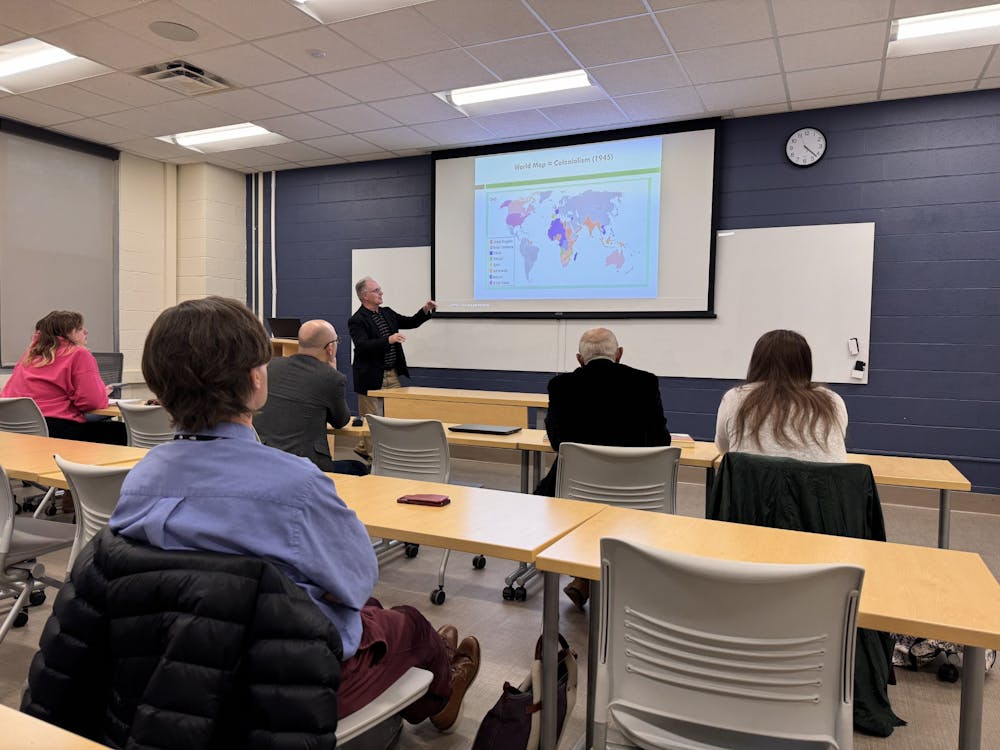
Seton Hall’s Department of History hosted a panel on Thursday where three professors shared insights from their presentations at the Collegium for African-American Research (CAAR) conference in Berlin last March.
Professors Larry Greene, Maxim Matusevich and Alan Delozier discussed their research and experiences presenting at the 14th bi-annual CAAR conference, “Knowledges in Motion: Black Travels, Belonging, and Transformations.”
The conference was hosted by the Department of English and American Studies at Humboldt University in Berlin, Germany. CAAR is an international organization of African-American and Black diaspora scholars from more than 25 countries whose mission is the “elaboration of multicultural and antiracist epistemologies by fostering interdisciplinary and transnational academic practices.”
Greene, Matusevich and Delozier presented at the conference alongside Drew University professor and historian Angela West.
Matusevich opened the panel by reflecting on the novelty of the group’s selection.
“The selection is very tough; it’s hard to get into this conference,” Matusevich said. “All four of us got in. And I think it’s probably the first time…in the history of the organization that the panel presented faculty from the same institution.”
The panel featured four presentations exploring race, journalism and global politics from different historical perspectives. West was the first presenter, discussing unity between Black and Jewish communities in her talk, “Solidarity Across Time: The Black-Jewish Fight Against the German American Bund and the Ku Klux Klan.”
West explained the importance of community in battling oppression in the 20th century.
“While there has never been a golden age of Black and Jewish solidarity and tensions did exist between the two communities, diverse organizations and active alliances underscored the importance of intercommunal cooperation, and the ongoing fight against racism and anti-semitism,” she said.
According to West, the cooperation between Black and Jewish communities symbolized a shared commitment to equality across racial and religious lines.
“I argued that Black and Jewish communities’ unity was not merely symbolic or random,” she said. “It represented a moment of powerful alliance, forged through shared experiences of persecution, and a collective commitment to justice.”
West is a historian whose work focuses on Holocaust and Genocide Studies, extremism, and gender in the United States. She also serves as the coordinator for programming and fundraising at Drew University’s Center for Holocaust and Genocide Study.
West told The Setonian that presenting in Berlin provided new insights into her research.
She said now more than ever, the past can be a guide for overcoming inequality and protecting democracy.
“I think particularly in this moment when we think about what can the past offer us during tumultuous times, looking at how communities come together, how even through disagreements or differences, that those can be overcome to fight a collective cause for [something] really important,” West said.
West, who had never presented internationally before the CAAR conference, said hearing German perspectives broadened her understanding of the subject.
“I think we're all learning about each other’s history in a new way,” West said.
While West focused on cross-community alliances, Greene, a professor of American history at SHU, shifted the discussion toward the role of African-American journalists in shaping discussions about race during World War II.
Greene’s presentation, “Ollie Stewart: Journalist, War Correspondent, and Advocate for Racial Justice,” examined the work of Stewart, one of the most prominent African American war correspondents of the era.
Stewart began his journalism career writing for publications such as the Reader’s Digest. A turning point in his career, Greene said, came during a tour of military training camps in the South in the 1940s.
“I think what influenced Stewart the most, in terms of his journey of transformation, his personal journey, was his tour of basic training camps in the South in the 1940s,” Green said. “And there he found tremendous racism that Blacks had endured in these camps of the South.”
In an interview with The Setonian, Greene said African-American journalists have historically played a key role in highlighting racial inequality in the United States.
“[Stewart] played an instrumental role in…opening up the U.S. military to African-American World War II correspondence,” Greene explained.
Greene expressed gratitude for African-American journalists like Ollie Stewart, who advocated for racial justice in times of global stress for minority communities.
“African American journalism has always been [at] the forefront of illuminating the inconsistencies in American rhetoric about land of the free, home of the brave…that there needs to be more work to reach those lofty goals,” Greene said.
Greene said the most rewarding part of presenting at CAAR was receiving recognition from the organization for his long-standing membership.
“I attended my first CAAR conference in 2001. You get to learn a lot about the culture, and of course, the food,” Greene reflected. “It was a wonderful experience, food, and talking with people.”
Building on Greene’s discussion of Black war correspondents, Delozier, humanities and outreach librarian at SHU, turned to journalist Roi Ottley and his global observations about race in the mid-20th century.
Delozier presented “Greener Pastures Today? The Global Views of Roi Ottley and His Post World War II Writings,” examining racism toward African nations both in the United States and abroad during the 1950s.
He noted that Ollie Stewart and journalist Roi Ottley worked together during their time as war correspondents.
“They met up at various points during their travels over to Europe during World War II,” Delozier said. “And actually, Ottley created a diary and wrote glowingly about Ollie Stewart. So it’s interesting how these intersections come together.”
Ottley spent his career traveling to understand how different nations treated Black communities, searching for what he described as the “greenest pasture.”
“Through Europe, [Ottley traveled] basically 60,000 miles, 22 countries during the war years, and also a little piece in the post-war period,” Delozier said.
Ultimately, Ottley concluded that the United States offered the best opportunities for Black communities at the time.
“He actually comes back to America as the best choice for Blacks in the world,” Delozier said. “And he puts this in code with economics, how things came after World War II, and so forth.”
Delozier told The Setonian that the most important part of his work is highlighting unheard stories like Ottley’s.
Matusevich, the chair of SHU’s History Department, concluded the panel with his presentation “Paul Robeson and the Soviet Promise,” which explored relationships between African nations and the Soviet Union.
Matusevich explained that Soviet leaders used anti-racism propaganda to position themselves above Western powers like the United States.
“Increasingly, the Soviets see themselves as indirect opposition to capitalism and imperialism,” Matusevich said. “The Soviets marched in millions, in the streets of Soviet cities against American racism.”
This campaign attracted figures such as Paul Robeson, who traveled to the Soviet Union in the 1930s and became a cultural icon for his work in anti-racism there.
“He’s immediately embraced by the Soviet people, and he eventually becomes a huge cultural symbol,” Matusevich said. “I grew up with posters of Robeson.”
Matusevich toldThe Setonian that the relationship between the Soviet Union and African nations was purely “ideological.”
“I would argue they rejected racism for ideological reasons, but I think this rejection was not very deep,” Matusevich said. “It was situational and sometimes very opportunistic, increasingly especially after the Second World War, anti-racism was used by the Soviets as kind of an ideological hammer against the West.”
Students who attended the panel said the presentations offered new perspectives on historical alliances and global views of race.
Lauren Darby, a sophomore political science major on the pre-law track with minors in history, international relations and diplomacy, said the presentations highlighted the importance of community during times of racial oppression.
“I think hearing how Black Americans and Jewish people had kind of gathered together around the 1940s…and hearing what people are willing to do in order to gather alliances, in order to create a sense of community…was something I had never ever heard before, which was really interesting,” Darby said.
Mariam Hamed, a sophomore diplomacy and international relations major, said events like the panel are essential for keeping the conversation about African-American history alive.
“It’s really important for us to learn our history because it’s everywhere, it connects our politics and connects why people make decisions today,” Hamed said. “It was really nice to learn from each professor.”
Michela DiLorenzo is a writer for The Setonian’s News section. She can be reached at michela.dilorenzo@student.shu.edu.