
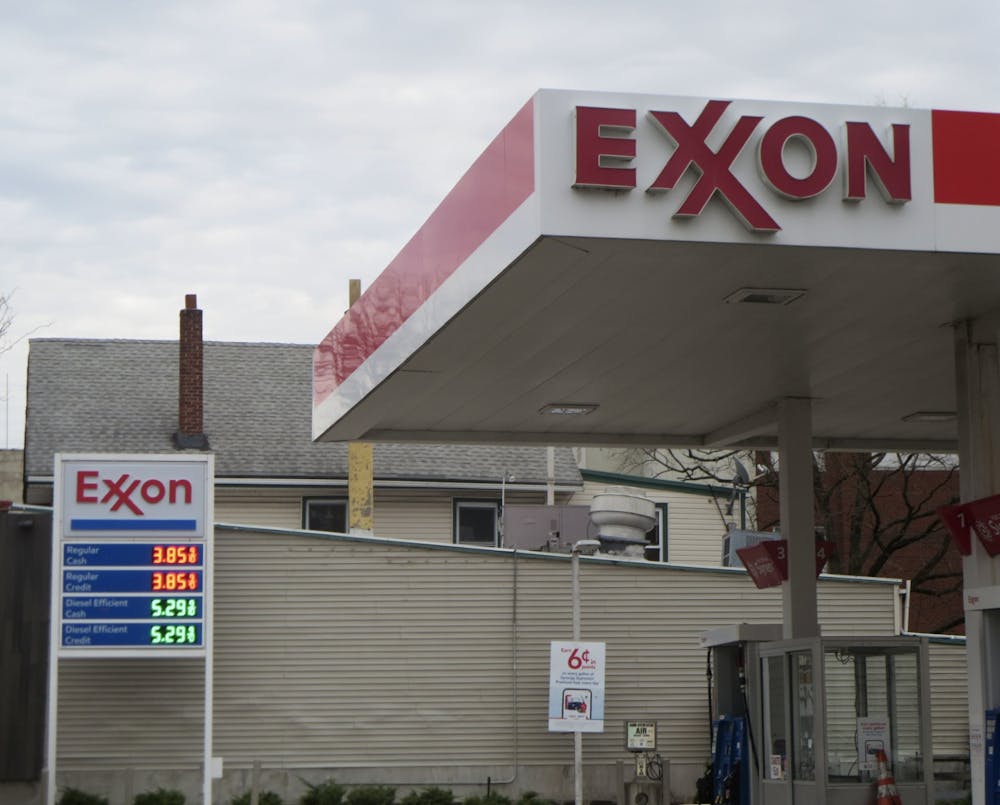
Gas prices across the U.S. are climbing at a fast pace, forcing many commuter students to rework their budgets, cut back on essentials and reconsider how often and how they get to class.
AAA reported sharp increases, with prices rising 74 cents in New Jersey, bringing the average price of regular gas from $2.94 last month to $3.68 today. Nationally, the average reached $3.79, up from $2.91 a month ago.
The surge is connected to the ongoing U.S.-Israel conflict with Iran, which has disrupted global oil supply chains. The war began Feb. 28, when the U.S. and Israel launched coordinated strikes targeting Iranian leadership, as well as military and nuclear sites. President Donald Trump said in a video posted to Truth Social that the operation, called “Operation Epic Fury,” was intended to eliminate an “imminent threat” posed by the Iranian regime.
Iran has retaliated by targeting U.S. military facilities, along with energy and shipping infrastructure, which has caused gas prices to rise.
Patrick De Haan, head of petroleum analysis at GasBuddy, said Americans could spend $900 million more on gasoline, and that prices may continue increasing another 10 to 20 cents in the upcoming days. He pointed to Iran’s blockade of the Strait of Hormuz—a passage controlling about 20% of the world’s oil supply—as a major driver of this inflation.
The impact is especially pronounced in New Jersey, where driving is the norm. With limited public transit options in many suburbs and a long-established car-dependent culture, residents rely heavily on personal vehicles for work, school and daily errands. For commuter students, rising gas prices mean higher weekly costs with few alternatives.
Hailey Diaz, a sophomore exercise science and nursing major, said she spends $50 to $60 a week on gas and has begun cutting back on other expenses.
“If I don’t have to drive, I don’t,” Diaz said. “But it wouldn’t really change how I commute. I still need to get to campus.”
For some students, even a small increase can force changes in daily routines.
Freshman biology major Inaya Dumar noticed the change when her usual $40 fill-up rose to nearly $50. She has cut back on eating out and said rising prices could push her to use public transportation.
“I’d probably take the bus if it keeps going up,” Dumar said. “It affects my monthly budget, especially with school expenses.”
Others have seen even steeper increases, forcing them to adjust more aggressively.
Candela Gutierrez, a freshman neuroscience major, said the last few times she filled her tank, gas was about $2 higher; she said a full tank recently cost her $15 more than usual.
Gutierrez now spends about $45 a week on gas and has started taking the train when possible.
“As a college student, the budget is already tight,” Gutierrez said. “It affects my ability to go home and [be] able to see my parents as much as I would like to.”
Not all students feel the change as sharply.
Hanna Ibrahim, a sophomore biology major, said she spends about $50 a week on gas but hasn’t had to cut back on other expenses yet.
“We’ve seen prices rise before,” she said. “If it hit three or four more per gallon, I’d feel it. But I’d still drive. The convenience matters.”
Still, as the war wages on, many students are bracing for further financial strain. The national average is now just below the highest price since President Trump returned to the White House and could climb if tensions overseas persist.
Julia Roman is a writer for The Setonian’s News section. She can be reached at julia.roman@student.shu.edu.


