
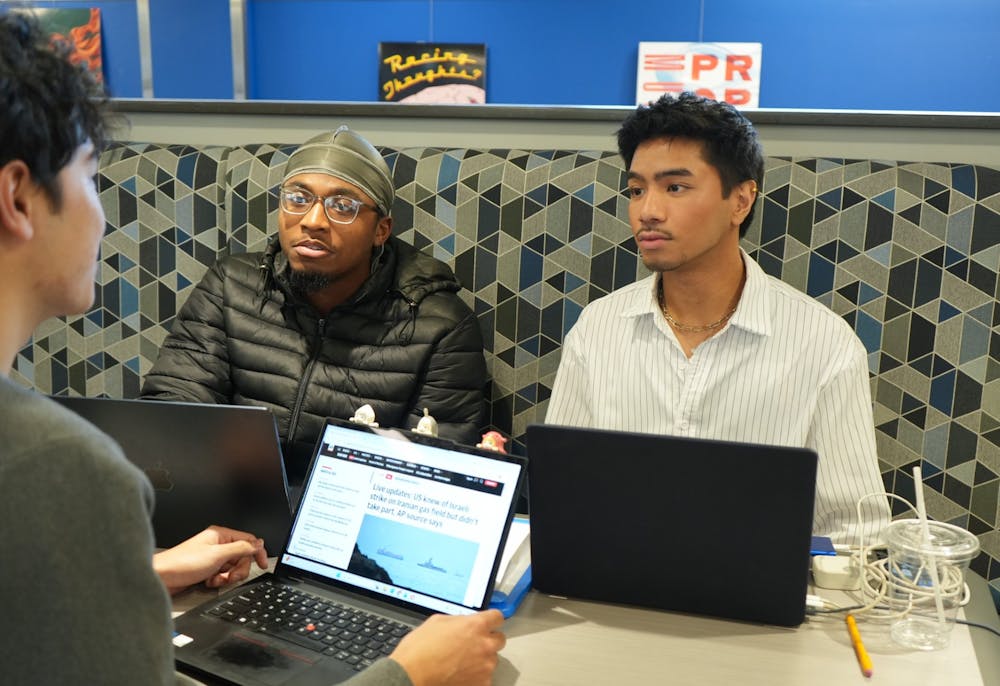
As tensions escalate between the United States and the Iranian regime, Seton Hall students are grappling with what a widening Middle East conflict could mean for their daily lives and families abroad.
On Feb. 28, the U.S., alongside Israel, launched “Operation Epic Fury,” a coordinated series of large-scale airstrikes ordered by President Donald Trump targeting Iranian military sites “that pose an imminent threat.”
Press Secretary Karoline Leavitt cited “various direct threats,” Iran’s alleged support of terrorism, and its “ rapidly and aggressively” expanding ballistic missile program as justification.
“The president was not going to be just another president on a very long list, who sat back and stood by and passed the buck of the direct threat to the next administration,” Leavitt said.
The strikes mark an escalation in decades of tensions between the two nations.
Beyond the broader political stakes, many students say the rising tensions have left them uneasy, prompting questions about safety, misinformation and the U.S.’s role globally.
Mehreen Khateeb, a sophomore biology major, said her main concern is the humanitarian impact.
“I feel like with the war, a lot of people [in the U.S.] are focused on how [they] are going to be deployed for war,” Khateeb said. “My focus is really on the other countries involved, like Lebanon and Iran and Qatar and all the other surrounding areas…being attacked right now.”
For students with family members in the region, the conflict feels personal.
Maya Omaish, a sophomore diplomacy major, said she’s been closely following the conflict because of her studies and because she has family in the Middle East. Omaish said her brother lives in Jordan and recently experienced a close call when a missile landed near his home.
“It's just kind of scary seeing how that could escalate with all my family there,” Omaish said.
While fearful for her relatives abroad, Omaish said she feels safe in the U.S.
“It all feels very hypothetical…but seeing tensions grow, I'm more scared for people who are closer in contact to like the countries that are facing this war—for the people who are more heavily involved,” Omaish said.
Others worry about military deployment.
Kiera Johnson, a sophomore diplomacy major whose family members serve, said her “biggest fear” is that her loved ones might be deployed.
“My boyfriend’s [in the] Air Force, and then my brother’s in the Navy,” Johnson said. “I’m not concerned for my safety, but for my family’s safety, more so because it’s a very high possibility that they will go there.”
Having lived overseas and grown up in a military family, Elora Hicks, a junior social and behavioral sciences major, said she thinks Americans often underestimate how global conflicts affect people worldwide.
“I think people don’t really realize how conflicts like this really do affect us and other people all over the world, and I'm kind of scared for the future because of that,” Hicks said. “I feel like in America, we have it pretty good, and it's easy to just overlook what's happening in places like Iran or Gaza.”
Hicks also has family in the military. She added that the conflict still feels somewhat removed from her daily life.
“I don't think that the war would ever come here, so I feel like it's very easy to feel disconnected, or just to go about your life,” she said. “It's very easy to live in that bubble.”
U.S.-Iranian tensions date back to the 1953 U.S.-backed overthrow of Mohammad Mosaddegh, which led to a period of close alliance under Mohammad Pahlavi. Relations worsened after the 1979 Iranian Revolution and hostage crisis, followed by decades of conflict, including the Iran-Contra affair, the Iran-Iraq War and the 1988 downing of an Iranian civilian plane. The 2015 Iran nuclear deal briefly eased tensions, but Trump’s 2018 withdrawal and increased pressure in 2025, along with military strikes in 2025 and 2026, have reignited direct conflict.
Despite military action, Congress has not officially declared war on Iran. The last official declaration occurred during World War II.
House Speaker Mike Johnson described the conflict as a “limited operation,” though Trump has referred to it as a “war” when speaking to reporters.
Some students argue that the U.S. should not have gotten involved in the conflict.
“We can use our tax money way more efficiently for other things,” Khateeb said.
Khateeb said that the U.S. needs to prioritize itself and its own people, to which Omaish agreed, saying the conflict is primarily between Iran and Israel. Johnson added that military involvement is excessive.
Weighing in on the subject, Will Coppola, a sophomore diplomacy major, said he does not believe the conflict will produce a positive outcome.
“I don't really see a way that attacking Iran right now is going to lead to anything good in Iran, like creating a free society or something,” Coppola said, pointing to past U.S. involvement in Afghanistan and Iraq.
And some students, like Christopher Papa, a senior public relations and psychology major, agree that the U.S. should not have gotten involved, though he described his stance as “in the middle.”
“Obviously, other people have reasons for [their opinions], and we've seen through the news there's been a lot of different opinions,” Papa said.
Students also said social media plays a major role in how they learn about global events, though many question its reliability.
Khateeb said social media is one of her primary sources of information, but stressed the importance of recognizing bias and being mindful of who you follow.
She also noted how online conversations can shape perceptions of the conflict, particularly when serious issues are turned into jokes.
“They’re like, ‘Oh my God, I'm gonna get deployed, and I haven't even gotten married yet,’” Khateeb said. “I just feel bad and wrong for making jokes about scenarios because we are seeing people dying in other countries.”
Amid the jokes, students also said navigating information online can be overwhelming. Papa said he would appreciate clearer, straightforward explanations of current events.
“Obviously, you want to be informed,” Papa said. “You don't want someone to ask you a question and sound like me right now—like I don’t really know much.”
Still, some students rely on social media because they feel traditional news outlets don’t show the full picture. Steck said platforms like TikTok offer more immediate, firsthand perspectives.
“Literally on TikTok, I see people in Palestine with their phones, like, ‘Can you please help me?’ and it's awful, and it breaks your heart,” Steck said. “In that sense, you get people who are literally there, and a lot of news sites are affected by the people funding them, so they won’t always show the depths and horrors of what's actually happening.”
Hicks said social media can also serve as a stark window into the realities of war.
“Whole homes are destroyed, families are just killed, people are living in bomb shelters, and I just saw it on Instagram,” she said.
At the same time, the constant stream of content can make it difficult to process what is happening and can lead to emotional fatigue, Steck said.
“You just can’t escape it. You just get so overwhelmed, and you become desensitized to it,” Steck said. “You'll see these videos, and it’s not like you don’t care that these people are going through a lot, but it’s just like ‘Oh, this has been happening for so long, and I know it’s happening,’ and it can be hard to keep up with.”
Steck added that social media, while overwhelming, makes it difficult to fully disconnect from the conflict.
“When there’s something happening like this that's so devastating and awful, it's kind of hard to disassociate yourself,” Steck said. “You're just watching f—ing war on TikTok. That’s so dystopian. It’s sad, and it’s scary, and there's not really anything you can do but watch it.”
Others, like Johnson, said the media’s often partisan nature feels unreliable.
“I feel like there's a lot of fear-mongering that goes on with politically backed news,” Johnson said. “I try to find information from unbiased sources that just are saying the facts as they are. It’s just less scary too because it just says how it is.”
With concerns about bias and misinformation online, some students said universities should play a larger role in helping students better understand global events.
Khateeb said this is especially important because public trust in the government to release accurate and complete information has eroded.
“We can't really look to the government [for information] because we're always kind of in a game of telephone,” Khateeb said. “Someone says one thing, and we're never gonna really know the truth at the end of the day.”
“The government is a facade,” she added. “They tell us one thing, but it's like, is that really what they are doing?”
Students’ academic backgrounds may also impact their knowledge level of current events. Coppola said students outside fields like diplomacy or international relations may not closely follow foreign policy issues.
“Most Americans don’t know where Iran is on a map,” Coppola said.
Because of this gap, some students, like Steck, believe universities have a responsibility to help keep students informed.
“You should want your students to know what is going on in the world right now, no matter what major you are, to help them be well-rounded,” Steck said.
At the same time, some students say staying informed is less about institutional support and more about navigating everyday responsibilities. Chelsea Major, a graduate nursing student, said she initially felt “slight panic” about the conflict, but was quickly distracted by the demands of daily life.
“Most of us have a fully packed schedule, so it's a little hard to indulge in these topics,” Major said.
Students who feel concerned about the ongoing conflict can reach out to SHU resources for support. Counseling and Psychological Services (CAPS) can be reached at 973-761-9500. For a psychological emergency, call CAPS’s 24-hour emergency number at 973-275-HELP (4375). Students also have access to Uwill, an online teletherapy resource.
Lakyn Austin is the head editor for The Setonian’s Features section. She can be reached at lakyn.austin@student.shu.edu.
Solomon Lee is the advertising manager for The Setonian. He can be reached at solomon.lee@student.shu.edu.


