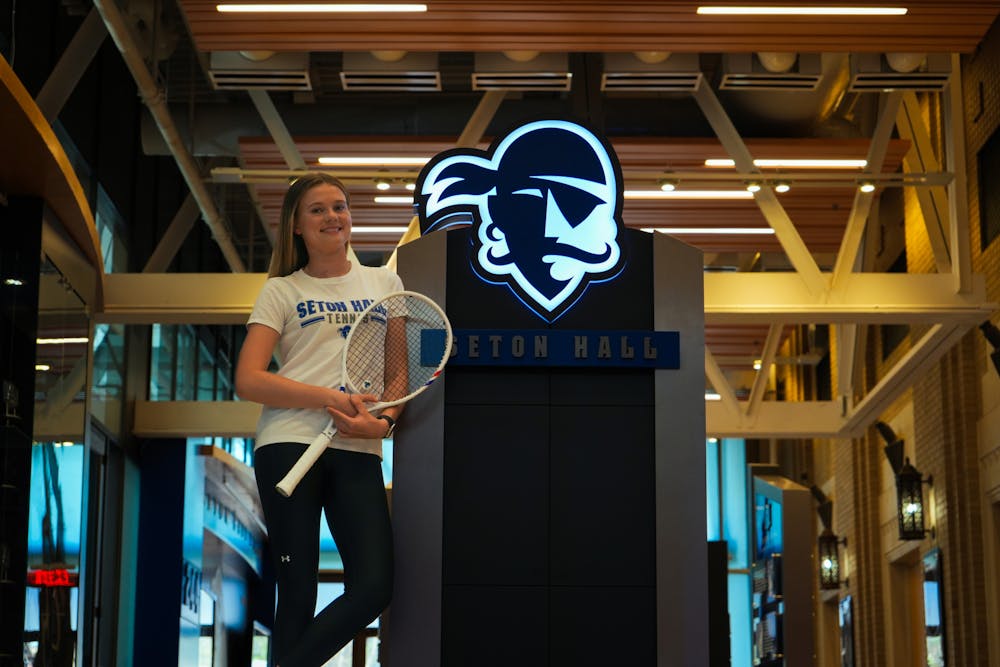
When Niamh Campbell committed to Seton Hall, it was not part of a carefully mapped recruiting plan. It started with something far simpler—a flyer in the mail that she almost ignored.
“I committed in February, which is a little late,” Campbell said. “I actually applied to the school because I got a flyer in the mail and I looked into it.”
As a visual and sound media major, SHU checked the boxes for an education in sports media, and a tennis team, so Campbell applied.
That unexpected piece of mail became the hinge point of a journey that now stretches from 5 a.m. practices to professional‑level broadcasts.
Her curiosity became action when she became co‑captain of the SHU women’s tennis team, but Campbell bounces off more surfaces than a tennis ball.
She is everywhere on campus: senior production manager and on‑air talent for the Pirate Sports Network (PSN), CHDCM ambassador, and a regular presence at open houses and Pirate Preview events.
At PSN, she works as both an on-air talent and a senior production manager.
As on-air talent, she provides play-by-play and color commentary for SHU athletics home broadcasts–primarily men’s and women’s soccer. She also researches the team, prepares game notes, calls games and reports from the sideline, as well as conducts halftime and postgame interviews
Additionally, her role as senior production manager includes responsibility for leading “advanced broadcast roles, including producing and directing,” according to Campbell.
Campbell is currently preparing to work the World Cup this summer, with potential assignments at the NBA Draft and the U.S. Open. She still describes these opportunities with a kind of disbelief.
“It’s definitely a lot,” she said. “It really all comes down to being really organized… I always say that you'll find time to do the things that you want.”
Her days often stretch from sunrise to well past dinner. A typical Thursday—“the dreaded Thursday,” as she calls it—begins at 5 a.m. with practice, followed by classes until 1:30 p.m., homework, work shifts, and PSN responsibilities.
“Usually I’m going [from seven] o’clock in the morning to 7 p.m., sometimes even later,” she said.
Still, she holds herself to a standard that keeps her moving.
“If I don’t do something and I don’t do it to what I think is my best ability, then I feel like I’ve failed at it,” Campbell said. “Just knowing I want to do everything as good as I possibly can definitely helps me stay motivated.”
But she’s learned balance, too.
“Even today, it’s my Sunday after [the tennis] season and I want to get some stuff done, but I’m also tired,” she said. “I know when to give myself a break…I’m probably just going to go and binge‑watch some TV after this, but I’ll get back to my work tomorrow morning.”
Her dual identity as both athlete and broadcaster shapes the way she approaches sports media.
“I know and understand what the athletes are going through,” Campbell said. “It’s a unique perspective.”
That perspective began forming before she even unpacked her freshman‑year suitcase.
“I reached out [to PSN] and they had me working a game before classes even started,” she said. “You don’t really turn down an opportunity—you do what they ask, and with that comes big things.”
Campbell started behind the camera, learned the control room and eventually moved on screen. Her first on‑air assignment was a swim and dive season preview as a freshman. Since then, she’s done sideline reporting, play‑by‑play, color commentary, and producing—a progression she still describes with a mix of pride and gratitude.
Her favorite moment came when she served as a color commentator, a broadcaster who provides additional context and analysis to bounce off the play-by-plays, for the first round of the NCAA men’s soccer tournament.
“It probably took me about four days to prep… all worth it though in the end,” she said. “To be a junior in college and be able to call a game with such status, I will never forget that.”
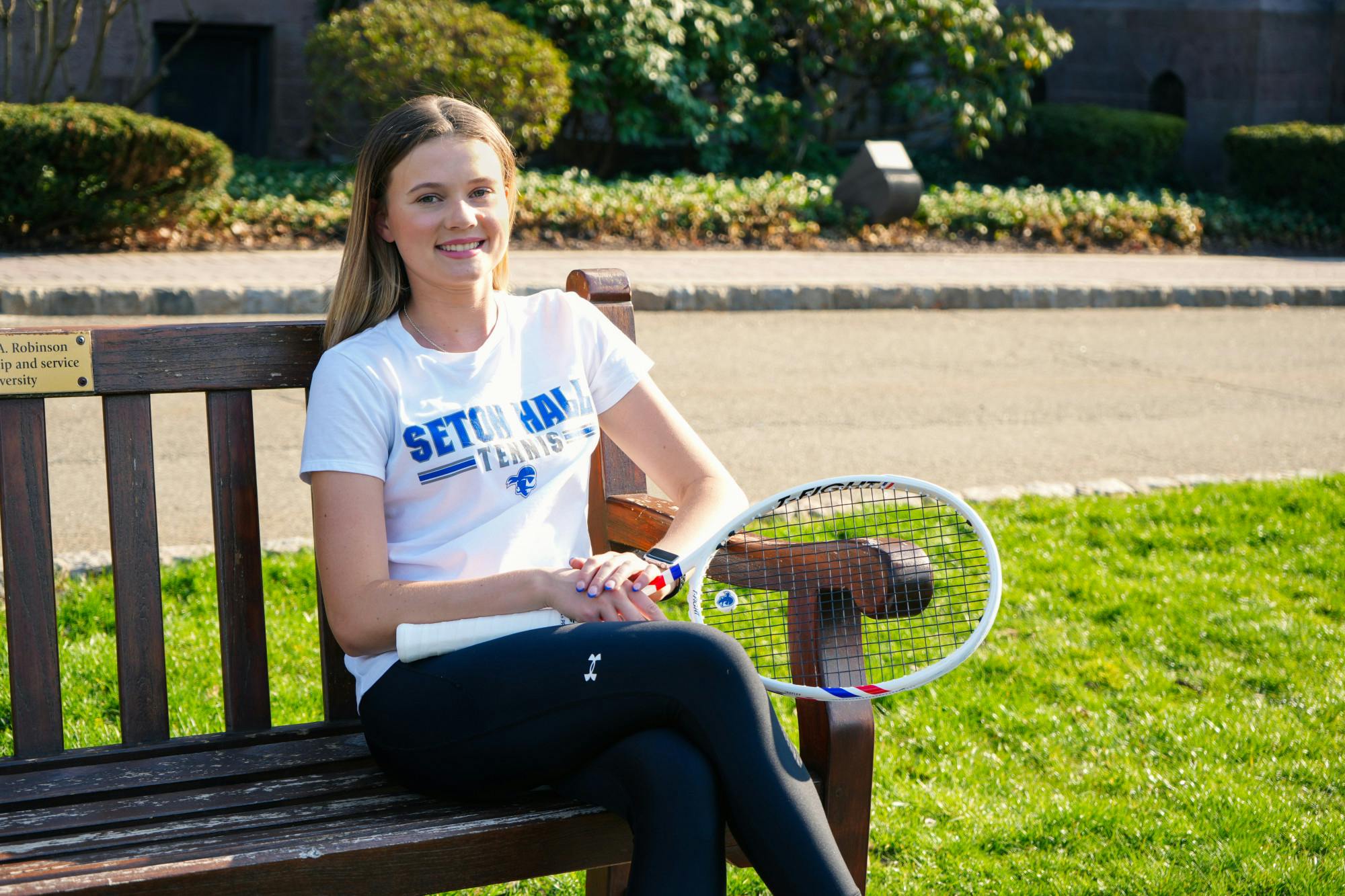
Her tennis journey began at age 4, after her family moved from Chicago to England. She tried “every sport under the sun,” and even competed in speech and debate. But when COVID hit, she made a major decision that changed everything.
“We knew that I kind of had to make a shift to give myself a chance to play D1,” she said. “So that’s when I moved to Spain and went to the Rafa Nadal Academy.”
The experience taught her resilience.
“It’s not been the easiest journey for me,” Campbell said. “There’s been a lot of ups and downs…but it just teaches you to continue to push.”
Her most meaningful tennis memories, though, are not from matches.
“A lot of the memorable moments I have from the tennis team is off the court,” she said. “We are such a tight‑knit group…we’re a major side‑quest team.”
As she prepares to enter her senior season next year, Campbell hopes her teammates remember her for her effort.
“Tennis is an individual sport, that’s true, but everything that we do is all about the team,” she said. “I hope people would be able to walk away and think ‘Niamh did everything she possibly could for the team.’”
In order to succeed and have this drive, Campbell said she draws inspiration from the people closest to her.
“My parents are definitely big inspirations to me,” she said. “They’ve both done a lot for me to be able to get to where I am today.”
Her siblings motivate her just as much.
“My sister is definitely one of the hardest workers that I know…and my brother has autism, so I just look up to him in everything that he does,” Campbell said. “He’s kind of the person that made me who I am… everything that I do is kind of for him.”
After graduation, Campbell hopes to work on the air.
“Whether that’s commentating, being a presenter or a host… that’s definitely something I would love to do,” she said.
She hopes her presence at PSN encourages more women to get involved, and she wants future students to embrace every opportunity.
“If you are interested in multiple things—do it,” Campbell said. “Don’t say no, don’t be afraid to say yes to everything. Those experiences are going to last forever.”
SHU, she said, gave her something she’d been searching for.
“I’ve always grown up not really knowing where I belonged,” she said. “But I found my place at Seton Hall.”
Julia Roman is a writer for The Setonian’s Features section. She can be reached at julia.roman@student.shu.edu.