Housing insecurity does not always mean being without a home. For many families, it can mean struggling to afford the one they already have.
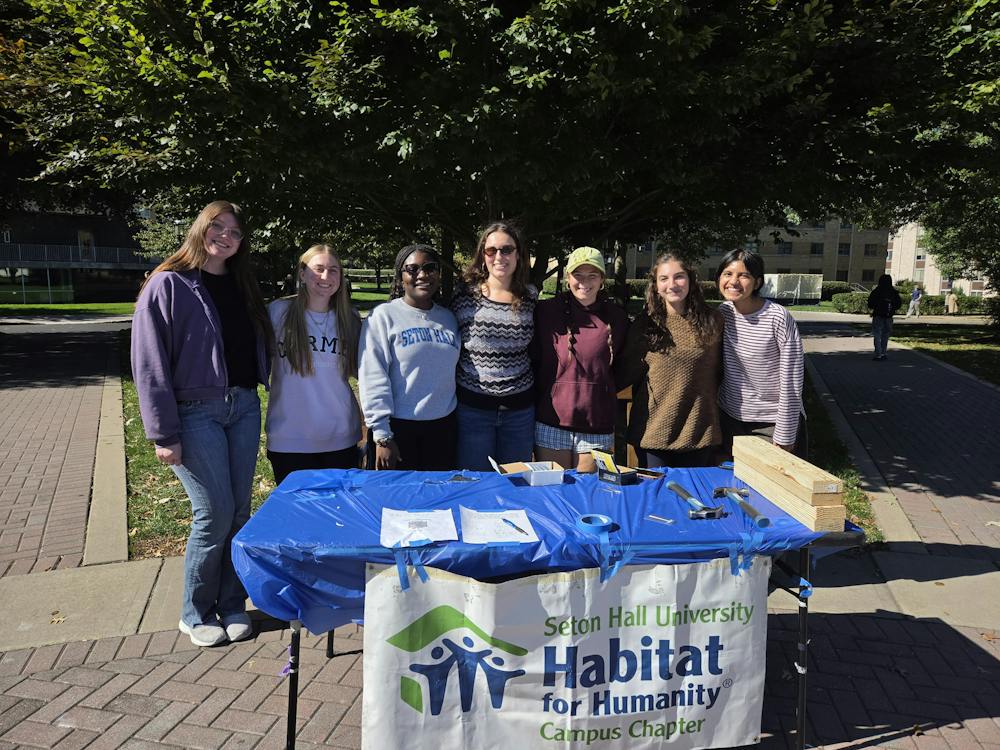
Seton Hall’s Habitat for Humanity Chapter used Act, Speak, Build Week to help students understand that distinction. Held in conjunction with World Habitat Day on Oct. 5, the week focused on affordable housing advocacy through hands-on activities on the University Green.
The club hosted three tabling events from noon to 3 p.m. Monday through Wednesday, with each day representing a different part of Act, Speak, Build Week.
On Monday, students made keychains to symbolize when new homeowners receive the keys to their homes. Tuesday focused on writing letters and postcards to people who feel like home. Wednesday featured a hammering competition to demonstrate the work that goes into building new, affordable homes.
While the activities were hands-on, the week was focused on advocacy, not fundraising. Instead, the chapter helped students understand Habitat for Humanity’s mission and what affordable housing means.
“We try to avoid fundraisers for this week, just because it is just our full week of pure advocacy,” Bella Kaplan, a sophomore social behavior science major and the club’s advocacy chair, said. “We want people to understand our mission, like, what we do on campus and what we do around the world.”
Part of that education is understanding how housing affordability is measured.
Maeve Hartley, a junior nursing major and president of Habitat for Humanity, said the organization focuses on ensuring families can remain in their homes rather than simply obtaining one.
“Habitat’s mission is to be able to give a home to a family and make sure that they can stay in that home,” Hartley said. “Not like ‘Oh, here’s a home’ and all of a sudden you’re priced out in like two years.”
According to Habitat for Humanity, housing is generally considered affordable when a household spends no more than 30% of its income on housing costs. Hartley said understanding that distinction is important because housing insecurity is not limited to people experiencing homelessness.
“[The week is about] helping students understand just because someone isn't homeless… doesn't necessarily mean that they're living in a place that they might be able to continue to live in,” Hartley said.
Habitat’s work throughout the semester centers on the Collegiate Challenge, where students can travel during spring break and volunteer at build sites throughout the week.
Kaplan explained how these build sites and trips are a way to branch out of the SHU community and see people come together over a common goal.
“I love talking to people who are building their own homes, because it really is like a process,” Kaplan said. “They are excited to do it. They're putting in the hours, a lot of their friends come to help, because they want to see that for them, too. That community is just really so fun to see everyone come together and to watch something get done.”
Emily Bruni, a senior social work major and vice president of Habitat for Humanity, has participated in the Collegiate Challenge three times. She explained that families who qualify for Habitat homes contribute “sweat equity” hours by working multiple jobs and volunteering to help build homes.
“They're working right alongside you, building not only their house, but other people's houses as well,” Bruni said.
For Bruni, participating in the trips has also changed how she understands the challenges these families face.
“You really get to see that firsthand perspective of the struggles that they face,” Bruni said. “Most of them are working multiple jobs on top of putting in all these sweat equity hours. Many of them have waited for years to get qualified for a Habitat home.”
Although Act, Speak, Build Week did not focus on fundraising, it is still a major part of what Habitat for Humanity does.
Robert “Jake” Karulf, a junior psychology and religion major, said fundraising supports the organization’s housing efforts and helps students participate in build trips.
“Fundraising goes towards helping people for housing, helping get students and volunteers to sites to build houses,” Karulf said. “Overall [fundraising] funds Habitat as a larger organization to make sure that they're able to fund their employees, fund the plots of land that they're building on and make housing more affordable for the people who have signed up for it.”
Through World Habitat Day and Act, Speak, Build Week, the chapter hopes to show students that understanding housing inequality is only the first step.
“[Students] don't have to just observe these issues and feel helpless,” Bruni said. “They can actually take action and get involved with organizations that are making real change in people's lives.”
For Habitat for Humanity, that action starts with recognizing that a home is more than a structure. It is a place where people should be able to build a stable life.
As Kaplan said, “everyone deserves a decent place to live.”
Kaitlyn Campeau is a writer for The Setonian’s Features section. She can be reached at kaitlyn.campeau@student.shu.edu.