
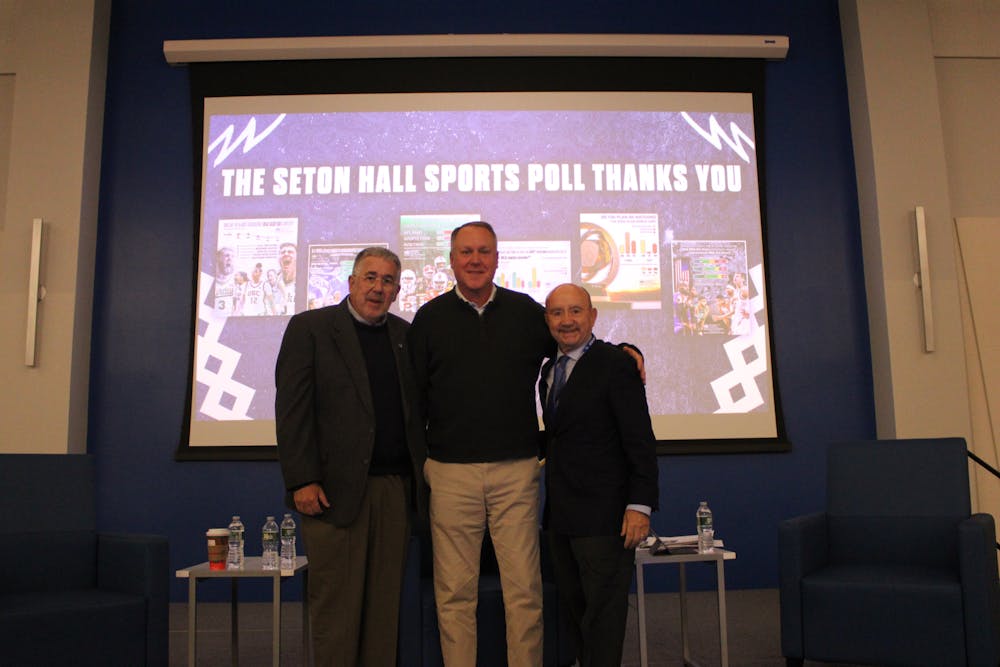
Seton Hall students got a look into the past, present, and future of college sports during the “March Madness: At the Root of College Sports Chaos” event held on March 16. The panel featured Stillman School of Business Professors Len DeLuca and Michael Smith, along with Director of Athletics and Recreation, Bryan Felt, who shared stories, history, and opinions on some of the biggest moments and issues in college athletics.
Among other topics, the panel discussed a painful moment for SHU fans: the 1989 National Championship game, when the Pirates lost to Michigan 80-79 after a controversial foul call in the final seconds.
Even though many believed the call was questionable, SHU’s players and longtime head coach P.J. Carlesimo handled the loss with class. Felt said that even today, when he speaks with former players and alumni, they still do not speak poorly of the referees or the calls.
Another major focus of the event was the impact of NIL in college sports. NIL stands for “Name, Image, and Likeness,” and it allows student-athletes to get paid. Felt explained that while this gives athletes more freedom and fairness, it also creates challenges. Bigger schools with more money, like Duke, Kentucky, and Florida, for example, now have a major recruiting advantage thanks to their bigger budgets, while smaller schools struggle to keep up.
Naturally, The Hall’s budget was also brought up during the NIL discussion as a real example of how college basketball is changing. After not being selected to play in March Madness on “Selection Sunday,” Seton Hall declined an invitation to play in a non-NCAA postseason tournament. The decision was made so the team could focus on the future rather than play extra games that would not have much long-term value.
SHU head coach Shaheen Holloway said the goal is to get a head start on next season. That includes keeping key players like junior guards Adam “Budd” Clark and Tajuan Simpkins, as well as freshman forward Najai Hines. With the transfer portal acting like free agency, players can leave at any time, so holding on to talent is very important.
DeLuca strongly supported paying student-athletes, saying that since schools, networks, and sponsors make so much money, it is only fair that the players earn money too. The panel connected this idea to recent legal cases, including Alston v. NCAA, which helped push college sports toward a more open system.
Towards the end of the panel, Smith and DeLuca gave a history lesson on the NCAA. The organization was created in 1906 after concerns about player safety. Over time, college sports grew into a major business, with TV deals now worth billions of dollars. March Madness alone brings in huge ratings and revenue every year, and now with NIL, the numbers are only going to go higher.
In the end, the event showed how much college sports have changed. From early concerns about safety to today’s battles over NIL money and fairness, college sports continue to evolve. The discussion made it clear that while March Madness is exciting, it also reflects the larger challenges facing college athletics today.
Jaden Highsmith is the assistant editor of The Setonian’s Sports section. He can be reached at jaden.highsmith@student.shu.edu.


