
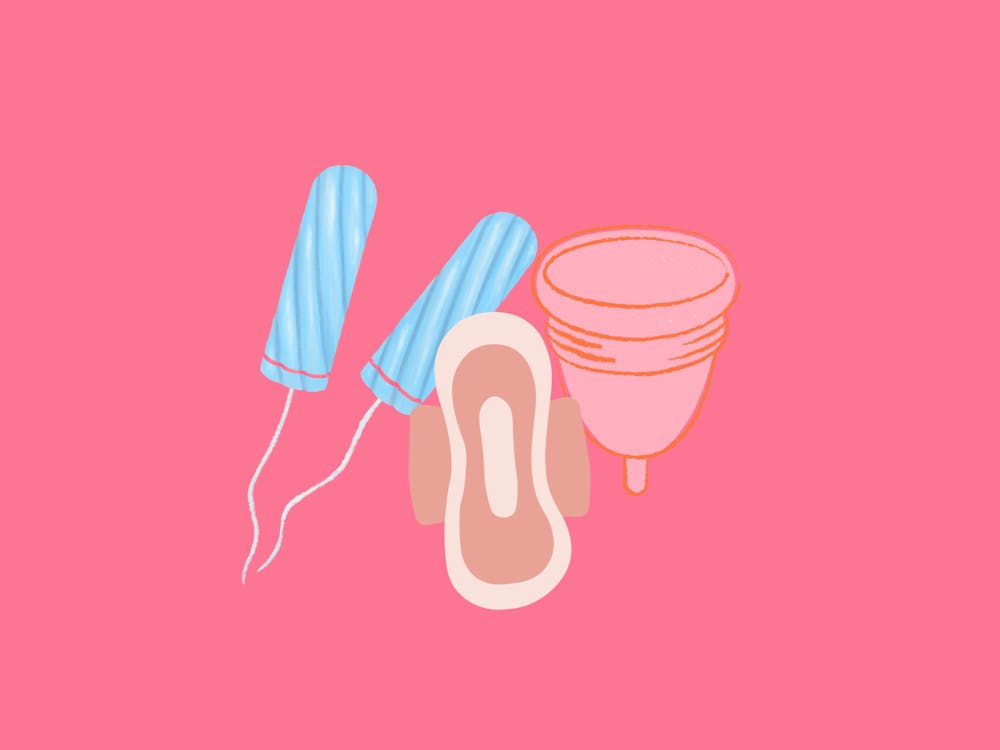
Menstruation is not rare, but talking about it is. Society still discriminates against women by viewing menstruation as taboo and treating menstrual products as optional instead of a necessity.
The lack of access to products is not just unfair, it is also a major health concern. Not having the proper menstrual products can result in major health consequences that can disproportionately increase the risk of diseases for women.
According to the CDC, specific ramifications include reproductive or urinary tract infection risks, or even toxic shock syndrome as a result of the misuse or failure to change products regularly.
This showcases that menstrual products are not just an extra item for women to buy, but a matter of basic healthcare that can prevent long-term consequences. If other medicinal items are recognized as necessary, menstrual products should be the same.
Beyond the health risks, menstrual product companies and even government legislators have ignored the financial burden this imposes on women.
CNBC stated that menstrual products cost the average person around $6,000 in their lifetime, even before the “pink tax,” which is a term used to describe how specific products are priced higher when they are for women, such as razors or deodorant. The pink tax is a price discrimination tactic for items that are identical for men.
Not being able to afford menstrual products is not just an inconvenience; it is denying access to an essential good for women to function in their everyday lives. According to Period.com, nearly 1 in 4 students struggle to afford period products in the U.S. alone.
6 in 10 teens feel personally impacted by the negativity surrounding menstruation. For example, teens have to miss school or feel like they have to hide their period because it is taboo. Menstrual stigma and financial barriers limit access to products, showcasing the necessity for free products in efforts to destigmatize menstruation as a whole.
The term “period poverty” is defined by Period.com as the “inadequate access to menstrual products or menstrual health education as a result of financial constraints or negative socio-cultural stigmas associated with menstruation."
Period poverty is a real concern amongst many women in the U.S. According to the Brookings Institution, a study conducted on low-income adult women in St. Louis found that 64% were unable to afford period products at least once in the last 12 months, and 21% of them experienced that issue every month.
Despite the push for equality, menstrual equity is not so widely accepted. There is still major pushback from lawmakers about the costs of implementing free products for all women. Many complaints that it will come out of taxpayer dollars or overall government expenses are putting women’s necessities on hold.
The argument comes down to the question of what is viewed as a necessity for all humans.
Lawmakers have decided that food and medicine are necessary to all humans for survival, even when extra costs are involved. Why, because of a gender-based necessity, are menstrual products different?
For example, while some states have made strides to eliminate the extra costs of menstrual products, others have made little progress. States like Florida, Arkansas, Georgia, Mississippi, and Tennessee have failed to pass legislation to remove taxes on products or to provide free products because of political stances or financial budgets.
In 2024, Florida Governor Ron DeSantis vetoed funding for free menstrual products in schools, claiming it was part of a larger budget cut plan, according to WUSF.
While government officials argue it is too expensive for free period products, it might be more manageable than we think. Providing free products in schools “costs $5-$7 per year per person to supply period products, while the average cost of providing free coffee is $50-$125 per year per person,” according to FreeTheTampon.
Governments already have funding set aside for health programs, making it easier to add to pre–existing budgets. When weighed against the fact that women have to forgo income or struggle to use products correctly, which may impact their health, the investment seems worth it.
Although period poverty exists across the globe, there are a few hopeful changemakers who are advocating for equality.
In Scotland, under the 2021 Period Products Free Provision Act, providers are now legally required to make period products free and available for women. According to the New York Times, schools in New Zealand provide free period products to all students in order to combat period poverty.
These efforts are the first of many that are spearheading a movement towards acknowledgement that period products should not have to be a financial burden for women.
The economic criticisms of free menstrual products ignore that period poverty has global consequences. When students are missing their everyday obligations because they are not guaranteed access to products, they suffer academically. The same goes for working adults who may need to miss work and therefore suffer economically.
Free access to menstrual products could alleviate these burdens for women and pave the way for greater gender-based equality.
Menstrual products should be a given, not a luxury. It is essential that women are given the same chance as men to perform optimally, and that cannot be equated if women are without a basic necessity.
Although critics argue that the cost of period products are not expensive, why is it that government officials continue to advocate for other universal care products for low-income individuals, such as toothpaste, clothing, or even shampoo, while menstrual products are pushed to the side?
This idea is not an extreme one; it is an idea that promotes fairness and equality in our modern society. Menstruation should be acknowledged as a normal biological process, not an anomaly.
Period products should be free for all women, regardless of cost or stigma; periods are not optional, and neither should access to products be.
Grace Tylee is a copy editor and head editor of The Setonian’s Social Media. She can be reached at grace.tylee@student.shu.edu.


