
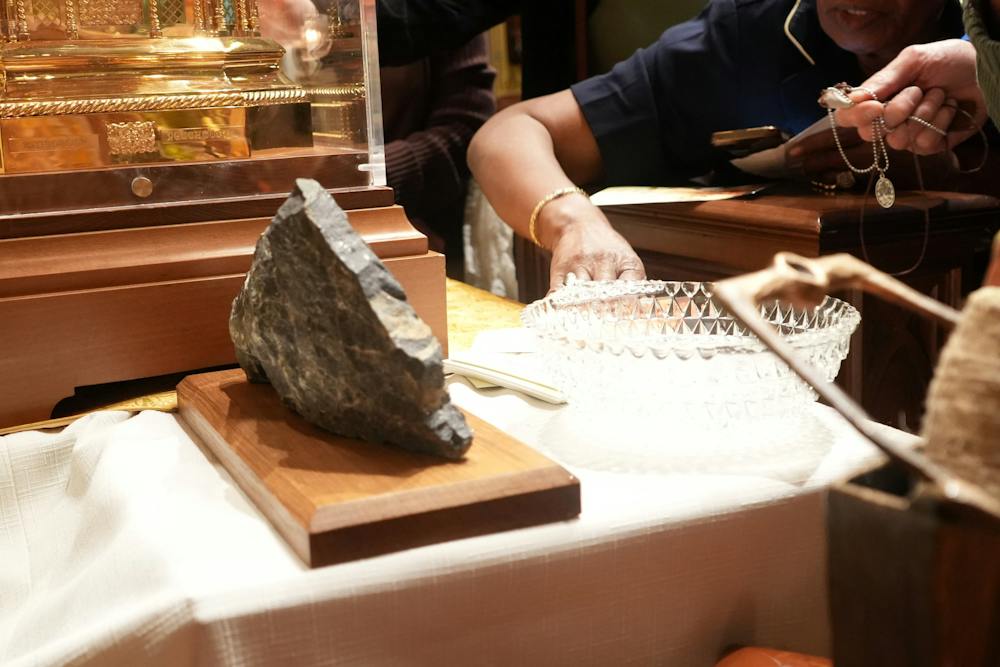
Seton Hall hosted the relics of St. Bernadette Soubirous from Oct. 4-6, drawing 550 people to a healing mass in the Chapel of the Immaculate Conception on Monday.
The visit marked the 11th stop on a national tour bringing Bernadette’s relics to Catholic communities across the United States. The relics include portions of Bernadette’s physical remains, including her kneecaps and a piece of her rib, which were recovered and preserved after her body was exhumed following her death.
Bernadette became known for reporting a series of Marian apparitions in Lourdes, France, in 1858.
According to Catholic tradition, the woman Bernadette said appeared to her identified herself as “the Immaculate Conception,” a title that shares a connection with SHU’s Chapel of the Immaculate Conception.
Rev. Nicholas Sertich, director of campus ministry and faculty in the University Honors Program, said Bernadette’s story shows the importance of trust and faith in God, as she endured hardship and struggled before becoming known for her apparitions.
“She was a little girl. She and her siblings…were from a peasant family,” Sertich said. “The story and the tradition is that one day she went out to collect firewood…and she hears this voice and she sees this image of a woman who’s radiant in light, standing in the grotto.”
Sertich said Church leaders were initially skeptical, but ultimately recognized the apparitions as miraculous.
“[Priests and bishops] realized that something else is going on here, that this must be some kind of miraculous apparition,” Sertich said. “Because how else would a little girl without any kind of education come up with the phrase ‘Immaculate Conception’ and know what it means? Since that day, Lourdes has been one of the most visited sites in the Catholic Church.”
Sertich described the grotto in Lourdes as a place of healing and prayer. Reports of healings at the Lourdes grotto date to its earliest years, Sertich said, and visitors still leave behind wheelchairs, crutches and canes.
“You can even see on display in different places [at the Grotto] wheelchairs and crutches and canes of people who have been healed,” Sertich said. “They send back their wheelchair or something else to signify that they were…truly healed from the waters of Lourdes.”
The healing Mass incorporated water from the grotto in Lourdes, connecting the event to the site of Bernadette’s apparitions. A rock from the Lourdes grotto was also on display.
For SHU students, the Mass provided an opportunity to engage with Bernadette’s story, while reflecting on faith and community.
Violetta Rzaca, a junior biology major, said she had not expected the chapel to be filled but was grateful to celebrate Bernadette alongside a large community.
“It was really inspiring to see so many people come for this event,” Rzaca said. She recalled seeing “people I knew, people I didn’t, old people, young people, mothers, babies,” noting that many attendees were not students.
Dailisa Robles Hernandez, a sophomore nursing major, said the event created a sense of community around Bernadette, whom she described as an inspirational figure.
Hernandez said events such as the healing Mass offer value even to those outside the faith.
“If you’re not Catholic or trying to be Catholic or just Christian, you get a sense of what it's like to see something more extraordinary other than your lifestyle,” she said.
Alumnus Stephen Beaman said SHU’s selection as a tour stop was meaningful because it gave the university an opportunity to deepen its Catholic identity through the celebration of Bernadette’s sainthood.
“I know they’ve chosen many different Catholic universities and institutions,” Beaman said. ”I think it’s just that we are a light in the Catholic world and in the Catholic education world.”
Beaman said Bernadatte’s example could serve as an inspiration to the SHU community.
“I think a lot of time we can think of attaining sainthood as almost like trying to be perfect in our faith,” Beaman said. “And what I think the saints show us is that we don’t have to be perfect…what it really is, is a deeper conversion each day.”
After learning of the healing Mass, Greiky Suriel, a junior criminal justice major, researched Bernadette and became interested once she learned Bernadette is the patron saint of the sick and those struggling in their faith.
“Regardless of what everyone says,” Suriel said, “you just have to really stay grounded next to God.”
Tristan Vollero, a sophomore mathematical finance major, said the visit offered a chance to grow closer to someone who “had already succeeded and made it to heaven,” and to participate in the tradition of relic veneration.
“I think that St. Bernadette, especially with her history of being in Lourdes with the healing there, I think it’s a great opportunity for others to come here and hopefully attain that same healing,” Vollero said.
Vollero added that an event of this visit’s scale could generate interest in Catholicism among students.
“I think that having something so high profile and special happening right here in the middle of campus…can do some great work in terms of spreading the world of all this,” Vollero said.
Christopher Cruz, a junior computer science major, similarly said bringing the relics to campus could create interest because of the national tour’s significance.
“I think having a relic from such a far place come here to campus is a fantastic opportunity,” Cruz said. “Having [them] here on campus could really help…reinforce or reinvigorate the faith of those who attend Seton Hall.”
Alongside increased interest in ministry, students said the timing of healing mass serves was significant as academic workloads become heavier.
Isabella Hardister, a junior modern languages major, said the event provided an opportunity for students to pause as midterms approach.
“It can be easy to get overwhelmed and need a lot of peace and healing,” Hardister said. “I think this was really good timing and something a lot of people need right now.”
"We're always in need of healing, physical healing, mental healing, spiritual, emotional healing," Sertich added.
Sertich said the Catholic tradition of relics, shared with Orthodox Christianity, focuses on understanding and appreciating the journey of saints.
“There are different types of relics,” Sertich said. “The principal relics are pieces of the bodies of saints or the things associated with them.”
He compared relics to family keepsakes, saying that he wears his grandfather’s cross to feel close to someone he loved and whose legacy he hopes to emulate.
“In the Catholic tradition, we don’t look to the saints like they’re God or that they’re demigods or anything like that,” Sertich said. “There’s only one God, but we look to the saints like they’re our ancestors in the faith, the same way…we might look to our grandparents.”
Relics are more common in the Catholic tradition than many realize, Sertich said. Most Catholic altars contain a small relic sealed in the altar stone, Sertich said, so Mass is typically celebrated above one.
“So even when we celebrate mass and we come together to pray, we’re always praying in the vicinity and closeness of the saints we want to be like,” Sertich said.
Sertich said he keeps a fragment of St. Elizabeth Ann Seton’s heart in his office as a reminder of her legacy and his own work in Campus Ministry.
“The relics stem from this desire to be close to the saints,” Sertich said.
Ultimately, Sertich said the presence of St. Bernadette’s relics connected SHU’s Catholic identity with the broader history and traditions surrounding Lourdes.
“I would love to see one day, one of our own students be a saint,” Sertich said. “And 200 years from now, somebody else is rejoicing because the relics…are coming around, and they can look to our students as somebody they want to be like too.”
Elizabeth Maria Churchill is the Assistant Editor of The Setonian’s News section. She can be reached at elizabethmaria.churchill@student.shu.edu.


