
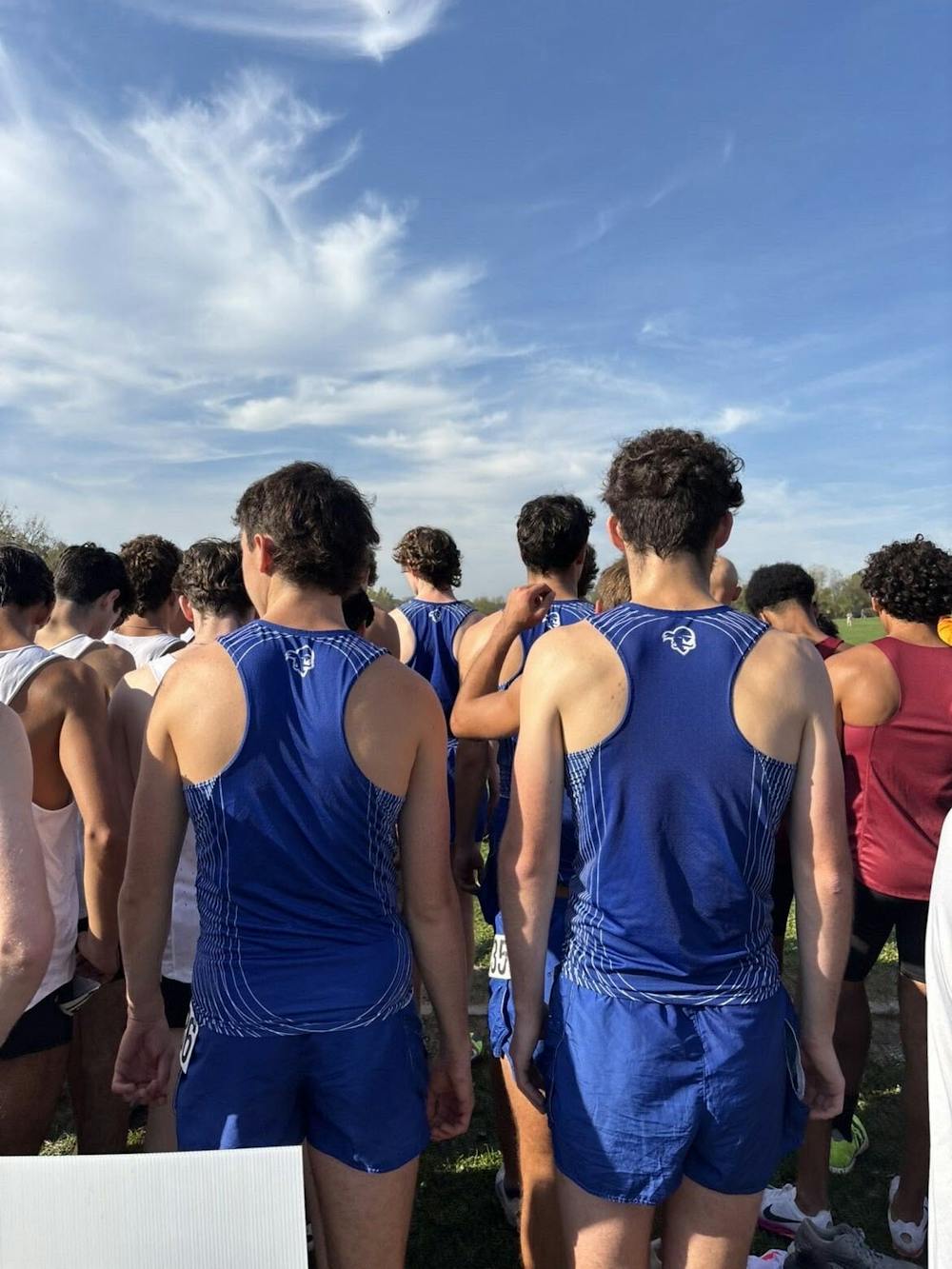
The Paul Short cross-country run was canceled after 115 runners, roughly 7% of all competitors, did not finish their races due to heat exhaustion on Friday.
When the race started, hundreds of runners poured out of the starting gates in Bethlehem, Pennsylvania. By the time it ended, some were walking, others were crawling, and many were being treated in the medical tent.
Heat had taken over the 52nd running of the Paul Short Invitational.
The temperature was around 78 degrees when the races began and climbed above 80 degrees as the day went on. Following the women’s Gold Race, meet officials were informed that all the hospitals in the Lehigh Valley area were at capacity, leading to the cancellation of the remaining races. While several Seton Hall athletes competed in the morning's Open races, the Pirates who were scheduled to run in the afternoon’s Brown race could not compete.
SHU competed in the men’s Open 8K, the largest race of the day, with 628 other runners. The Pirates ran a very tight race, with five runners finishing within 38.6 seconds of each other.
Freshman Evan Roberts led SHU, finishing in 27:31.0. Sophomore Caden Lazzor followed at 27:42.2. Redshirt freshman William Gilhooly set a personal best by finishing in 27:58.3. Freshman Joseph Friedman crossed the finish line in 28:09.5, with redshirt sophomore Aidan Griffin just a tenth of a second behind him.
The SHU women competed in the Open 6K, with a field size similar to the men. The four Pirates finished within just over two minutes of each other.
Junior Margaret O’Connell led the Pirates, finishing in 24:50.5. Sophomore Sophia Paparsenos finished in 25:31.5, followed by junior Kennedy Roskopp at 26:02.4 and freshman Skyler Quigley at 26:55.0.
Despite the strong showing, the heat eventually caught up to the Pirates.
Senior Aidan Smith said he noticed the heat by the second mile.
“The first mile was not too bad,” Smith said. “But as the miles kept going on, I found that my breathing definitely became much more difficult.”
The course created another problem for the Pirates. About 400 meters into the race, runners entered the cornfield section, where the course became narrow and runners had little space.
“I’ve never been one to really thrive in those kinds of conditions,” Smith said. “I took a couple of elbows.”
Friedman, racing at Paul Short for the first time, also struggled with the conditions.
“There was a lot of contact at the beginning of the race,” Friedman said. “There were many runners bumping into me and, in some cases, even pushing me.”
The lack of space also made it harder to breathe.
“There was no airflow in the cornfield, and the air was very stagnant, so it was very hard to breathe,” Friedman said.
Friedman started seeing runners fall out of the race. Some were walking while others were trying to fight through. With about 800 meters remaining, he said he saw a runner collapse.
Smith saw similar sights after finishing. He saw other runners being helped by medical professionals and one runner crawling toward the finish line.
Friedman said he was surprised by how quickly the heat began affecting runners.
“It was quite sneaky,” Friedman said. “People did not really anticipate that heat would cause so many problems.”
However, meet directors faced major backlash for canceling the rest of the races. Teams from around the nation traveled for the event, and, most notably, many of the nation’s top Division III schools did not get the opportunity to compete.
“I think in the moment they made the right call,” Smith said. “This was the best thing they could have done at the time to avoid problems.”
Friedman agreed.
“I think it would have been very dangerous to continue,” Friedman said.
Both runners wondered if the meet should have been rescheduled ahead of time. Smith suggested that officials could have checked the forecast several days before the meet and considered changing the schedule.
“I think either Saturday or Sunday would have been good times for the meet,” Smith said. “It would have been much cooler then.”
Despite the difficult conditions and shortened meet, Head Coach Jacob Simon said the Pirates were still able to get valuable work in.
“We still got some good training in,” Simon said. “I think the biggest takeaway is you [have] to adjust to your surroundings. It could be a thunderstorm, heat, cold—it could be anything.”
Simon said he was encouraged by the performances of the athletes who competed and believes the team is in a good position heading into championship season.
“We saw progress from the guys who did race, and we are sharpening up heading into championship season,” Simon said.
The Pirates will now turn their attention to the IC4A/ECAC Championships on Oct. 17 and the BIG EAST Championships on Oct. 30.
Colin Comerford is a writer for The Setonian’s Sports Section. He can be reached at colin.comerford@student.shu.edu.


