
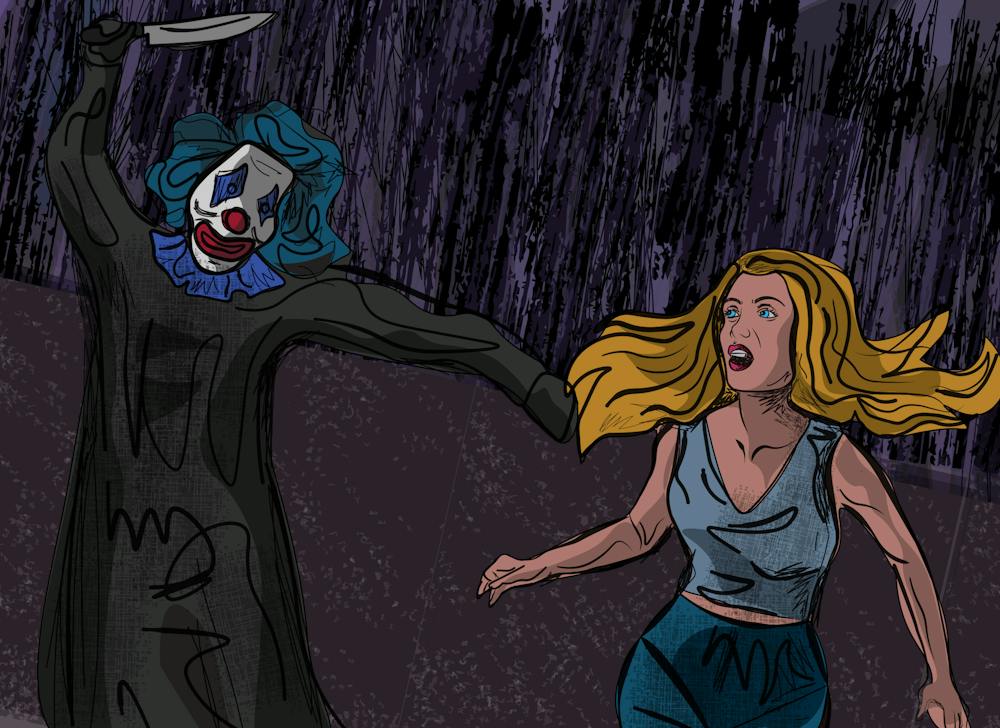
High-pitched screams. Blood soaking into a rotting wooden door frame. A knife raised inches from a character’s throat.
This is the world of slasher films: brutal, frightening and entertaining. But beneath the blood and screams is something more complicated. Slashers do more than scare audiences. They confront taboos and give their characters—particularly women—the opportunity to fight back against violence. What may appear to be simple gore can actually reveal something meaningful about the fears of society.
So, what exactly is a slasher?
A slasher film is defined as a horror film in which a serial killer—or sometimes multiple killers—hunts down a cast of characters.
This is a broad definition, but it encompasses a variety of films such as “Halloween,” “Psycho,” “Friday the 13th,” “A Nightmare on Elm Street” and “Scream.”
Slashers are often dismissed as less sophisticated than “elevated horror,” a term commonly used for horror movies that emphasize slow pacing, psychological depth and deep metaphors about grief or trauma rather than relying on jump scares and graphic violence.
Mike Flanagan, a prominent horror filmmaker, has criticized some slasher films for prioritizing violence and gore at the expense of the characters.
“A lot of slasher movies from the ’80s were only focused on violence and gore, which robs the human beings in the story of any empathetic reaction from the audience, and instead makes them cheer for the gore,” Flanagan said.
I do not believe films should be criticized for prioritizing entertainment value. Whether the movie is categorized as “elevated horror,” “psychological horror,” or a plain slasher, its ultimate purpose is to entertain. Entertainment is not a vice. If anything, it allows expression, and expression is essential to humanity. Expression is the act of communicating ideas or feelings through media. Slashers, despite appearing superficial on the surface, can hold valuable ideas and provide insight into the culture and anxieties of the time in which they were made.
Unlike many other genres, slasher films do not shy away from the wickedness of humankind. They do not sanitize violence, sex, murder, or other subjects that audiences may find uncomfortable.
When “Psycho” by Alfred Hitchcock was released in 1960, audiences were appalled by the film’s taboo content, including its sexual themes, vulgarity and portrayal of Norman Bates.
Critic Alexander Walker of the London Evening Standard said, “Hitchcock has laid the film out like a morbid morgue attendant. His eye for corpses has never been as wide open, nor his sense of bizarre death sharper. But what nauseates one is his sick relish of anything in it that is perverted or blood-spattered. And much is.”
This reaction is not unfamiliar when looking at the way critics and audiences have responded to slasher films throughout the genre’s history. Yet, today, “Psycho” is held in high regard.
Hitchcock not only created a great film, but he also challenged the famous “Hays Code,” which censored “vulgar movies,” and laid the foundation for the modern slasher genre. An integral part of the slasher genre is its willingness to challenge taboos and force audiences to confront real-world concepts that may make them uncomfortable.
Slasher horror is also known for its history of female protagonists. The genre popularized the trope of the “final girl,” a term coined by Carol J. Clover in her 1987 essay, “Her Body, Himself: Gender in the Slasher Film.” The final girl is the female protagonist who survives long enough to confront the villain of the story and lives to tell the tale.
The “final girl” is more than just another victim waiting to be killed. She is given agency, triumphing over her oppressor and demonstrating strength while overcoming the violence inflicted upon her.
My personal favorite “final girl” is Nancy Thompson from “A Nightmare on Elm Street.” Nancy is a resourceful protagonist who actively resists Freddy Krueger. Rather than passively waiting for someone to save her, she sets booby traps and attempts to defeat him herself.
Although Nancy is my preferred protagonist, many other slasher films have notable “final girls.”
In “Halloween,” Laurie Strode repeatedly fends off Michael Myers by outwitting and stunning him. In “Friday the 13th,” Alice Hardy enters a grisly, difficult battle with Mrs. Voorhees on the shore of Crystal Lake. In “Scream,” Sidney Prescott holds off not just one Ghostface, but two, ultimately killing both murderers.
These characters demonstrate that many slashers provide female protagonists agency, refuting the stereotypes of “delicate” or “gentle” women. Instead, women are survivors and are allowed to be rather ruthless.
The golden age of slashers arose during the 1970s, reflecting the turbulent cultural environment of the U.S. at the time. The aftermath of the Vietnam War, political assassinations and the emergence of notorious serial killers contributed to cultural anxieties and uncertainty.
American suburbs were often seen as safe havens in the 1970s. In 1978, the release of “Halloween” turned that idea upside down.
“Halloween” centers on a sadistic, almost otherworldly serial killer, Michael Myers, who returns to his hometown of Haddonfield and terrorizes its quiet suburban streets. Violence and bloodshed are no longer happening somewhere distant or unfamiliar, but are happening in the very streets that are supposed to represent safety.
Before the rise of the slasher, many horror films focused on Gothic Universal Monsters such as Dracula, Frankenstein, the Mummy and the Wolf Man. After World War II, horror films also reflected atomic anxieties through stories about alien invasion and mutated creatures such as those found in “The Blob” or “Invasion of the Body Snatchers.”
The slasher genre moved the monster close to home, shifting away from fantasy creatures to human monsters. America’s fears were now at home.
The slasher icon, though usually defeated at the end of the film, almost always returns in the sequel. This persistence portrays the idea that while evil can be defeated, it may never disappear permanently. Human evil is a part of the world, and we will always be at war with it. The battle is never completely over, but that does not mean it cannot be fought.
Slashers continue to prevail today because many of the cultural anxieties that created the genre still exist today. They are not only valuable because of how they reflect human fears, but because they allow us to experience fear in a safe and controlled way. Human beings are fearful creatures and always will be; it’s an integral part of us. But slasher movies give us a way to experience that fear without being exposed to real danger.
Beyond offering entertainment and a safe place to explore fear, slashers force us to confront things we would prefer to avoid. They confront the taboo. They confront the ugliest aspects of humanity. And despite all of this darkness, they force us to consider the possibility that wickedness can be vanquished—if only for a little while.
Christianna Bennett is a writer for The Setonian’s Opinion section. She can be reached at christianna.bennett@student.shu.edu.


