
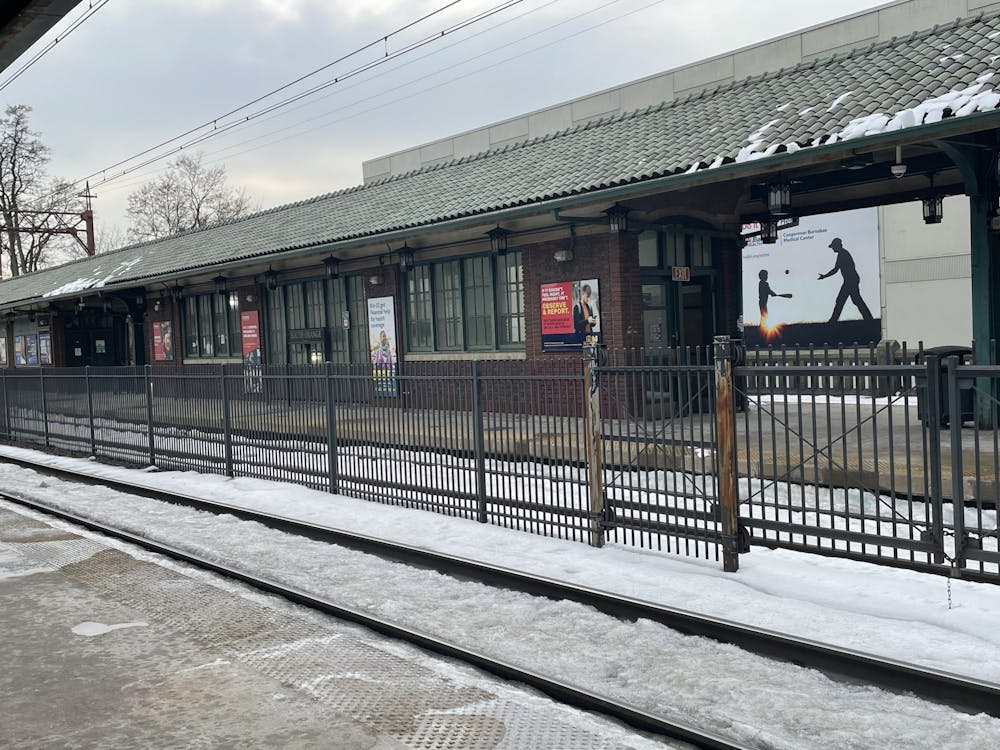
NJ Transit schedule changes went into effect last month as construction began on the Portal Bridge, affecting the Morris-Essex line that serves South Orange. This has caused significant delays for Seton Hall students who commute into New York City for internships.
Due to the construction, students who travel on the Morris-Essex line into New York Pennsylvania Station (Penn Station) are now being rerouted through Hoboken, resulting in longer commutes as commuters have to take Port Authority Trans-Hudson (PATH) or the New York Waterway Ferry to get into the city.
The construction is for the Portal North Bridge Project (PNBP), which is replacing the century-old Portal Bridge over the Hackensack River with a new, elevated bridge that will not have to open and close for traffic. The project is part of the larger Gateway Program, which aims to improve long-term reliability and capacity along the Northeast Corridor.
During construction, trains can only operate on a single track between Newark and Secaucus, reducing the number of weekday trains into Penn Station. As a result, commuters are experiencing schedule changes, reroutes and longer travel times. Some students have shifted to remote work to avoid the delays.
For Daniel Roche, a senior finance and sports management major, the changes have added nearly an hour to his commute.
“It’s pretty much affected 45 to 50 minutes there and back each way,” Roche said. “Each day I usually leave for work around eight, where now if I want to get there at the same time, I have to leave at 7:15.”
Roche is a sports property student associate at Madison Square Garden, where he assists with ticket sales and event preparation for sporting events. Before the construction, he took the South Orange train directly to Penn Station and walked to the office. Now, he travels to Hoboken and transfers to a PATH train.
Roche said Hoboken station is struggling to handle the increased volume of commuters.
“It’s a lot more congested, a lot more people in a cramped area, where I think Hoboken can’t handle it as best as Penn Station can,” he said.
Despite the delays, Roche said his commute now costs less.
“Instead of the 16 dollars there and back I’d pay a day, now it’s 12 dollars,” he said. “I think that’s one benefit of all of this.”
Similarly, Grace Iannacone, a senior marketing and finance major, said her commute has increased by 20 minutes. Iannacone is a strategy and operations intern at Marvel Entertainment, where she assists with sales in the comics department.
“I have to wake up a little bit earlier just to make sure that I make the trains that I need to get on,” she said.
To accommodate the disruptions, Iannacone said her employer allows her to work remotely on days when the train schedule is more hectic than usual.
“Thankfully, my boss understands because…he is from the area and his commute is also impacted by the shutdowns,” Iannacone said. “He has been very flexible with me.”
Iannacone said that NJ Transit is doing its part to help commuters adjust to the schedule changes.
“I'll give New Jersey Transit some credit,” Iannacone said. “It's a little inconvenient, but I think that they're handling the transition very well…There's people at the Hoboken station telling people where to go at all times.”
While many students describe frustration, others say the new routes have unexpected advantages.
Allie Bodaken, a senior diplomacy and international relations major with minors in Spanish and journalism, said her commute now takes up to 20 minutes longer, but she prefers the revised route.
Bodaken is a digital intern at NBCUniversal, where she helps produce digital content and articles for their English and Spanish news channels. Before the construction, she would take the South Orange train to Penn Station and transfer to the subway to get to her office. Now, like many others, she has to transfer to Hoboken and take the PATH to 33rd Street.
“It’s nice because…the trains come on a more regular basis, and there’s not as many stops,” Bodaken said.
Though she had never taken the PATH train before, Bodaken said she quickly adapted.
“I was confused and initially worried before I had tried out the PATH myself, but once you get the hang of it, it’s like riding a bike,” she said. “I was able to pick up quickly on the changes in my schedule.”
For some students, however, the delays have made commuting impractical altogether.
Justin Lotito, a senior communication studies major with minors in business and journalism, is a public relations intern at MikeWorldWide. His duties include writing press releases, writing speeches for CEOs, and assisting with public relations accounts.
Lotito is working remotely this semester because the construction is making it difficult to get into the city.
“There’s less of an incentive to go into the office while it’s being conducted,” Lotito said. “The Portal Bridge [construction] has affected me by…almost incentivizing me to work fully remote because I don’t want to deal with having to do a transfer into Hoboken.”
Lotito added that NJ Transit disruptions have affected him before.
“While it’s great that we have public transportation available in our state, it has a lot of shortcomings,” he said. “In the summer, I experienced a lot of difficulties…when it was 110 degrees, they canceled all their train services. So it took me around four hours to get home on a regular work day.”
Ramon Cedeno, a graduate student pursuing a master’s degree in science and financial technology and analytics, also shifted to remote work. Cedeno is an intern in the office of the Chief Operating Officer at the Port Authority of New York and New Jersey, focusing on budgeting, business performance and strategic initiatives. He said remote work has made his internship experience less exciting.
“I don’t get the same in-person understanding, or that in-person vibe from someone as I normally do going in four times a week,” Cedeno said. “I guess I feel more distant from my colleagues."
Cedeno said the Port Authority works closely with NJ Transit, and that he was advised by his employer to work remotely.
“They said NJ residents are permitted to work from home,” he said.
The modified schedules related to the PNBP are expected to remain in effect until March 15. Commuters should anticipate train consolidations, cancellations, altered departure times and changes in stopping patterns.
“We understand that this work will disrupt the way our customers travel during the cutover period, which is why every element of our service plan was designed to keep people moving as safely and efficiently as possible,” NJ Transit President & CEO Kris Kolluri said in a press release.
Michela DiLorenzo is a writer for The Setonian’s News section. She can be reached at michela.dilorenzo@student.shu.edu.


