
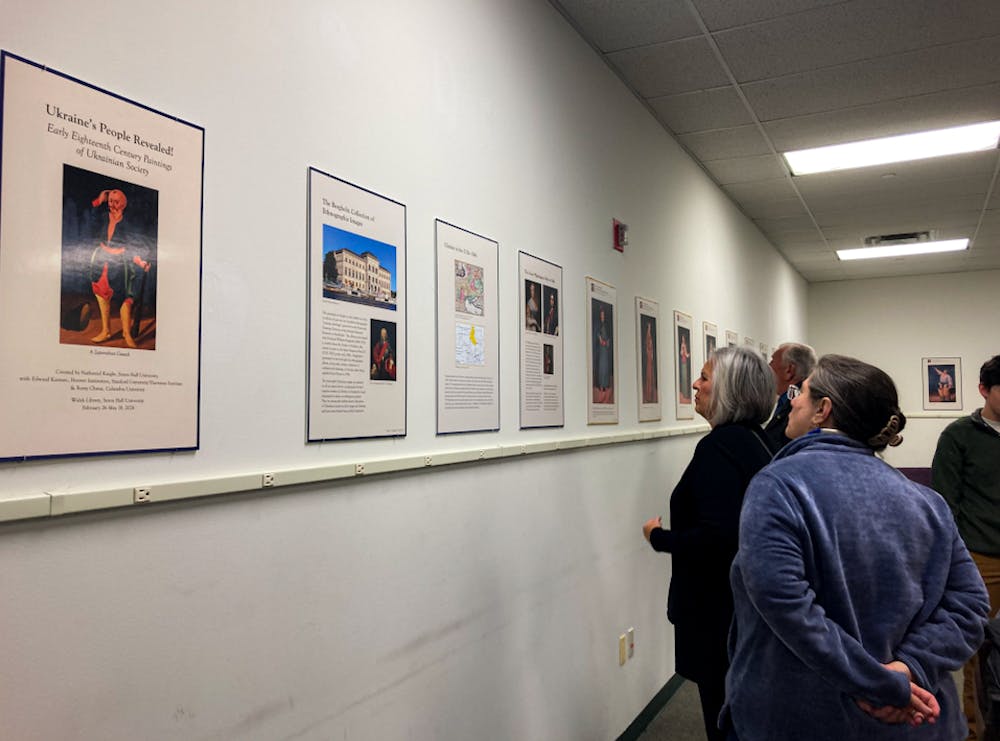
Dr. Nathaniel Knight, a professor of history and director of the Russian and East European Studies Program at Seton Hall, unveiled a new Walsh Gallery exhibit on Wednesday in the silent study room on the first floor of the library.
The exhibit, titled “Ukraine’s People Revealed,” opening drew 23 attendees, nearly filling the room’s 29-seat capacity.
According to a university press release the exhibition is designed to challenge Russian President Vladimir Putin’s claims that Ukraine lacks a distinct national identity. Featuring 26 artworks from the 18th century, the exhibit visually documents Ukrainian society and culture.
In an interview with The Setonian, Knight explained the significance of the collection, which includes what may be the earliest ethnographic images of Ukrainian people.
“The collection shows a broad cross-section of Ukrainian society—not just the wealthy noblemen who might have portraits painted, but women, townspeople of various occupations, peasants and members of other ethnic groups living in Ukraine,” Knight said.
Knight said the paintings were likely created or commissioned by Friedrich Wilhelm Bergholtz, tutor to the Grand Duke Peter, who later ruled briefly as Emperor Peter III of Russia.
“We suspect they are connected to a visit of the Imperial court to Kyiv in 1744,” Knight said. “Among the participants, along with the Grand Duke and his tutors, was Peter’s fiancé, the Princess Sophie Auguste Frederike of Anhalt-Zerbst, the future Catherine the Great of Russia.”
The original paintings, housed in the Swedish National Museum in Stockholm, are too fragile to travel, Knight said. Instead, the exhibit features high-quality photographic reproductions that Knight captured during a visit in 2018.
Knight emphasized the exhibit’s relevance in the context of Russia's ongoing war with Ukraine.
“The collection directly repudiates assertions which have been made by Putin and his supporters with regard to the Ukrainian nation,” Knight said. “Contrary to the assertions that Ukraine did not exist [as] a distinct nation prior to the twentieth century, the paintings show a dynamic and prosperous society whose inhabitants are directly identified as Ukrainians. They also show a distinctive Ukrainian style of costume and appearance.”
Originally consisting of 49 paintings, the exhibit was narrowed to 26 pieces organized into three thematic sections: Ukrainian society from top to bottom, Ukrainians at work, and ethnic diversity in Ukraine.
“We looked for paintings that were illustrated and exemplified in these categories,” Knight said. “Technical issues were also a factor. Not all of the images available were suitable for display due to the quality of the photographs or the original condition of the paintings.”
Knight noted that curating the collection posed challenges, as many of the works were unsigned and lacked formal documentation.
“All we have are handwritten captions in 18th century German script,” he said. “By comparing the handwriting to the captions on a collection of architectural drawings known to have been assembled by the Grand Duke Peter’s tutor, we were able to establish a connection. There is a great deal that we still don’t know…but we have made good progress.”
Knight added that the exhibit strengthens the understanding of Ukrainian identity.
“I always think that having visual images helps to conceptualize the identity of others,” he said. “The exhibit includes iconic images associated with Ukrainian history and culture—the proud nobleman with his cane, the elegant women with their fancy dresses and hats, and the Zaporozhian Cossack with his shaved head and tuft of hair. These and other images tell us something that we could not otherwise know about what it meant to be Ukrainian in that particular time and place.”
Knight said he hopes the exhibit will inspire curiosity, cultural appreciation and academic engagement among students.
“I hope it will spark an interest in Ukraine and Eastern Europe more broadly and highlight the distinctive qualities of Ukrainian culture,” he said.
Ultimately, Knight said the exhibit allows students to better understand the scope of their professors’ work, from collaborating with scholars outside the University to conducting research in archives and museums worldwide and contributing new knowledge to their fields.
The exhibit will be on display for the remainder of the semester.
Victory Odundoyin is a writer for The Setonian’s News section. She can be reached at victory.odundoyin@student.shu.edu.


