
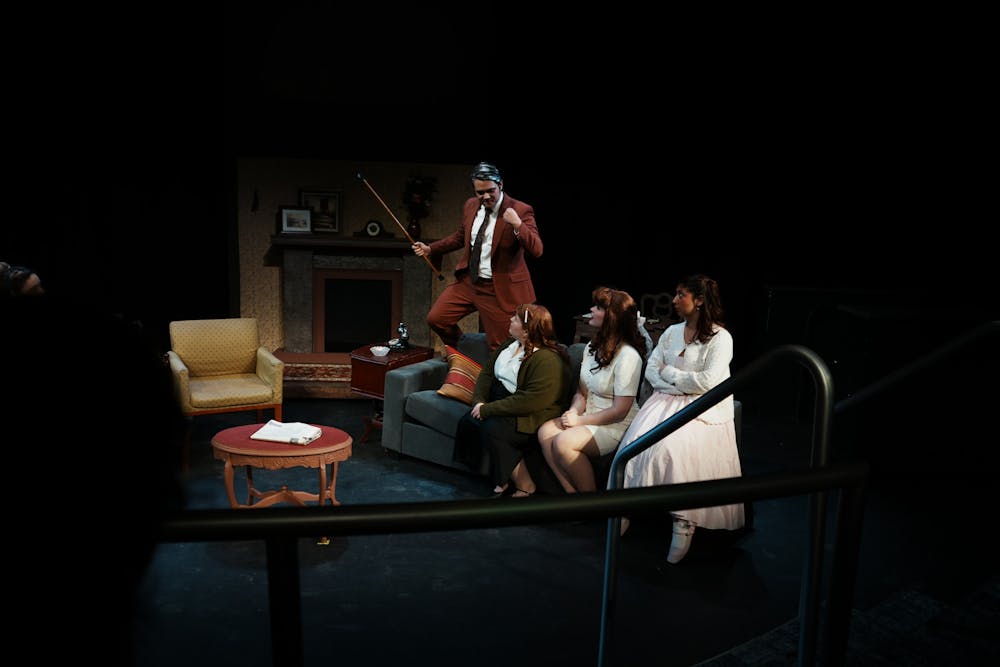
Newspapers typically break the news, but this mainstage play broke the inside story of live theater.
“The Philadelphia Story” follows wealthy Tracy Lord and her family as she prepares for her wedding day amongst the presence of her ex-husband, a reporter, and a photographer prepared to break the story of her father’s affair. Originating from a 1940s romantic comedy film starring Katherine Hepburn, James Stewart and Cary Grant, Seton Hall University Theatre Council (SHUTC) put the headlines under stage lights.
“I think it’s meant to be about class divisions, but what it really ends up being about is, I guess, what it means to be human,” Annabelle Fette reflected, a freshman communication major who portrayed Elizabeth Imbrie, the photographer, in the play.
“Being a human means slipping up. It means making mistakes, and it means recovering from that,” she continued.
“Every single character is a special character, but everyone has their problems; no one is perfect,” agreed Nayla Paula, a senior secondary education and English major, who portrayed Margaret Lord, Tracy’s mother, in the play.
For the past few years, romantic comedies, including “Almost, Maine” and “Months on End,” have taken the winter mainstage.
“It has shown kind of how SHU Theatre is maturing and how we are becoming a department that really prioritizes love and comedy,” Paula said.
This year, the winter mainstage production was directed by Jasmine Gomez, a senior theatre major, for her senior thesis project. Gomez worked closely with Brendan Blaesser, a sophomore neuroscience major and the show’s stage manager, to produce the play.
“We collaborated on a lot of creative ideas to make this story really come to life based on what her vision was,” Blaesser said.
This included adding an homage to the play's movie origins with film-style introduction credits before the show began. Black and white shots of all the characters were projected onto the curtain with the names of the character and their actors.
“Our black box theater is kind of small, so we’ve kept it very minimal [and] simplistic, while also trying to replicate the same ambiance that I feel like the film has,” Paula said.
To accommodate the smaller space and fast-paced play format, Gomez came up with the idea of creating a two-sided turning wall to be the backdrop for the entire show.
Michael Makar, a freshman psychology and speech-language pathology major and part of the play’s backstage crew, commented on the set design.
“There [were] basically two primary sets; it was the home and the outside garden area,” Makar said.
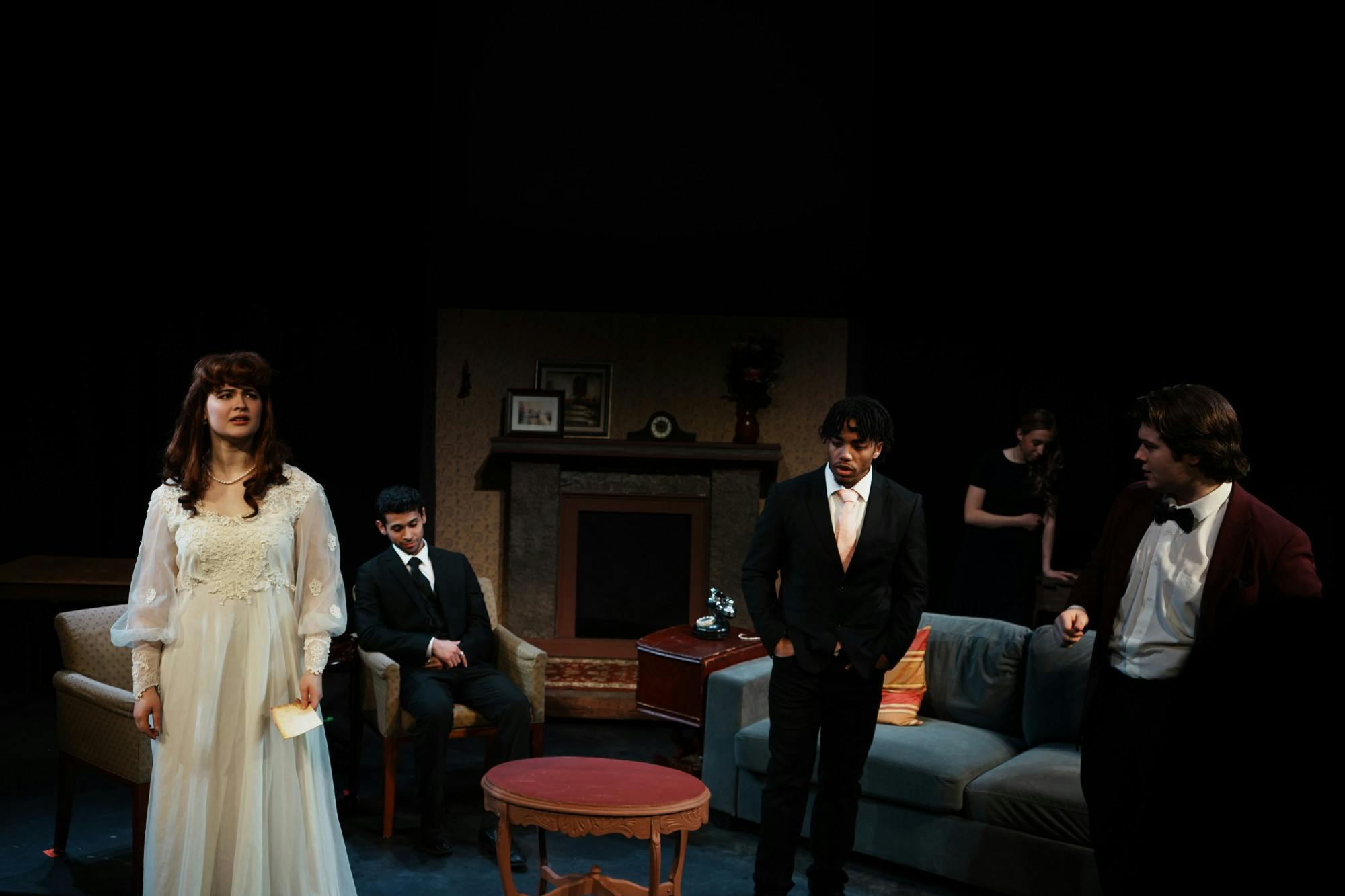
SHU Theatre Council performing 'A Philadelphia Story' on opening night | Photo by Rickiya Coulton | The Setonian
Additionally, Paula said Gomez had thrifted clothes that looked like they were from the 1930s or 1940s and researched different hairstyles from that time period to make her vision come to life.
According to Blaesser, Gomez was also responsible for the lighting and sound design.
“For the kiss scene that we did, we added a special light to track them during the whole scene so that they were specifically illuminated during that scene,” Blaesser said.
They also used a base blue light for the show to create a romantic atmosphere.
In terms of rehearsals, both Gomez and Blaesser worked collaboratively with the actors. On average, rehearsals for specific scenes lasted between two and three hours and ran about five days a week; however, the team only had a month and a half of rehearsals before tech week to produce a one hundred and twenty page script.
During rehearsals, according to Fette, Blaesser was “the ultimate understudy,” as he stood in for any missing actors, and Gomez gave suggestions to the actors on their performances and blocking.
“[Gomez] was the one controlling the actors [and] controlling how the set looked,” Blaesser said. “My job [was] mostly the technical side of things, [and it] was to coordinate all that during the show.”
Despite all their best planning, some things simply could not be accounted for.
“The spike tape did not come up just once, but twice,” Makar said.
Spike tape is used to mark where certain props and set pieces should be located during the show.
On Tuesday, during tech week and before the Saturday performance, the tape was mysteriously pulled off the ground.
Additionally, before the Saturday performance, there were issues with the lighting board.
“So technically we had a few malfunctions,” Makar said. “We brought it together, though, before 8 o’clock, which is what mattered.”
The most impactful setback for the crew was when the couch, an integral set piece that the actors often interact with, broke.
“The Sunday before we started [tech week], the couch broke, initially,” Blaesser said.
Makar added that “one leg folded in on itself.”
They were able to find a replacement, and during the weekly SHU theatre shop on Friday, they fixed the couch—or so they thought. That same night, as crew members were setting the couch down during one of the scene transitions during the performance, the leg snapped off again. The crew and cast were able to adjust quickly, and they brought out the replacement couch, with which they finished the show
The cast and crew found light with their quick thinking, with actor Darius Gajano, who played Seth Lord, even commenting in character: “And what happened to the couch?”
“When you rehearse this so much, you develop a trust in your crew that you know that if something does happen, they will be able to handle it, and they did,” Blaesser said.
This example of the cast and crew’s improvisation and collaboration emphasizes one of SHUTC’s best qualities: its interconnectedness.
“If you’re a part of SHUTC, you’re global,” Paula said. “We do it all. It doesn’t matter what you’re doing or what role you’re in, you are going to be doing anything.”
Another aspect of SHUTC that Makar finds to be a “blessing” is teamwork.
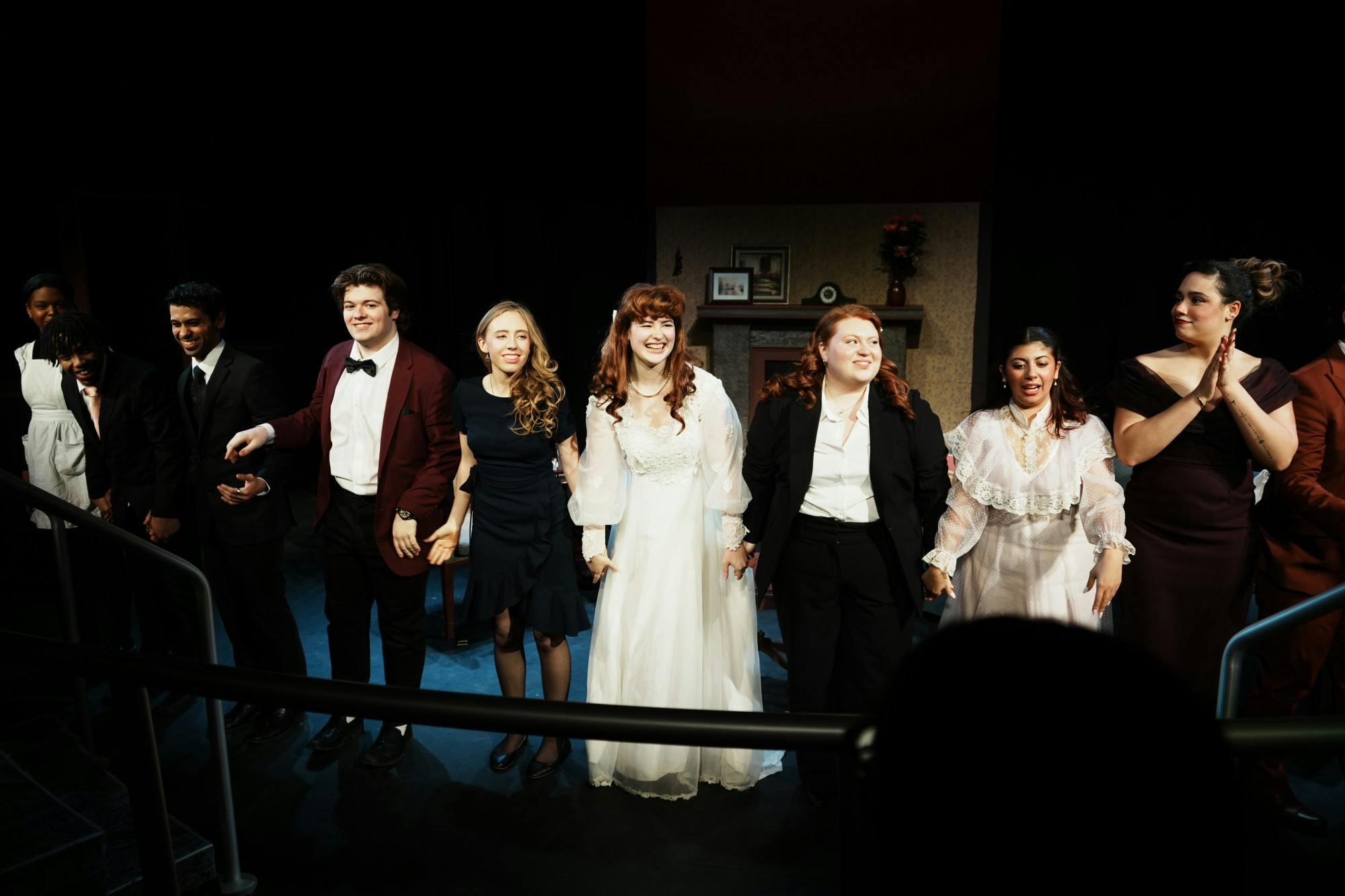
SHU Theatre Council closing 'A Philadelphia Story' on opening night | Photo by Rickiya Coulton | The Setonian
“Everyone is so willing to work together as a group rather than individually,” Makar said. “Being able to work together is so much better than individually.”
Blaesser also feels a sense of synergy amongst the group.
“All of us are kind of interconnected,” Blaesser said. “I think that’s the best part of our Theatre Council here.”
The cast leaned on this interconnectedness after the unexpected cancellation of their final show, which was set to perform on Sunday at 2 p.m. With the impending winter storm and University parking restrictions, the Council could not, in good conscience, ask the performers, crew, or audience to safely travel to the show, as reported on their Instagram.
They gave their all despite the early ending and focused instead on community new beginnings.
The SHUTC is made up of students from different grades, majors and walks of life. As freshmen, Makar and Fette were both new to the SHUTC this year.
“Even though it’s definitely nerve-wracking to join a new company and to want to make the best impression that you can... it’s a community of acceptance,” Fette said.
Makar agreed, saying the community is "welcoming and very kind.”
“We support each other,” Makar added.
As a seasoned SHU Theatre member, Paula said, “When you come in, it’s easy to assimilate yourself with us. It’s easy to become a part of us and blend in with all of us.”
“Combining the newer people and the older people is so great because it shows what SHUTC has been and what it’s going to become,” Paula added.
Fette recounted standing with the rest of the cast and crew before each show and chanting one of SHUTC’s traditional circle warm-ups, which is recited as follows: “Whether the weather be cold or whether the weather be hot, we’ll be together whatever the weather, whether we like it or not.” This shared experience made Fette feel even more included and welcomed within the SHUTC, which Paula described as being her family.
“Everything has been such an amazing experience,” Paula said. “I recommend fully being a part of SHUTC.”
“Just do theatre,” Blaesser said. “If you never do it, you can never say you liked it.”
Annabelle Fette, who was interviewed for this article, is a writer for The Setonian.
Carly Hunter is a writer for The Setonian’s Features section. She can be reached at carly.hunter@student.shu.edu.


