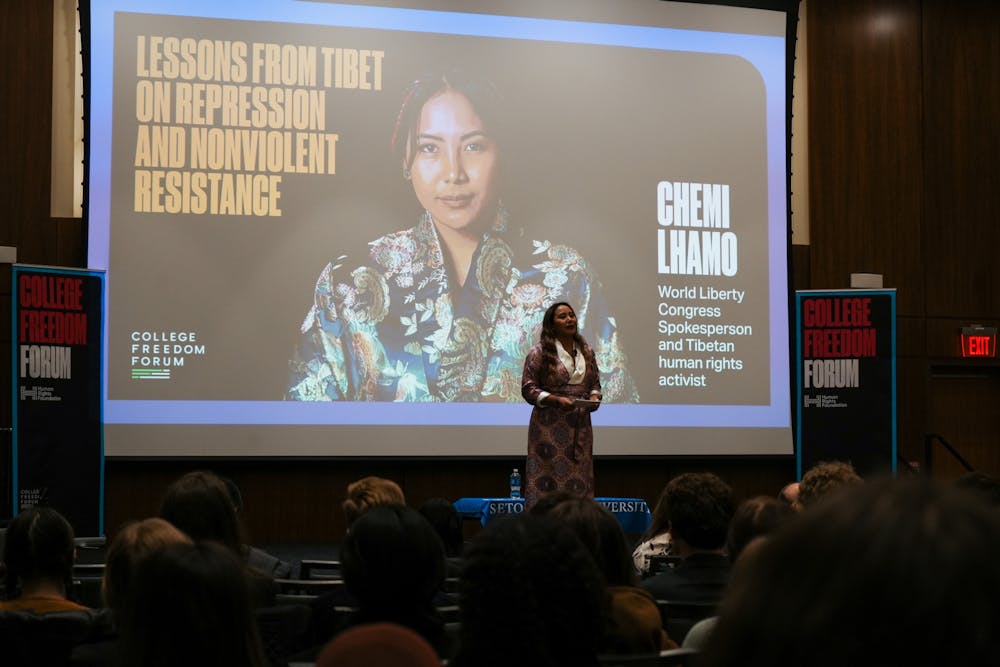
The School of Diplomacy and International Relations hosted the College Freedom Forum, presented by the Human Rights Foundation (HRF), on Feb. 20, gathering students and faculty to explore global human rights issues and hear from Tibetan activist Chemi Lhamo, who shared her journey of exile, resistance and community-driven activism.
Lhamo is a representative of the International Tibet Network’s steering committee and a spokesperson for the World Liberty Congress. She was recognized on MacLean’s Top 50 Power List of 2022.
At the Forum, Lhamo described growing up in exile, constantly being told she did not belong, and experiencing being othered in nearly every space she entered. She highlighted the challenges that Tibetans face worldwide and emphasized that the key to the Tibetan movement’s resilience is the power of community. Despite their relatively small population, the Tibetan diaspora comes together every five years to vote for leaders of their government in exile, with voluntary voter turnout rates surpassing those of many established democratic nations, Lhamo said.
Lhamo has also served on the boards of the Canadian Tibetan Association of Ontario and Students for a Free Tibet Canada. She strongly believes in the power of nonviolent movements and advocates against authoritarian and colonial powers that rely on surveillance and censorship, she said.
Though born stateless and part of three generations raised in exile, Lhamo explained that her political identity has shaped every aspect of her life and fueled her deep involvement in community activism.
Her advocacy journey has not been without challenges. While running for student union president at the University of Toronto Scarborough, Lhamo faced significant backlash.
She recalled a petition circulated by an international Chinese student that labeled her as a “separatist” and a “terrorist” on baseless claims and gathered approximately 10,000 signatures, surpassing the number of voters in the election.
Lhamo received death and rape threats, some traced to real students on campus, while others were from bots. One message said there was “a bullet already made for her.” Initially dismissed by campus administration, the situation gained international media attention and became part of Canadian government investigations into alleged transnational repression by the Chinese government.
Despite these threats, Lhamo found peace and clarity in recognizing that the attacks were not truly about her personally, but about what she represented: Tibetan identity, culture and resistance.
She used the attention she gained to further amplify awareness of the Tibetan cause.
When discussing the role of education, Lhamo emphasized that young people are the driving force behind global change.
She reflected on her involvement with Students for a Free Tibet from the age of 13, and her move to New York to work on nonviolent strategic campaigns challenging authoritarian governments. Lhamo stressed that meaningful change is possible when young people understand the agendas of oppressive regimes and recognize their role in making change.
Lhamo’s slogan, “existence is resistance”, captures this philosophy. She explained that by continuing to exist with resilience, Tibetans challenge colonial powers.
“It’s about raising the cost of occupation,” Lhamo said. “Oppressive governments seek silence.”
Lhamo said that it is the responsibility of students and young people to carry that weight with resilience and courage.
She also highlighted the cultural risks facing Tibetan youth, noting that approximately 80% of Tibetan children are placed in state-run reform boarding schools, raising concerns about cultural erasure and the loss of language and identity. Rather than discouraging her, she said this reality reinforces her commitment to education and awareness, not only for Tibetans, but for young people worldwide.
Lhamo cited student-led movements as a personal inspiration, sharing how witnessing young people organizing, even under internet shutdowns in places like Nepal, demonstrates the collective power of youth.
“We are all gonna get freedom when we all believe in the right to be free for everyone, including yourselves,” Lhamo said, emphasizing unity and connectedness in the fight for global human rights.
As Lhamo continues her advocacy, her words encouraged students to become active agents of change in the global fight for justice, peace and human rights.
Nihma Abdallah is a writer for The Setonian’s News section. She can be reached at nihma.abdallah@student.shu.edu.