
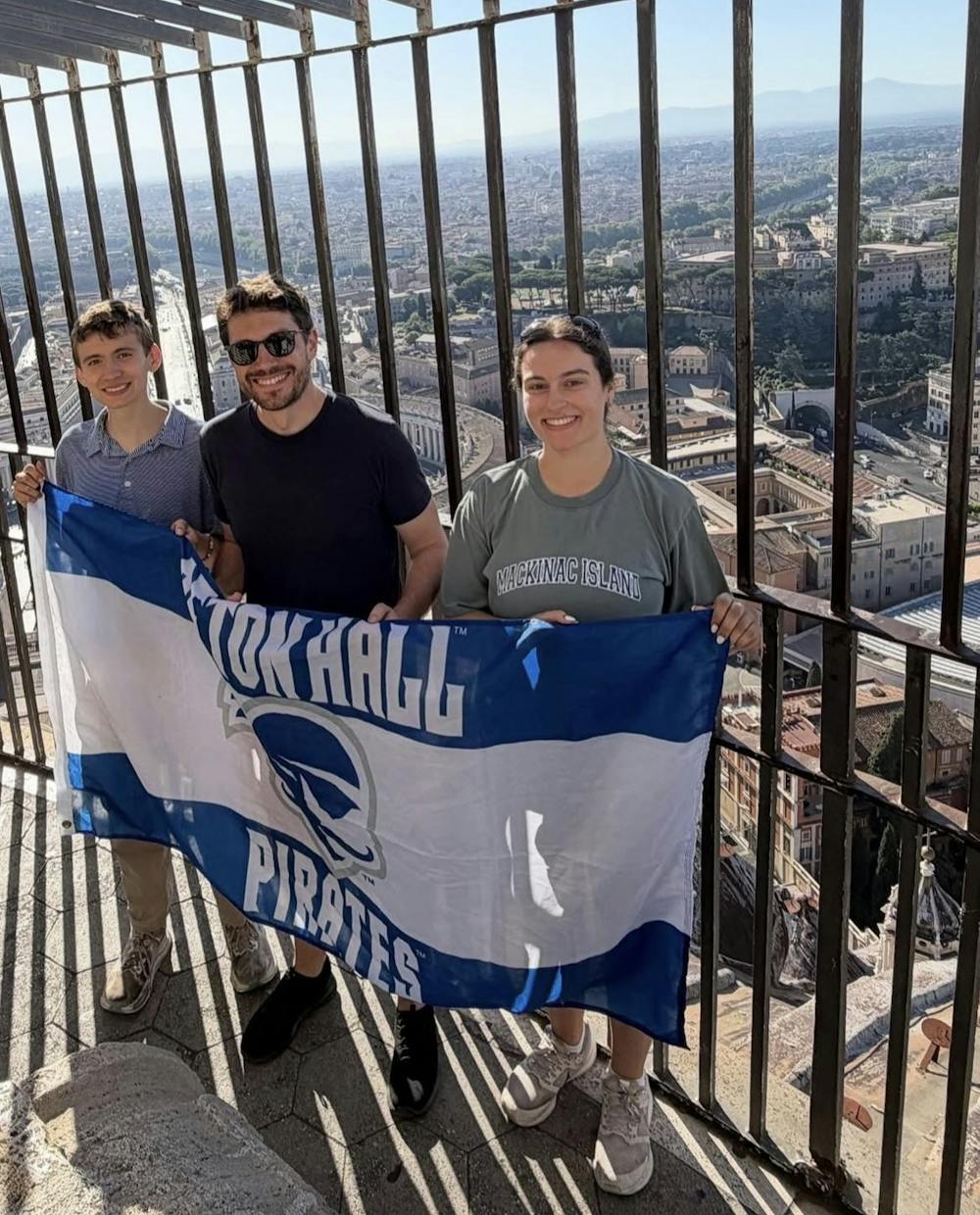
A brand-new city. A first trip outside the country. A chance to experience the world beyond Seton Hall’s campus. For students who want to study abroad, these once-in-a-lifetime experiences are within reach.
For Taylor Boyd, a sophomore anthropology major, who studied in Rome, one moment perfectly captured just how connected the world feels. While dining at a restaurant in Italy, she spotted a Rutgers University T-shirt displayed on the wall.
“Even though the world is far apart, it's still connected,” Boyd said. “It’s not a dream that I’m in Rome.”
That sense of connection was just one of the lessons Boyd took from her time abroad. For other SHU students, studying abroad offered an opportunity to encounter unfamiliar cultures, form unexpected connections and discover new perspectives.
Whether through conversations with locals, exploring historic landmarks or simply learning to navigate a new environment, students found that the experience extended far beyond the classroom.
Studying abroad gives students the opportunity to experience places beyond the familiar surroundings of South Orange.
Boyd said her experience changed her awareness “in every sense of the word.” She learned “what it means to be human, not in one country, but anywhere.”
During the program, Boyd noticed differences in how people communicate across cultures, noting that those speaking their native languages were much more animated.
Boyd described “the art of language” as beautiful and said she loves being able to speak both English and Spanish.
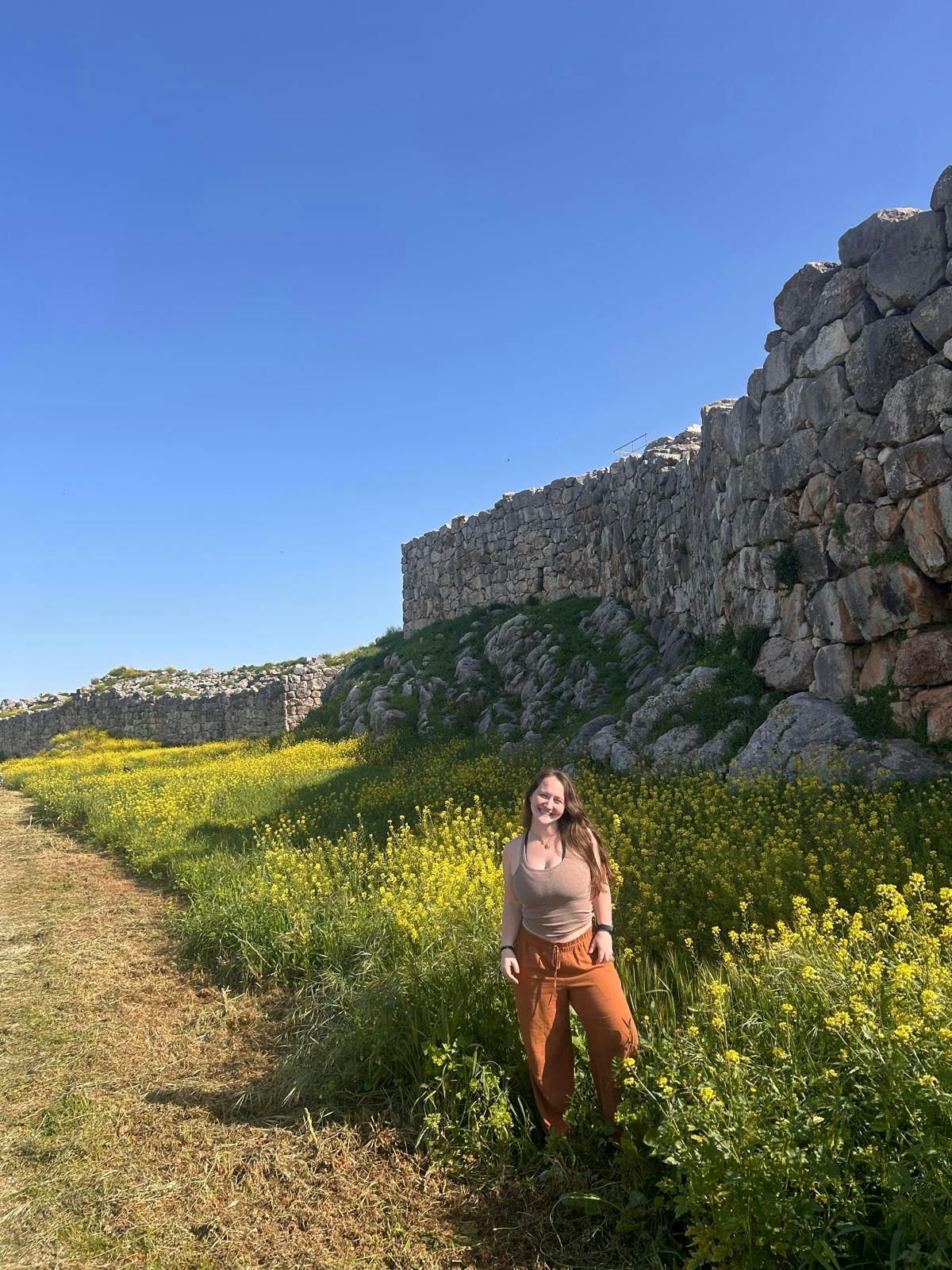
Chloee Lynch, a senior international relations and diplomacy major, also found that experiencing different places firsthand challenged her perspective. During her study abroad experience in Greece, she visited Delphi, Crete and Mount Olympus, among many other places.
"One city is only one window, not the country as a whole,” Lynch said.
Joseph Harrison, a sophomore creative writing and theology major, was drawn to Rome for a similar reason. He said he was tired of living in “a city that's a bunch of glass rectangles.”
“I wanted depth–it feels older, grander and has more personality into it,” Harrison said. “The old cobblestone path is annoying to walk on but also fun at the same time.”
Harrison still remembers the first time he entered St. Peter’s Basilica.
“I still get chills, and the only way I can describe it is like I was walking into a dream,” he said. “Walki
ng into it, you feel so small. You feel like an ant. The shape of it felt like a mother gathering her children, the entire world is being embraced.”
The experience prompted Harrison to reflect on his faith and his understanding of life.
“It felt surreal. I can’t describe it in words,” he said. “Yes, this is the meaning of life. This is it. This is the beautiful love of God, for all humanity. It gave me a greater appreciation [of] the gift of life from God.”
For Jessica Hoffman, a junior English major who studied in Rome through a travel writing program, experiencing the city in person was especially meaningful.
“Seeing the city for the first time, the Tiber River , the San Angelo castle, walking over the bridge and seeing Italy for what it is, and not just an image in my mind, but just being there,” Hoffman said. “It was really special.”
Although visiting historic landmarks and exploring new cities are major parts of studying abroad, students often remember the people they meet just as vividly.
For Boyd, one of the highlights of her time in Rome was a beach trip to Ostia with her friends.
“It was the perfect blend of all my passions,” Boyd said. “The cross of archeology and the history of the
land I was standing on mixed with hanging out with my friends and being able to be 18 and chill.”

Lynch similarly found that the people she met helped define her experience. She recalled watching the sunset at a necropolis with two other SHU students and friends who lived in Greece.
“Seeing sites is amazing but what sticks is the people you connect with and how they make you feel,” she said.
During her time in Rome through the Rome Connection program, Lynch also helped water historic trees and unexpectedly found a sense of belonging in the local community.
“I didn’t expect to be accepted right away. It was a feeling I didn’t expect to have while randomly studying abroad for two weeks,” Lynch said.
She particularly enjoyed “finding the pockets of community that feel like home while abroad.”
Some meaningful connections even formed across language barriers. For Zahir Mooring, a senior mathematics major and student worker in the study abroad office, a basketball game with Roman locals became one of his favorite memories, combining his lifelong passion for the sport with the opportunity to connect across cultures.
“[It was] a fun experience, and even though there was a language barrier, we were still able to share our love for that sport,” Mooring said.
Along with new friendships, studying abroad gave students the opportunity to learn more about themselves.
For Boyd, that growth became visible in her everyday habits. Before the trip, she rarely made her bed. Now, it’s a habit she “can’t go without doing.”
She also learned to appreciate her mornings more. Rather than waking up five minutes before class, as she had during her freshman year, she often got up an hour and a half early to grab a muffin and coffee.
“I was able to be comfortable in my own skin rather than just surviving,” Boyd said.
This shift allowed Boyd to be more present and reflect on her experiences.
“It’s not something in my notes app that I want to study abroad,” Boyd said. “I’m actually doing it.”
Hoffman experienced a similar shift in confidence. While abroad, she discovered a sense of bravery that she had not previously recognized in herself.
“People told me I was brave, and I never noticed that about myself. It helped me to not be afraid and speak up, and to take control of the situation if I needed to,” Hoffman said.
She also appreciated the opportunity to slow down and become more present in her surroundings.
She got to “breathe and take things in.”
There were so many moments to sit with my thoughts, and to enjoy the moment while I was in it,” Hoffman said.
For Lynch, navigating unfamiliar environments helped build confidence in both her personal life and her academic interests. As an international relations and diplomacy major, she recognized the importance of becoming comfortable in different countries and cultural settings.
“As a diplomacy student you need to be comfortable abroad, and more confident in your field of study,” Lynch said.
She said there is very little she feels she couldn’t handle now.
“If I can handle that, I can handle a bad grade on a test,” Lynch said.
Harrison’s experience in Rome also influenced how he viewed himself and his studies. As a creative writing major, he said the trip inspired him “to write stories about the human experience that shows both the beauty and joy, but also the pain and suffering.”
His reflections on the experiences people share across cultures became another part of what he carried home.
“We have to realize this world is way bigger than ourselves and our little community,” Harrison said.
“We all have dignity, we all have a story, we all share in suffering and sorrow, and desire for community, and hunger for love,” Harrison continued. “An unfathomable love that moves the sun and stars, and moves the world, and a love that everyone deserves.”
For many students, the impact of studying abroad continues after the trip ends.
After participating in Rome Connection, Boyd decided to spend her fall semester in Santiago, Chile.
“If you can do it, do it! It broadens your perspective on life and the US as a whole,” she said. “You get to know news and opinions from outside of the country.”
Lynch also chose to pursue another international experience, deciding to spend a semester in Germany after her time in Rome.
While abroad, Lynch has been learning German, strengthening her skills through classes that emphasize conversation.
“The teachers are extremely good,” Lynch said. “It’s very personalized. The classes are a lot more dialogue based, and there’s not a lot of lectures.”
For Lynch, studying abroad was a starting point for personal growth, rather than an experience that ended when she returned home.
“Study abroad is the launch pad,” she said. “You build on top of it. You can carve your own path, and everything is what you make of it. Take a chance, things are going to go bad. It’s more fun that way. It teaches you a lot.”
While students describe the personal impact of studying abroad, SHU’s programs offer opportunities for students to experience cultures and communities around the world.
Doug Cantelmo, director of study abroad and global engagement, provided insight into the university’s expanding selection of programs.
According to Cantelmo, SHU students have access to 57 campuses across six continents.
“Seton Hall is the fastest growing study abroad program in New Jersey,” Cantelmo said.
The most popular destinations include Italy, Spain, France, England, Japan, Mexico and Ireland.
“The average cost for a semester abroad is [$2,900] which is cheaper than domestic campus housing. There are also generous scholarships for students given by alumni and donors,” Cantelmo said.
When Cantelmo first arrived at SHU, students applied through paper forms and the program did not have a dedicated website. He said simplifying the application process helped make studying abroad more accessible and supported the program’s growth.
“Doug [Cantelmo] has made each program so accessible for every student,” Mooring said.
Nearly 30% of SHU students will study abroad before graduation, according to data provided by the Office of International Programs.
For Mooring, helping students find the right opportunity begins with identifying their interests. His advice is to “translate your passion” when choosing a program.
For students interested in studying abroad, Lucy Balaam, a sophomore public relations major and student worker in the Office of International Programs, recommends visiting the office on the main floor of Jubilee Hall.
“There is a program that you can do and will work for your classes, financially and with your personal interests,” Balaam said. “Students think they can't because of this and that. The reality is that we’ve worked hard to make sure there is a place, and everyone has the opportunity to fulfill an experience for studying abroad. We will figure it out with you.”
Cantelmo also encouraged students to take advantage of the opportunity while they are in college.
“Don’t push it off,” Cantelmo said. “Students keep telling themselves that they’ll get to it eventually, and do it next year, but don’t let it be a regret. Don’t put it off. Seize the moment.”
Mooring echoed that sentiment.
"Don't underestimate the impact it will have on you,” he said. “I have made connections that changed my perspective on the world itself and experienced things that have opened me up and made me a better person.”
SHU’s expanding study abroad programs aim to give all students the opportunity of a lifetime.
Whether you want to go for the fun of being on a trip, or want to immerse yourself in the culture, there is something for everyone. So, will you seize the moment?
Safa Hashmi is a writer for The Setonian’s Features section. She can be reached at safa.hashmi@student.shu.edu.


