
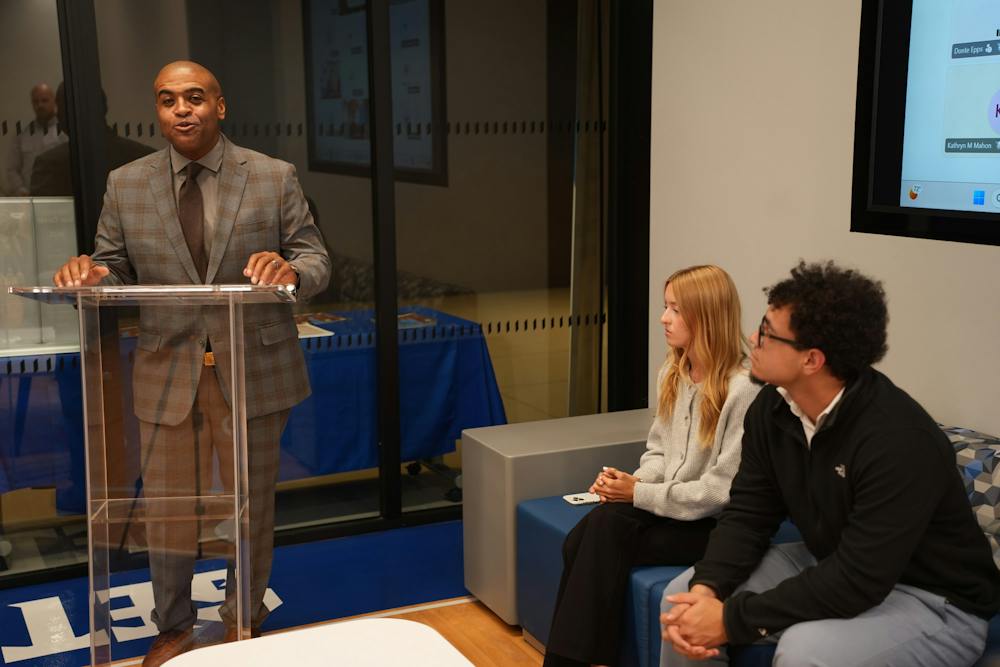
Seton Hall hosted former New York Police Department Lt. Darrin Porcher on Oct. 8 for a discussion on the pressures impacting law enforcement leaders as public expectations evolve in an era of constant news coverage and social media. The event, “When the World is Watching: A Media Strategy for the Law Enforcement Voice,” took place at SHU’s Welcome Center at the Gateway Center in Newark.
The College of Human Development, Culture, and Media welcomed Porcher to discuss strategies for communicating effectively during high-profile cases. SHU’s Law Enforcement Executive Leadership (LEEL) program offers a crisis communications course, and Thursday's event expanded upon coursework and allowed students to learn from someone with experience maintaining public trust while navigating high-profile cases.
Kishon Hickman, program director of LEEL, opened the event alongside senior criminal justice majors and co-presidents of SHU’s Criminal Justice Club James Estevez and Sarah Dickson.
Estevez said Hickman asked students to open the event “because a night about how these leaders talk to the public should start with the people who are going to be doing that next.”
Estevez and Dickson said they appreciated the opportunity to learn from Porcher, who has provided analysis on criminal cases for CNN, Fox News, Court TV and other major news outlets.
Reflecting on the event, Estevez said he wanted to understand how law enforcement leaders respond to high-profile cases, specifically when investigations are ongoing and the public demands answers.
“When something big happens, and the facts are still coming in, how does a police department tell the public the truth without saying something that turns out to be wrong?” Estevez said. “I never understood…tonight we get to ask somebody who actually knows.”
Dickson added that criminal justice students may not receive enough preparation for communicating with the public, even though public relations are an important part of responding to high-profile cases.
“The part of this job no one teaches you is the talking. We learn law, we learn procedure, we learn support,” Dickson said. “Nobody sits you down and says, here’s what you say when a city is angry and you don’t have all the answers yet.”
Porcher began the event by reflecting on his journey to the NYPD, pointing to the violence he witnessed growing up as sparking his interest in law enforcement.
“Violence was something that was like the natural order,” Porcher said. “People were getting shot, people were getting stabbed, it was the natural order of business when I was in high school.”
Porcher enlisted in the military in 1986. The experience, he said, broadened his perspective because he connected with and began to understand individuals who had different values than him.
“I realized that we’re an extremely diverse population,” Porcher said. “We come from all different walks of life. That being said, policing is the foundational blueprint on how we uphold the social contract.”
Porcher said his upbringing and military’s chain of command influenced his interest in policing. He credited the discipline he learned from both experiences with preparing him for a career in law enforcement.
“I got the sense to really develop values at that point,” Porcher said. “There were two things I wanted to do. I wanted to become a police officer. I said, I have the discipline now that makes me capable of committing to this line of work.”
While Porcher was drawn to policing, he said he hesitated to pursue the field because of its lack of diversity in 1986. Porcher began exploring journalism, inspired by investigative programs like CBS’s “60 Minutes."
“I got a job at the United Nations,” Porcher said. “ I thought, this is gonna help me in facilitating my pathway to becoming both a police officer and a reporter working in the news.”
Porcher was sworn into the NYPD in April 1991 and served for 20 years, eventually leaving the department in 2011 to pursue his doctoral degree.
Reflecting on the intersection of law enforcement and the media, Porcher said the two sectors work together to keep the public informed.
“The media presents a tremendous partnership with the police to inform the public about what is happening in society,” Porcher said. “If we didn’t have a media or a free press, you wouldn’t know that there was a mass shooting that happened in Las Vegas.”
However, Porcher added that law enforcement officials may be reluctant to trust the media to appropriately and effectively communicate information on high-profile cases. He said sensationalized coverage can decrease public trust in police.
“It is a slippery slope. Police departments have become unwilling to give up common information,” Porcher said. “It’s easier for the police to not put the information out there. But I’m a supporter of putting the information out there to get people to justice.”
Michela DiLorenzo is the Head Editor of The Setonian’s News section. She can be reached at michela.dilorenzo@student.shu.edu.


