
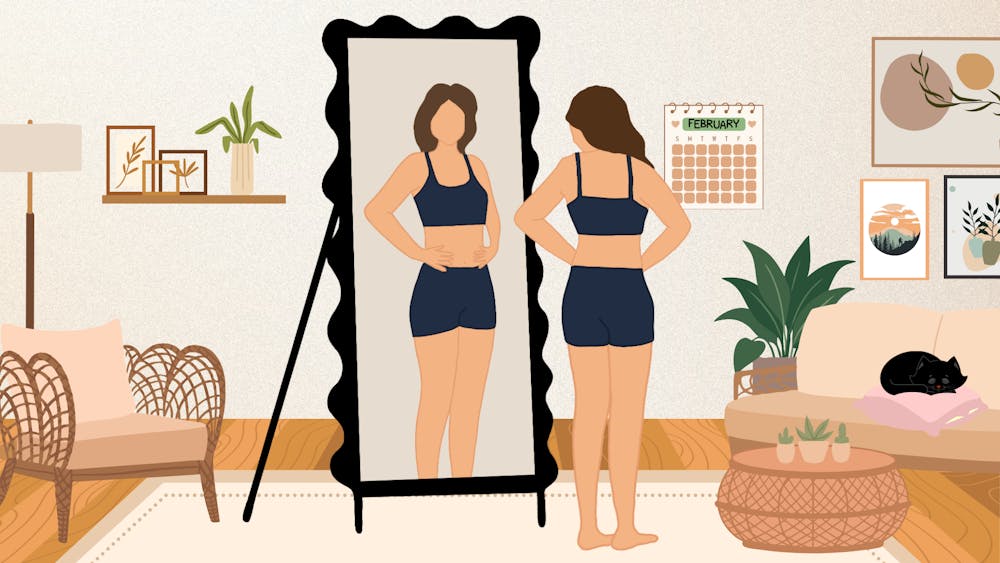
Social media has changed the way we talk about food, bodies, and health. On TikTok and Instagram, trends like “girl dinner” and “what I eat in a day” videos turn eating into performance and discipline into identity.
They are framed as harmless, even empowering, but beneath the pastel filters and soft-spoken voiceovers lies a familiar message: eat less, control more, take up less space.
Disordered eating is no longer hidden from us. It is curated, filtered, and algorithmically rewarded.
These pressures are real and measurable.
A study of University of Rhode Island students found that 50% reported changing what they eat because of social media, and 48% felt judged for their food choices because of social media—evidence that these trends can shape both diet and self-image long before young people have the tools to navigate them.
Research also suggests that exposure to weight‑loss and body‑focused social media content is linked to increased body dissatisfaction and disordered eating habits, meaning that it isn’t just time online that matters.
It's the content we’re fed.
For a generation raised online, the line between wellness and disordered eating has never been blurrier. I know because I’ve lived on both sides of it.
I can say, in all honesty, that my 11-year journey with disordered eating has been the most isolating experience of my life. And that is not the fault of my loved ones. Eating disorders are not discussed—not openly—and silence is easier to maintain when harmful behaviors are normalized online.
I was first told that I needed to lose weight when I was 10 years old by my pediatrician. I became aware of my body that day, sitting on that crinkled wax paper, listening to my 60-year-old male doctor explain my new diet and exercise regimen to my mother. I have hyper-fixated on food, exercise, and my appearance every day since.
A scale stole my childhood.
I abandoned Barbie dolls for the Wii Fit. I cried when my parents tried to feed me spaghetti and meatballs for dinner. I hid in my bedroom, watching advanced workout videos on YouTube while my family watched movies together down the hall. I started fights with my loved ones because I was exhausted and malnourished.
By middle school, my social media feed had become a mirror for my fears.
Workout routines, clean-eating accounts and transformation videos flooded my screen, turning comparison into a daily ritual. Every scroll was a reminder of what I “should” be doing, eating, and looking like.
In my lowest moments, I became consumed with “wellness” influencers, letting their videos and their routines dictate my choices. Their validation felt essential, as if my choices weren’t legitimate unless they deemed them acceptable. These strangers, with curated feeds and perfectly edited bodies, became the ultimate arbiters of what was “healthy” and “right.” Their influence shaped not only what I ate, but how I measured my self-worth.
Social media didn’t just show me ideals; it dictated them. Algorithms amplified content that glorified restriction and perfection, turning every meal, every bite, into a well-orchestrated performance.
The praise grew as my body shrank, and I became addicted to the recognition. I was twelve, and all I cared about was whether anyone noticed my abs coming in.
One day at field hockey practice, my coach pulled me aside.“You’ve lost a lot of weight, very quickly,” she said. “Are you okay?’
That was probably the happiest moment of my middle school years.
I was utterly obsessed.
I went vegan, cooked my own dinners and was inconsolable if I consumed even one gram of added sugar. Online, I found endless validation for these behaviors: workout routines, clean-eating accounts, and transformation videos that framed this type of restriction as success.
Nobody in my life understood what I was going through then, and I didn’t expect them to; I didn’t even understand it myself. I only knew that food felt dangerous and control felt safer.
The pendulum swung in high school. I fell to the other end of the spectrum, eating compulsively and gaining weight quickly. My body changed faster than my sense of self could keep up with. None of my clothes fit. I felt freedom in being able to eat whatever I wanted, but I was still deeply uncomfortable in my own skin.
People noticed my body then, too, but in a different way.
On my senior trip to Disney World, my teacher came up to me and advised me to wear pants to Magic Kingdom rather than shorts, despite the fact that it was 75 degrees outside.
“We big girls have to stick together,” she said.
I felt 10 years old again, aware of every inch of my body and all the ways it seemed to take up too much space.
Online, the contrast was impossible to ignore. My feed still worshipped shrinking bodies, highlighting the exact image I no longer fit. The praise I craved felt out of reach, and comparison became constant.
Those feelings linger. They trail behind you into fitting rooms, into dining halls, into mirrors and meal plans, settling into your habits and thoughts. Sometimes, it seems like they’re unshakable.
I’d like to say I have fully outgrown my harmful patterns. But that’s the part of eating disorders that social media rarely shows: they don’t end. Recovery is not a finish line. For many people, disordered eating isn’t something you beat once. It is a daily concern, a lifelong management, a quiet battle that unfolds at every meal.
I’ve come a long way, and I am so proud of that. I don’t cry over cupcakes anymore. I can visit friends without packing my own meals. I can eat without needing to justify it.
Yet, I still feel a flicker of panic when my jeans feel tighter or when my face looks softer in photos. Each post, each video, each curated “healthy” plate reminds me that the world values restriction and thinness above comfort, nourishment, or self-acceptance. It takes all of my strength to resist slipping backward, and every day proves that healing is not a performance, but a quiet, unglamorous act of survival.
Recovery, I learned, does not fit into 30-second videos. It is slow, uncomfortable, and deeply unphotogenic. My arms and legs are lined with faded purple stretch marks, a map of the obsession, pain, and endurance that no trending video could ever capture. Scroll past a “what I eat in a day” clip or a “girl dinner” post, and you’ll never see the moments in between: the panic at a full plate, the endless mirror checks, and the silent victories no one applauds. Healing is messy, uncurated, and completely invisible to an algorithm that only rewards perfection.
Eating disorders thrive in silence and shame, but they are also amplified by cultures that glorify thinness and restriction. They are fed by “wellness” trends, by doctors who prescribe weight loss to children with a few extra pounds of baby fat and by well-meaning family members who remind you that you’ll have to fit into a bikini by summer.
Today, social media and wellness culture emphasize restriction more than ever. Some apps track every calorie. TikTok videos celebrate “girl dinner” as a curated collection of tiny, controlled snacks. “What I eat in a day” videos flood YouTube, turning nourishment into performance. Social media does not create eating disorders, it gives them a stage, an audience, and an algorithm that knows exactly how to feed insecurity.
And the stakes are real. Eating disorders have the second-highest mortality rate of any psychiatric illness, after opioid addiction, and claim a life every 52 minutes. This is a stark reminder that recovery is a matter of survival.
If we truly care about prevention and recovery, the conversation must be sustained, uncomfortable, and structural. It must include conversations about how we talk to children about food, how doctors frame health, and how social media platforms reward thinness. It must include holding industries accountable, from diet culture to fitness marketing to influencer economies built on selling insecurity.
Most of all, it must include listening.
Because behind every trending video is a child learning to hate their body. Behind every calorie counter is a teenager crying in their bedroom, bargaining with hunger. Behind every statistic is a person trying to survive a war inside their own mind.
Change begins when no child leaves a doctor’s office believing their body is a problem to be solved and when we demand a culture rooted in care, nourishment, and self-acceptance rather than perfection.
Megan Pitt is the head editor of The Setonian’s News section. She can be reached at megan.pitt@student.shu.edu.


