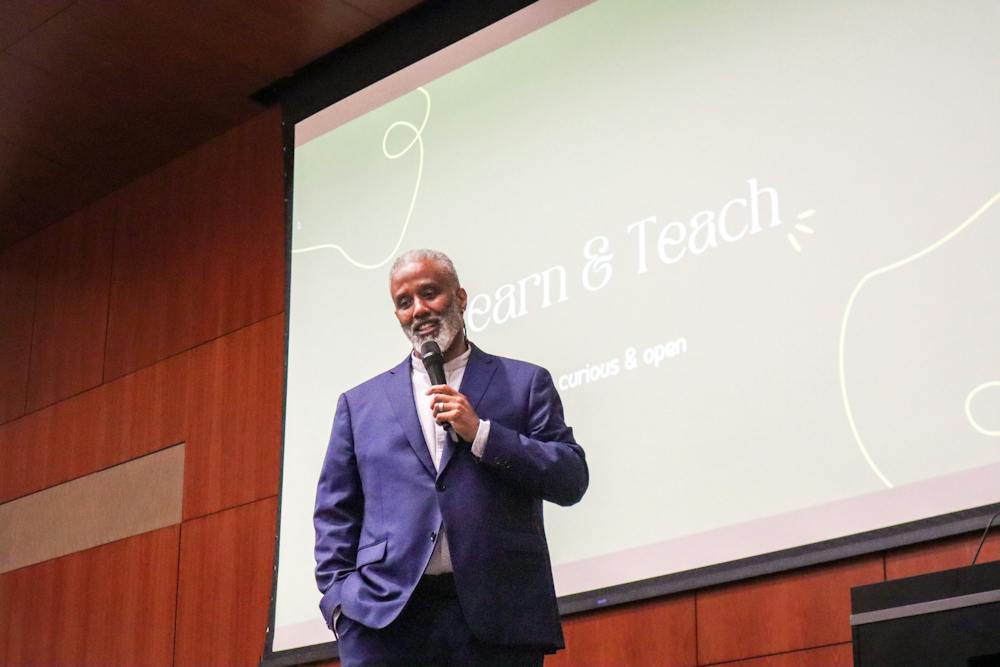
Mohammed Bilal doesn’t give a typical lecture.
During Welcome Week at Seton Hall, songs, rhymes and raps accompanied lessons about belonging, identity and navigating differences. Stories from Bilal’s childhood, career and relationships became part of a larger conversation with the Class of 2030.
Bilal has spent much of his life moving between creative and professional worlds. His former band, Midnight Voices, was signed to Sony Music. At 21, he starred in MTV’s "The Real World: San Francisco.” He has performed with Mos Def and Santana and, today, brews Kombucha. Bilal has enjoyed writing poetry, making beats and dancing since he was young, and each was reflected in his Welcome Week presentation.
Stories about his upbringing, lessons he has learned, relationships he has experienced and his ideas about belonging unfolded through rap and poetry. Bilal spoke openly with the incoming students and asked the same of them. His lifelong commitment to bridging cultural divides was apparent in his work, which focuses on creating safe spaces for people to thrive.
For Bilal, connecting across differences is a commitment that began when he was a child.
"When I made that pact [at 11 years old] that I was going to connect across differences, I knew that I needed to learn a lot about other people to really be a friend," Bilal said.
That commitment has followed him through various different careers. When asked how he connects his creative work to his work in DEI and higher education, Bilal pointed to learning as the common thread.
"I'm a learner," Bilal said. "All of the different environments are all learning environments for me. I think the through line is learning."
Learning is a lifelong practice, and long before modern discourse surrounding "cancel culture," a young Bilal navigated the ultimate social experiment on MTV’s "The Real World: San Francisco" in 1994. Thrust into a "vacuum" with culturally diverse roommates, Bilal approached differences with empathy—a trait he still carries today.
When individuals exhibit problematic behavior, it often reflects how they were raised, Bilal said.
"If people are showing up a certain way, it means they've been socialized to show up that way," he explained. "If somebody's mean, they're mean... But I can be gentler with you, because maybe your meanness is coming from somewhere.”
During his presentation, Bilal challenged conventional approaches to inclusion, reinforcing the philosophy that communities must be harder on systems and gentler on individuals.
This mindset facilitates what Bilal calls "belonging without othering" — the ongoing work of creating tight-knit, culturally specific groups that remain flexible and open to inviting others in.
Bilal urges students to reevaluate the language they use to cultivate welcoming environments. Especially during the first semester of school, using language that encompasses students as a whole, rather than referring to a specific group, can help open the student body to more opportunities for connection.
“Everybody's here is a Pirate,” Bilal said. “How do we continue to remind students that [they] have a shared identity?”
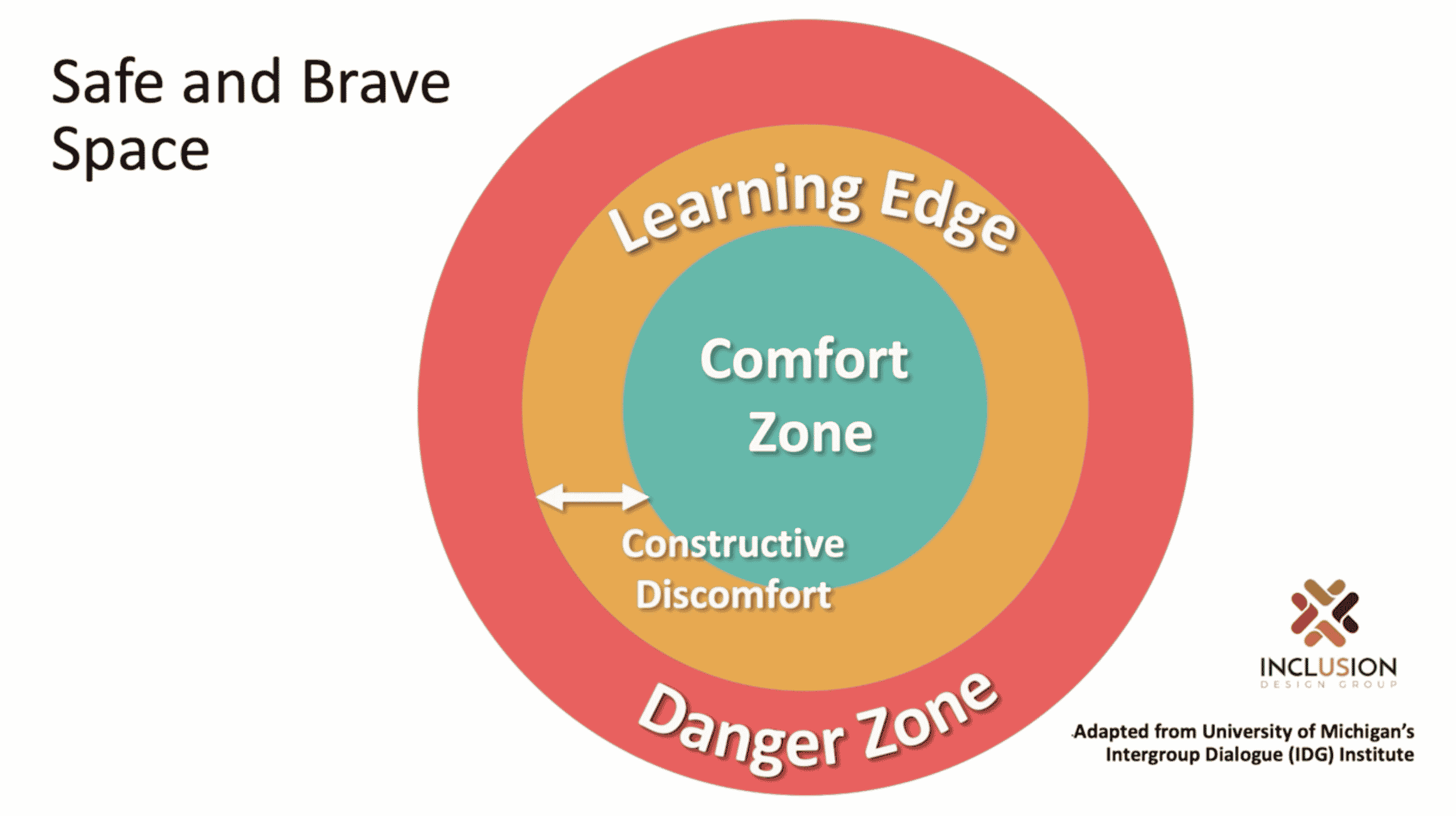
He also challenges the traditional concept of the "safe space," advocating instead for "safer" spaces anchored by collective group agreements. Using the Safe & Brave Space model, students often feel less burdened when there are symbols and language used to describe their comfortability.
“I think collective language is really important. Like, we all have the same language for what we're experiencing. We can all start to say, ‘Hey, I'm kind of in the learning edge right now’ or ‘This puts me in the danger zone a little bit,’” Bilal said.
Ultimately, Bilal’s challenge to the student body is a call for mindfulness when entering new environments.
"I think the mental shift is really about, I'm here to be open," Bilal said. "I'm here as a guest, really, because I'm new and I'm here to learn."
Belonging is more than simply feeling welcome in a space. It is rooted in shared identity, destiny, values, ability to be oneself and a sense of independence. Bilal demonstrates that true community building is not about checking boxes to prove a group is inclusive. Rather, it’s an ongoing pursuit of empathy and a willingness to learn from one another.
Keira Bala is The Setonian’s videographer. She can be reached at keira.bala@student.shu.edu.