
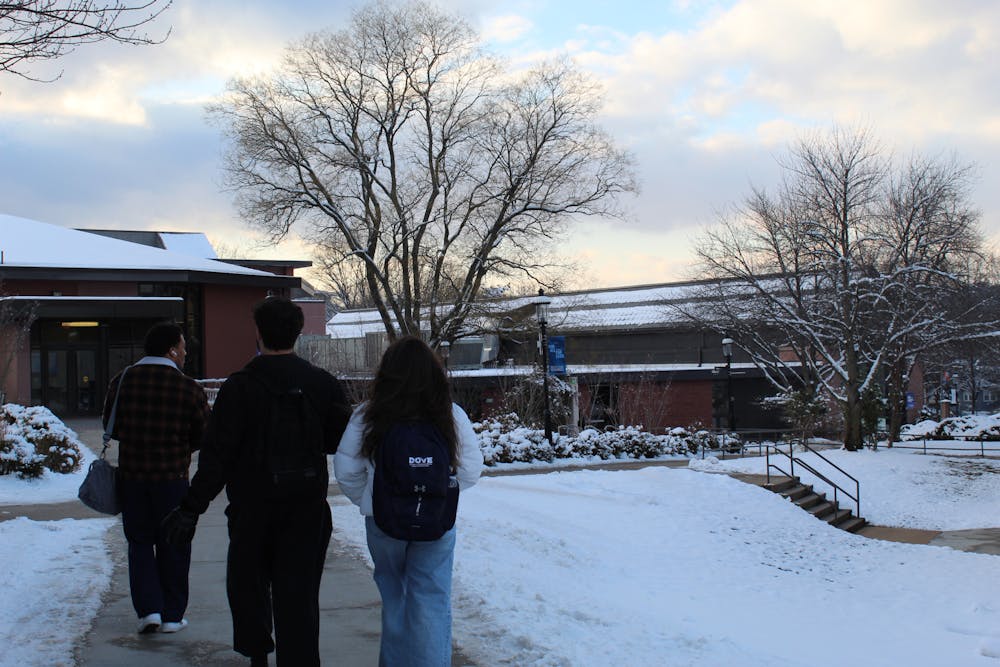
With winter often comes the winter “blues,” and students are still feeling the chill.
Students believe seasonal mood changes come from many different factors. With rigorous classes and chilling temperatures, students face the possibility of becoming less motivated and productive.
Layla Paulino, a freshman diplomacy major, thinks that the uptick in seasonal depression is because classes become more intensive during the winter season, adding to student stress.
“This stress can also cause me to lose interest in myself, my friends, and my general hobbies, ruining my overall motivation at times,” she said.
On the other hand, Asher Ruiu, a sophomore visual sound and media major, feels the exact opposite.
“I enjoy winter,” Ruiu said. “I like the cold, and mayhaps I get a little bit more depressed during the winter, but I still prefer it.”
In a similar sense, Naarah Asamoa, a senior criminal justice major, said that while the cold is difficult, she has developed smart strategies to combat it.
“Walking in it is a nightmare, but cutting through the UC, the Arts and Sciences building and Schwartz helps a lot,” Asamoa said.
However, when there are no more shortcuts to take, she utilizes her mental resilience.
“My mood is not too different because I don’t allow the cold to bother me anyway,” Asamoa said.
Students are not the only ones affected by the cold weather—professors are too.
Rider Foster, an adjunct director in the music department, said the cold affects everybody.
“In the wintertime, it’s sometimes a struggle to put up the same number of people in regular attendance as I would in the spring, the summer, or in the fall,” Foster said. “I think a number of people, whether it’s conscious or not, feel more inwardly focused. I find that in the winter, people struggle to come out of themselves.”
Due to student mental health concerns, Foster said that he has adjusted deadlines and policies in the winter.
Rider said that whenever students come up to him with concerning information about their mental health, he asks, “could you tell me more about that?” in order to get an elaborative response to know the state of their well-being.
Though it hasn’t happened since he started working at SHU, Rider said he would do what he can to give students more time to get their work done in case of mental health issues in addition to university policies. But also, he said it is important that the student communicates their needs in order to get the help that they need.
With the cold and possible mental plummet in mind, how do students feel SHU does with accommodating and acknowledging additional challenges students may face during the winter months?
Kayla Noh, a freshman elementary education major, wants to see SHU meet in the middle. She would like the option to choose to attend class virtually or in person.
Noh said last semester’s midterms and finals season made her miserable with the addition of cold weather. Offering virtual attendance could offer a solution and improve academic and mental performance.
On the contrary, Paulino believes SHU already provides many resources to acknowledge students’ possible added difficulties in the winter.
SHU has been commended for their student support, receiving recognition from The Princeton Review as the highest-ranked university for student support and counseling services in the nation.
However, Paulino believes these resources often go unnoticed by students because she said she believes not enough information is provided.
“ I think the awareness of said resources can be lack thereof at times or not enough information is given,” Paulino said.
To spread awareness of the mental health disorder, Paulino said her resident assistant (RA) made a comprehensive board on SAD.
“I want to give a mini-shoutout to my RA, Khalil, for his beautiful board up on the fourth Aquinas Hall floor regarding ‘winter blues,’” Paulino said. “It was very informative, concise and a compassionate look at the experience.”
Students, like Paulino, appreciate this information to help them utilize the little energy they have to better balance academics and social life.
“Academically, I’ve been attempting to keep up with time management,” Paulino said. “As for social encounters, I have little to no time because of what I do, and I feel burnt out and tired when exerting social energy.”
For students like Paulino and Asamoa, actions such as leaning on their faith help get them through the cold season.
“Sometimes, I go to the chapel around midnight and just sit with my thoughts in the presence of the Lord to better ground myself mentally,” Paulino said.
Asamoa also turns to God, but in a different manner.
“Listening to music, praying, or just taking a nap to recharge improves my mood a lot because the body is an instrument and you must take care of it,” Asamoa said.
Despite being worn down by the cold weather, Asamoa still has a positive outlook.
“My friends know the cold is one of my greatest enemies,” Asamoa said. “However, the chilly weather is not the end all be all. Knowing that a warmer day will arrive is a hope worth clinging to.”
Rickiya Coulton is a writer for The Setonian’s Features section. She can be reached at rickiya.coulton@student.shu.edu.


