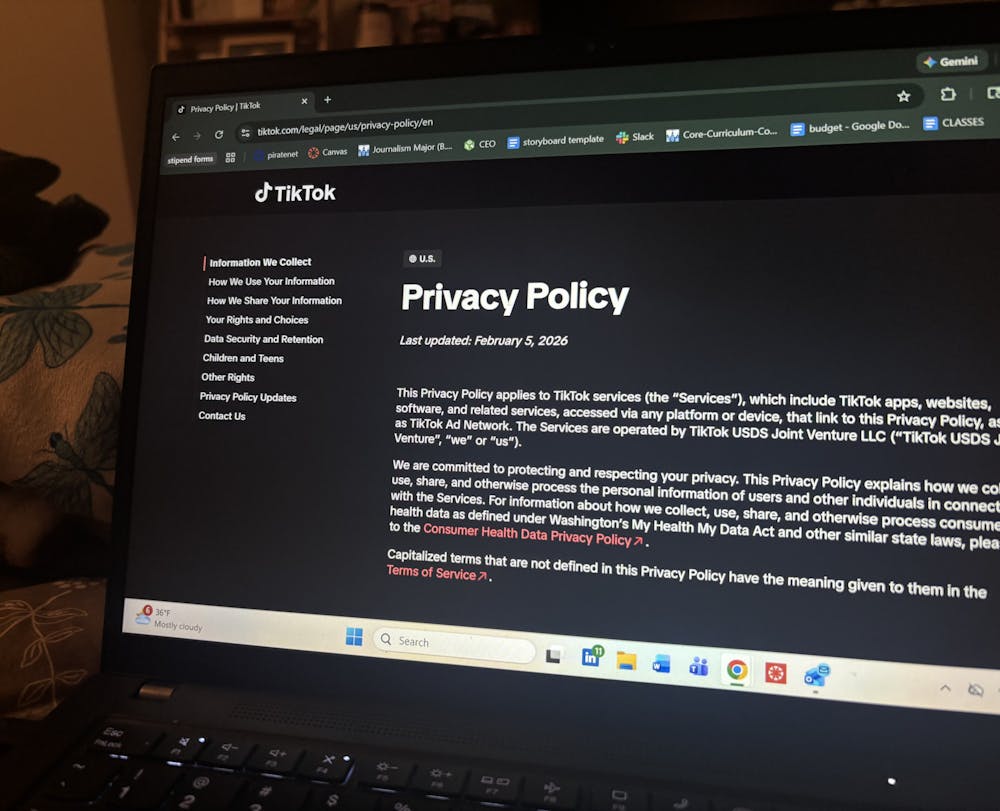
On Jan. 23, TikTok’s Chinese owner, ByteDance, said they had finalized their deal with the United States to create a U.S. version of the app, ending six years of political and legal battles.
Under the new deal, global and American investors will control 80.1% of the new adaptation, while ByteDance will retain 19.9% stake. Oracle Corp. and Silver Lake will each hold 15%, TikTok confirmed.
The venture will be directed by CEO Adam Presser, who previously oversaw TikTok’s U.S. data security efforts, and Chief Security Officer Will Farrell, who directed privacy and security operations. Experts say the platform will continue using ByteDance’s core algorithm, though the content users see could shift as the U.S. version adapts to American trends.
The agreement appears as TikTok remains one of the country’s most commonly used platforms, with an estimated 170 million U.S. users, making the United States its largest national audience.
The ownership change follows years of scrutiny from lawmakers who argued that the app posed a national security threat because of its Chinese ties. President Donald Trump, who once pushed for full U.S. ownership, later declined to enforce a 2024 law requiring ByteDance to sell TikTok’s U.S. assets or face a nationwide ban.
On the Seton Hall campus, many students say the change barely registered.
“I pressed open the app and scrolled,” Yzonne Auquilla, a sophomore biology major, said. She said she noticed an in-app notification about updated terms of service, but “just scrolled past it.”
Auquilla said she uses TikTok more than ever and does not feel more secure knowing the app is now majority U.S.-owned.
“It doesn’t really make a difference,” she said.“They’ve been taking my data since I got my phone. The U.S. probably knows what I’m doing.”
But, Auquilla did notice her feed has shifted, especially around sensitive topics.
“I used to get a lot of women talking about rape and ICE stuff,” Auquilla said. “Then it just stopped. Now I have to actually search for it, rather than it being on my for you page.”
Junior exercise science major Kenya Pierson expressed concern about potential censorship under new ownership.
Pierson said TikTok has become a major source of international news for younger generations, which makes privacy and moderation decisions consequential.
“A lot of things aren’t being talked about on the news,” she said. “We’re learning our news from TikTok.”
“I think the whole buying [of] it was for the wrong reasons,” Pierson said. “Our country said China was using it for the wrong reasons, but nothing really happened with that. I think in our hands it could be a problem.”
On the other hand, Marc Manapat, a senior visual and sound media major, said, “surprisingly” his algorithm didn’t change.
“I’m still seeing a lot of things in regard to protests and ICE,” he said. “I was assuming that was going to be changed.”
Manapat said he’s continued using the app regularly since the sale, but would move away from it if he noticed his feed being censored.
“I think the beauty of TikTok when it first came out was that it was everybody sharing their own experiences, sharing their lives, sending out information that was never censored,” he said. “Once it gets to a point where I am censored for what I’m saying or what anybody else is saying in regards to [what] they believe, that’s when [I’ll] start to get worried.”
Under the new owners, TikTok is expected to collect more data on its users, including precise location and interactions with Artificial Intelligence (AI). They also plan to expand the platform’s ad network, allowing interactions with ads on TikTok to influence the types of ads users see on other websites and platforms.
Manapat said this is of little concern to him, considering that using any social media platforms comes with concerns of privacy and data protection.
“Across any social media platform you use, whether it be Snapchat, Facebook…you were always going to have the worry of certain data being released,” Manapat said.
Auquilla echoed his sentiments, saying most people her age have simply accepted privacy trade-offs as “the cost of being online.”
Whether the ownership change will meaningfully address lawmakers' security concerns remains unclear. For now, TikTok continues to dominate screens on college campuses, even as questions about data, influence and control linger.
Julia Roman is a writer for The Setonian’s News section. She can be reached at julia.roman@student.shu.edu.
Solomon Lee, the advertising manager for The Setonian, contributed to reporting. He can be reached at solomon.lee@student.shu.edu.