
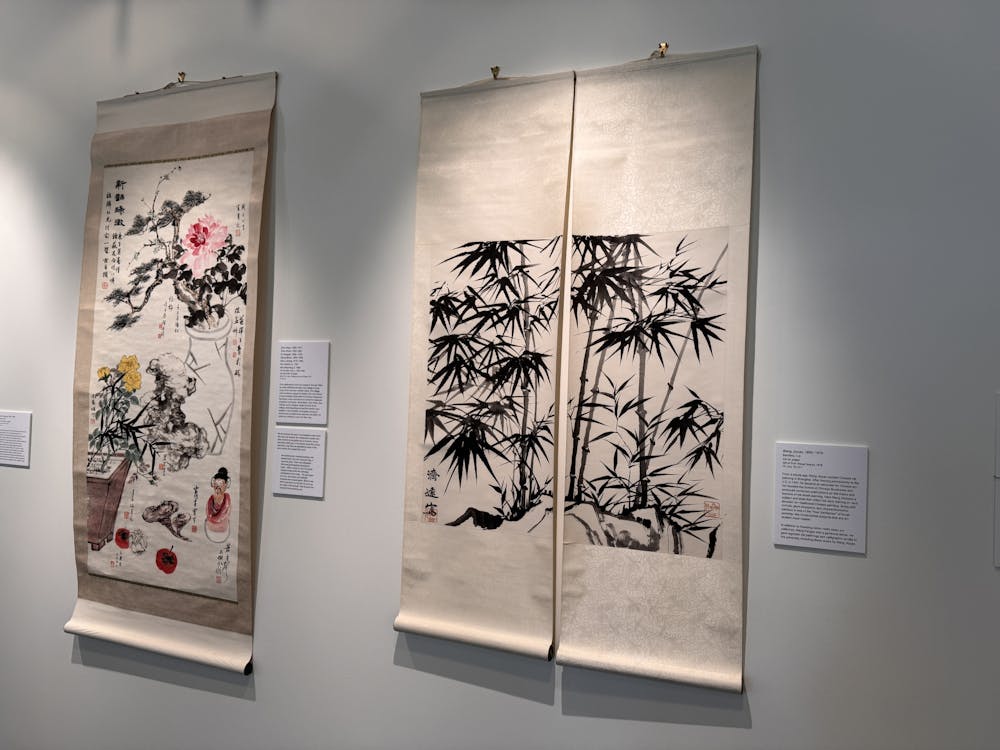
Seton Hall’s Walsh Gallery debuted its exhibit “The Art of Community: the Wang Fangyu Collection of Asian Art” on Aug. 31, which displays works of art donated to SHU by various artists in honor of Prof. Wang Fangyu, whose work created new opportunities for Asian language and art education.
Fangyu served as the chairman of SHU’s Department of Asian studies and had a strong impact on expanding student involvement in the program, particularly through his development of the first Chinese language teaching computer system.
Fangyu taught Mandarin at SHU for 33 years, collected Chinese art and created award-winning calligraphy. Outside of SHU, he also taught Chinese language and literature at the Institute of Far Eastern Languages at Yale.
The exhibit includes more than 300 works of art originating from Taiwan, Hong Kong and the United States. Themes of community span the collection, with the works exploring how Asian communities responded to the establishment of the People’s Republic of China (PRC) in 1949.
The exhibit notably features works from Chi-chi'en Wang, an influential collector and artist who donated his portfolio of paintings titled “A Hundred Drinkers in Fairyland.” Wang was a friend of Fangyu and collaborated with him to establish SHU’s Asian art collection.
Paintings by Fang Zhaoling are also displayed, including her piece “Plum Blossom,” which showcases qualities of traditional Chinese brush painting and influences from Western artistic practice. Zhaoling studied under two innovative 20th-century artists, Zhao Shao'ang and Chang Dai-chien.
Emily Handlin, Walsh Gallery’s gallery director, said the art pieces document the resilience of Asian communities during the growth of the PRC and serve as a testament to Fangyu’s dedication to Asian education.
“We picked [pieces] that were not only visually interesting, but also paintings that had been given by interesting people,” Handlin said, “because we wanted to focus on the collection, not only as a collection of amazing works of art, but also this kind of document of this artistic community that had fled China, and scattered across the world, but were bound together by their shared love of artwork.”
Because of his impact on Asian art education at SHU, Fangyu built a strong community of artists around him. Handlin noted that his work rose to prominence during a period when Asian art was significantly understudied.
“I think that [the exhibit] is not only a testament to him,” Handlin said, “but also a testament to the school, too, for supporting Asian studies when it wasn't popular to do so.”
The university began collecting pieces for the collection in anticipation of Fangyu’s retirement in 1978. Walsh Gallery reached out to artists within Fangyu’s community for additions to the collection, and Handlin said the response was unimaginable.
“Wang Fangyu had this amazingly large artistic community in China, but also all of these people who had immigrated, mainly after 1949 and the founding of the Communist Republic,” Handlin said. “They all kind of mobilized in this amazing way, and worked together to give us all this amazing art.”
The collection was stored in the Father Monella Art Center in the 1970s before moving to Walsh Gallery in 2014, where the pieces were catalogued. Handlin said when she joined SHU in 2025, she helped streamline the launch of the exhibit by assisting with translation and preservation of the pieces.
“When I came to Seton Hall around a year ago in May 2025, it was like this wonderful surprise that we had all of these amazing artworks," Handlin said. “We immediately started going through them and photographing them and cataloguing them. We were really thrilled at the quality of the works”
Dongdong Chen, professor of Asian studies, said the exhibit shines a light on an important figure who transformed SHU’s Asian studies department.
“I think, to be honest, nowadays only a few colleagues on campus still know him,” Chen said. “Most of the students probably don’t know him at all. This is a hidden history”
Chen is including “The Art of Community: the Wang Fangyu Collection of Asian Art” in the curriculum of her course, Chinese Calligraphy and Culture (ASIA 2128). With the exhibit displaying Fangyu’s influential calligraphy, Chen said she wants her students to draw inspiration from his skills.
“I think it is a good opportunity for my students to go there to see some masterpieces,” she said. “Above all, I want them to apply what they are going to learn in this course, and put that knowledge and skills into practice.”
Alongside artistic appreciation, Chen said the exhibit allows students to recognize the strength of Asian cultural traditions during this historical period of migration and change.
“I think it is significant in the sense that it’s always good to provide different perspectives, different cultures to the community, and Asian culture, just like any other cultures, has lots to offer,” Chen said. “And in terms of this particular Asian collection by Wang Fangyu, his collections that we can see on campus brought the history back to everyone.”
The exhibit will be on display in Walsh Gallery until Dec. 11. Qiumeng Fu will host a lecture about the social and artistic networks that shape the collection on Nov. 4 from 5:30-6:30 p.m.
More information about upcoming Walsh Gallery events and exhibitions is available on its website.
Michela DiLorenzo is the head editor of the Setonian’s news section. She can be reached at michela.dilorenzo@student.shu.edu.


