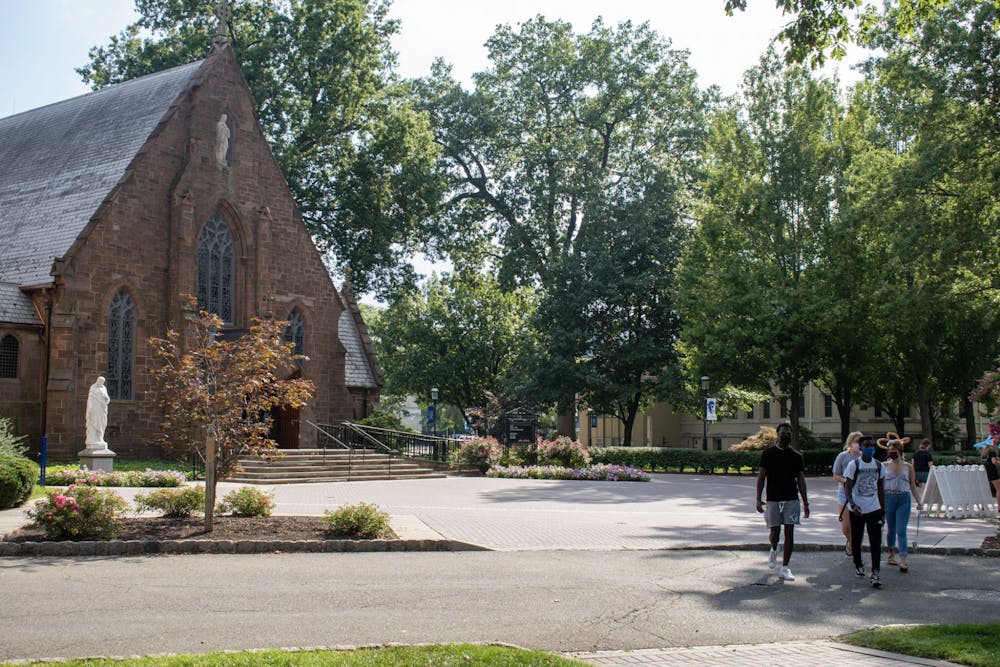
A former seminarian at Immaculate Conception Seminary (ICS) filed a lawsuit against Seton Hall University, ICS and University President Msgr. Joseph Reilly on Aug. 14, alleging he faced retaliation after reporting that he was sexually harassed by another seminary student in 2012.
The plaintiff, identified in the suit only by his initials, said he was a graduate seminarian when he experienced unwanted sexual advances and touching, including having his genital area grabbed by another seminarian, according to a court filing obtained by The Setonian.
“The nonconsensual genital contact and the conduct surrounding it constituted intentional, offensive sexual touching and caused Plaintiff fear, humiliation, shock, and emotional distress,” the suit reads.
The plaintiff alleges that he reported the actions to Reilly, then-rector and dean of the seminary, and to then-Vice Rector Fr. Robert Suszko in 2012. The complaint alleges that ICS leadership failed to follow SHU’s Policy Against Sexual Harassment, which required incidents of that nature to be reported to the University’s Title IX Coordinator. According to the suit, Reilly did not make such a report.
The recently released Ropes & Gray public report, commissioned by the Roman Catholic Archdiocese of Newark (RCAN), also found that the 2012 incident was not reported to SHU’s Title IX Coordinator. However, the report concluded that Reilly was not aware of his obligation to make such a report.
According to Ropes & Gray, Reilly reported the alleged misconduct to “all parties he understood needed to be apprised of the situation,” including the alleged assailant’s sponsoring diocese, ICS’s formation faculty and RCAN. The report also found that Reilly removed the alleged assailant from residential formation at ICS because “in Monsignor Reilly’s estimation, his conduct was inconsistent with expectations of a candidate for priesthood.” The seminarian later reenrolled at SHU and completed his degree requirements through non-residential independent study. The Ropes & Gray report stated that he did not return to classes on campus.
Despite the alleged assailant’s dismissal from residential formation, the plaintiff claims that he was “threatened and ostracized” by the man’s friends after they learned that he had reported the incident. The suit further alleges that seminary leadership “treated the resulting hostility as a problem attributable in part to Plaintiff” and that Reilly attempted to delay the plaintiff’s diaconal ordination.
According to the suit, “Reilly asserted, in words or substance, that Plaintiff was not sufficiently a ‘man of community.’”
Ultimately, Archbishop John Myers, who possessed ultimate ecclesiastical authority at the time, found no sufficient cause to prevent the plaintiff’s diaconal ordination, according to the suit.
Several years later, when the plaintiff entered fourth theology—the final year of his four-year major seminary program—he began a consensual relationship with a woman with no connection to SHU, ICS or the Catholic Church. In the suit, the plaintiff acknowledges that “this relationship was inconsistent with the obligation of chastity applicable to him as a transitional deacon.”
However, the suit claims that before the plaintiff voluntarily disclosed the relationship, “Reilly and/or persons acting for ICS caused a private investigator to follow Plaintiff.”
Approximately two months before the plaintiff’s anticipated priestly ordination in 2015, he was summoned to a meeting with Reilly and other formation officials, the suit alleges. When Reilly asked if he was prepared for ordination, the plaintiff allegedly admitted to the relationship, expressed remorse and vowed to end it. The suit says Reilly then acknowledged hiring a private investigator to follow him.
Although the plaintiff was allowed to complete his academic work, he was “required to leave the Seminary residence, was not ordained a priest as scheduled, and was not permitted to continue functioning in active ministry as a deacon,” according to the suit.
Following these incidents, the plaintiff remained an ordained transitional deacon and, after one year, sought permission to return to active ministry. Myers told the plaintiff that he should return after an additional period. During that period, Myers retired and Cardinal Joseph Tobin became Archbishop of Newark.
When Tobin declined to return the plaintiff to active ministry at that time, the plaintiff met with Reilly and asked what Reilly had communicated to Tobin. Allegedly, Reilly said “he had supplied information and materials concerning Plaintiff but refused to tell Plaintiff precisely what he had said, telling Plaintiff in substance that the specifics were none of Plaintiff's business and that the answer given would have to be sufficient.”
It was not until 2019, during SHU’s investigation into allegations of sexual harassment at ICS, that the plaintiff says he began to understand that his 2015 removal might have been connected to his 2012 report.
That year, the plaintiff met with SHU EEO/Title IX personnel and outside counsel about the 2012 incident as part of the Latham investigation. According to the plaintiff, a Latham attorney asked him “whether he had considered that his eventual removal from the Seminary might have been retaliation” for reporting the alleged assailant.
The suit alleges that the plaintiff “had sensed for years that the relationship with Seminary leadership changed after his report and had privately wondered whether [the] events were connected,” but had believed his 2015 removal was attributable solely to his admitted consensual relationship. The lawsuit describes an Aug. 16, 2019 interview as the point in which the plaintiff “first reasonably appreciated that the assault, his report, the post-report hostility, the adverse community narrative, Reilly's effort to delay his diaconal ordination, the private surveillance, his removal, and later impediments to restoration could be causally connected.”
As the Latham investigation neared its end in 2019, the seminarian accused by the plaintiff also came forward, according to the Ropes & Gray report. The seminarian, referred to as “Seminarian 2” in the report, alleged that he was actually the person who had been sexually harassed by “Seminarian 1” in 2012 and that he had been denied due process when Reilly dismissed him from ICS.
At this point, SHU engaged Nukk-Freeman & Cerra, P.C. to investigate the 2012 incident. According to the lawsuit, the firm concluded in 2020 that Reilly had not followed proper reporting and investigatory protocols in responding to the complaint.
In February 2020, the plaintiff sent Cardinal Tobin a written disclosure describing both the 2012 incident and his discussion with SHU in 2019. Four months later, in June 2020, Reilly sent Tobin a letter acknowledging “that he had not reported the 2012 incident to Seton Hall because he did not understand at the time that such a report was necessary.”
According to the suit, the plaintiff alleges that, after those 2020 findings and acknowledgments, “the institutions had an opportunity to correct records, disclose the complete secular context to affected decision-makers, and remediate consequences of the reporting failure, but did not timely do so.”
In 2024, the plaintiff was restored to active ministry and ordained to the Roman Catholic priesthood.
Ultimately, the plaintiff’s lawsuit contends that the issue at hand is not whether his consensual relationship warranted ecclesiastical discipline, but rather “that the surveillance, incomplete record, prior retaliation, and secular handling of his sexual-assault report materially contributed to the injuries and consequences that followed.”
The plaintiff is seeking monetary damages from SHU, ICS and Reilly for the conduct alleged in the complaint.
University Relations told The Setonian that the University has “no comment on the pending litigation,” and “remains focused on its educational mission.”
The plaintiff’s attorney declined to comment on the specifics of the case.
SHU faced additional legal scrutiny earlier this month. On Aug. 13, New Jersey Sen. Joseph Vitale requested Attorney General Jennifer Davenport “conduct an independent investigation into Seton Hall University and its compliance with federal requirements regarding the reporting, investigation, and treatment of sexual harassment and abuse allegations.”
Separately, Reilly’s predecessor, Joseph Nyre, refiled a whistleblower lawsuit against the university, claiming that he faced retaliation before resigning as president. A judge dismissed his lawsuit in February, although SHU’s separate lawsuit against Nyre remains ongoing.
Megan Pitt is the Editor-in-Chief of The Setonian. She can be reached at megan.pitt@student.shu.edu.