
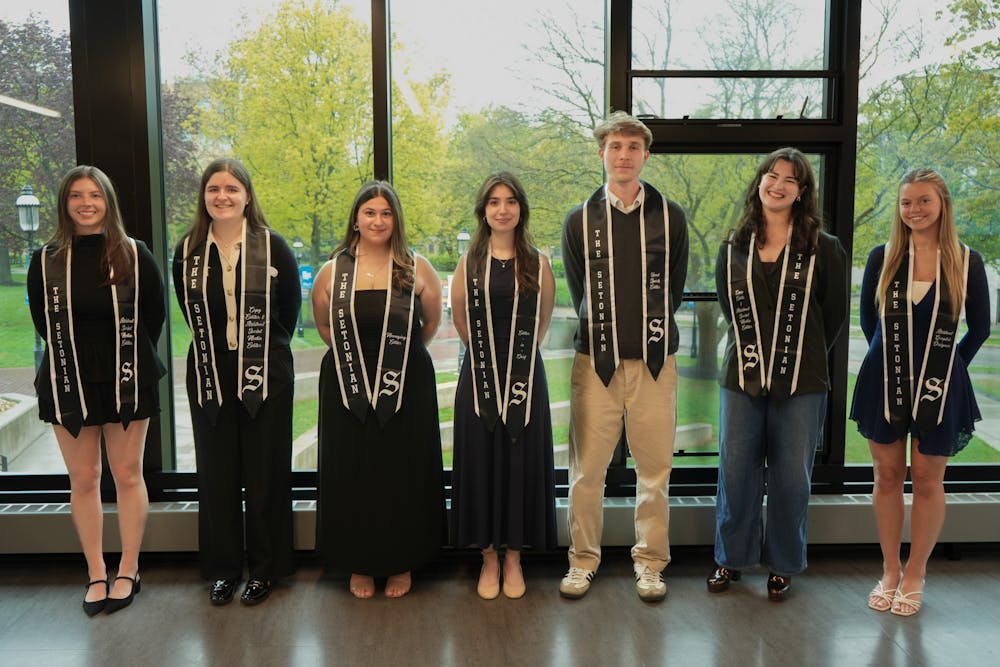
For The Setonian’s graduating seniors, the paper was more than an extracurricular activity. It was a crash-course in real world journalism, where one word could change a story, one article could spark backlash and the work often became part of who they were.
“It’s more than just a resume booster,” Rhyleigh Russell, assistant features editor and three year member of The Setonian, said.
Sofia Kasbo, managing editor, called The Setonian “a boatload of opportunity.”
“It's a creative space where anyone can do anything—bold, underline that whole phrase,” Kasbo said.
For this year’s seniors, their time at The Setonian was defined not only by the work they produced, but how they grew.
For Editor-in-Chief Dominique Mercadante, that growth came with a new understanding of responsibility.
“You have to be so cautious before anything goes up,” Mercadante said. “One word that’s off, one fact that’s slightly off or incorrect could get you in a lot of trouble…you have to be so careful as a journalist.”
That level of accountability reshaped how she viewed the field.
“I’ve grown more cautious and weary, but that’s for the better,” Mercadante said.
Jackie Litowinsky, former head news editor and current copy and social media editor, said The Setonian broadened her view of what stories matter.
“‘Soft news’ is just as valuable as ‘hard news,’” she said. “The stories that seem small could mean so much more to someone else.”
Jules Griesbauer, head graphics editor, said her role pushed her to grow, especially when it came to managing deadlines.
“I’m a procrastinator,” she admitted. “With super big projects like The Setonian, you really can’t just wait until the last minute.”
With support from Mercadante and Kasbo, Griesbauer learned to break large assignments into smaller milestones, allowing her to keep projects on track and meet production deadlines.
Similarly, Zachary Mawby, head sports editor, said that The Setonian helped him understand urgency and the importance of “being on top of things,” which leads to, a lot of the time, being chronically online.
“I check Twitter so often now, which was not the case before,” Mawby said. “It's very demanding, but in the best way possible, and I feel better because of it.”
It’s not always easy to get the scoop—more often than not. Christian Hui, assistant sports editor, reflected on his “crazy journey” and its “ups and downs.”
“You have good days, you have bad days…and covering sports at Seton Hall, you get a lot of downs,” Hui said. “Just to see that from a writer's perspective, writing some sports I didn't want to write, to writing the sports that I love to write about is something I’ll always be grateful for.”
Even while covering some “low”lights of SHU athletic performances, Hui found that people cared about what he was publishing, with e-board members pushing him to be better and better every day.
“They were really transparent about what I could be doing better and I think that's an important thing to have in any sort of space…you know, saying the tough stuff,” Hui said. “You tear me apart and I'll come back the next day better.”
For many seniors, busy schedules require superb time management skills, something Hui learned along the way.
“There's no shortcuts—if you're a photographer, you take more pictures, if you're a videographer, you take more videos, and if you're a writer, in the case of Zachary Mawby, my glorious head editor, you write a lot,” Hui said. “[Finding balance] is one of those things where the feedback loop is really simple: you just do it.”
That work often paid off in defining projects, like the basketball print edition—a months-long effort spearheaded by Mercadante, Kasbo, Mawby and Griesbauer.
Mercadante, Kasbo and Mawby spent the summer brainstorming and pre-writing articles, while Griesbauer joined the project in the fall.
The edition, featuring both Seton Hall’s men’s and women’s teams, marked Griesbauer’s first print issue and gave her the opportunity to experiment with design. Its cover appeared to show both teams in a single photo, but the image was actually created by combining two separate photos in Photoshop.
“It was like a dream becoming a reality,” Mercadante said of seeing the final product. “When Jules put it together, I was like ‘Oh my god, this is everything I wanted it to be.’”
That’s what the editorial board is at The Setonian, a team where support is of the utmost importance. Kasbo said the e-board’s receptiveness of her ideas allowed her to flourish.
“I think to be able to challenge other people, and then have people challenge me, that's when I was, like, ‘This is a home,’” Kasbo said.
Over the course of her three years at The Setonian, Russell found being a voice for the community and being an outlet for representation of the utmost importance.
“Recognizing the little wins of people when everything seems so big,” Russell said. “There is so much going on for college students…and recognizing things that get skipped over deserve their time.”
Hui also recognized the importance of highlighting minorities, specifically in sports, recalling his pieces on Black history in SHU sports and notable women in SHU sports history that changed his perspective on what it means to be a journalist.
“If you go back to times where it was just white athletes, and now moving towards a more equitable space…it really offers a new perspective on how that's a platform,” Hui said. “For a lot of people, especially the people that I covered in those two articles, it meant the world, it meant life or death, and it meant putting food on the table.”
At The Setonian, Hui recognizes that the publication is a platform that can and should be used to make strides in the sports world.
“As students and student athletes, there's a way to move forward equitably,” Hui said. “That's something that we can keep an eye on, and that we as students have a platform to do, because there's students that are our age trying to also put food on the table.”
For Morgan Dence, a social media editor, the experience was about understanding what resonates with readers.
“It really helped me see what stories were most important to students based [on] engagement, whether it was comments, shares, or likes on a post,” she said, noting the challenge of keeping up with social media’s fast pace.
Dence also reported on a variety of topics ranging from light-hearted features to hard-hitting news. Her favorite story, though, was on the rising costs of living that incorporated both students and faculty perspectives.
“It was interesting to hear people’s viewpoints,” she said.
Contributing over 130 articles to The Setonian, Mawby has a strong catalogue to look back upon making it difficult for him to choose a favorite.
“I can't point to one and say, you know, ‘This is my favorite child,’ because I love them all equally,” Mawby said.
However, Mawby did write an opinion piece on his top artist, YoungBoy Never Broke Again, that changed his perspective—that maybe YB isn’t better to everyone.
“I got a lot of not so great feedback from that, which is okay, not everybody has to agree with me,” Mawby said. “That's not why I did that…I'm just super passionate about his music.”
Not only does The Setonian cover lighthearted stories, others are much more serious. Kasbo reflected on her protester story, which she is most proud of because of the effort she put in from scouting to publishing.
“That was something where I physically saw it on social media, and I was like, ‘I need to be there and I need to get the scoop,’ Kasbo said. “I was physically running across campus to go find this protester…and it really paid off.”
Not only did Kasbo find this a rewarding experience because of her hard work paying off, but also due to setting a precedent for the type of stories she wanted the publication to cover.
“It really showed the change that I started to make here with the types of coverage that we did,” Kasbo said. “I feel like that was just like a story where it was all encompassing, with the reporting, with the writing, and just like the literal physical effort I put in.”
Mercadante shared a similar sentiment, reflecting specifically on the backlash following an editorial calling for greater transparency on campus.
“I’ve never received so much backlash in my life,” she said. “Mentally, that was very draining.”
Still, Mercadante stood by her work, which ultimately won a second-place New Jersey Press Foundation (NJPF) award.
Moments like that reinforced her goal for the publication.
“I hope that people remember that we pushed barriers this year,” Mercadante said.
Both Kasbo and Mercadante saw major shifts in the publication this past year, including the expansion of multimedia content, return of print, staff growth and an increased social media presence.
For Jackie Litowinsky, former head news editor and current copy and social media editor, The Setonian shaped her confidence as a writer.
“Once I reached the point when the articles started writing themselves, I felt like I had ‘made it,’” she said.
Her time at The Setonian also reinforced the importance of impact—particularly when covering complex issues such as the New Jersey Supreme Court’s investigation into Catholic clergy sex abuse allegations.
“I read over 300 articles in preparation for the story,” Litowinsky said. “Some victims reached out to me afterward…which was a moment I’ll never forget.”
Despite working in different areas of the newsroom, the seniors shared a common takeaway: growth.
“I learned so much…just as much as I would learn in any class,” Griesbauer said.
For many of these seniors, The Setonian was not only part of their college experience, it was their college experience, and it is bittersweet for Russell to leave behind what was “such a big chunk” of her college years.
“The Setonian contributed so much to building my confidence, not just as a writer, but as literally a human being,” Russell said. “That is hard to step away from.”
As part of the editorial board, each member holds unique responsibilities, like representing communities and informing their peers and, for Russell, this is another aspect that she will miss.
“Doing that work is just so rewarding and so fun,” Russell said. “But I also know that just because I'm moving on does not mean that that's ever gonna stop happening—that's the best part.”
Russell is not the only one facing “bittersweet” feelings. Mawby said “it’s really tough” to move on from something that has been such an integral part of his college career.
For many, The Setonian became more than an extracurricular—it became part of their identity.
I’ve been struggling to accept that I won't be able to cover Seton Hall sports as often, or maybe at all anymore,” Mawby said. “I really hope it's not like the last time I'm able to cover Seton Hall, especially the basketball team, because I love doing that.”
Kasbo feels similarly, calling The Setonian “a piece of [her].”
“It's in my blood, and I feel like it's just a legacy, and I'm really thankful to be a part of that legacy and be one of those names on the Pirate Press plaques,” Kasbo said. “It's a memory I'll have forever.”
Mercadante shares a similar feeling.
“It’s really hard because this has been who I am,” Mercadante said. “When you lose a part of yourself, there’s a void.”
Not only are these seniors leaving behind the publication, but they are also leaving behind their peers. Kasbo said this is the aspect that is the most difficult for her to part with.
“People are what makes the home a home…The Setonian is filled with a lot of really strong journalists, whether that's written or multimedia,” Kasbo said. “The personalities we have on the e-board, the hard working people we have on the e-board—that's what I'm gonna miss the most.”
These peers are what Kasbo calls the most “unexpected thing” the publication has given her.
Similarly, Mercadante hopes the relationships she’s built with her fellow editors will continue beyond graduation.
“I hope to always keep my Setonian friends because I feel like we all understand each other,” she said. “I love them so much.”
Even so, leaving behind the space they helped build brings a sense of hesitation.
“I’m a control freak,” Griesbauer said. “The hardest part about stepping away is giving my baby to someone else.”
That feeling of hesitation, Mercadante said, comes from how much the work has meant to her.
“It’s very hard for me to leave because it means so much [to me],” she said. “When you love something so much, that’s what makes saying goodbye so hard.”
As the seniors prepare to graduate, they leave behind a new generation of Setonians to carry on their legacy. Russell wants to instill in those behind her to”continue to not be afraid to redirect.”
“Don’t be afraid to take that jump and look into something new, because it ends up being so rewarding,” Russell said. yeah. “Truly, if you're following ‘this is what we think is best, we're going to take it together’—that's always the best, good way to go.”
As for the sports section, Mawby hopes to have inspired others to be passionate about sports journalism.
“I hope I helped keep the Seton Hall community informed [on sports],” Mawby said. “I try to be timely with what I write, so that it’s almost like we get the first scoop…I hope I set a good standard for the sports section going forward.”
Kasbo encourages upcoming editors of The Setonian to “better themselves every day.”
“I want them to...challenge themselves every day and question what other people say and don't take anyone's sh—t,” Kasbo said.
Apart from standing your ground as a journalist, dedication to the craft is something Hui wants others strive to obtain.
“Rise and grind, put pen to paper, get on the laptop, let your eyes bleed out,” Hui said. “It's a tough industry…you're always second to somebody, so you got to work hard.”
For these seniors, The Setonian was more than experience; it was where they learned how to tell stories that matter.
As Litowinsky put it, “it’s going to be weird watching history unfold from the outside.”
Megan Pitt is the head editor of The Setonian’s News section. She can be reached at megan.pitt@student.shu.edu.
Lakyn Austin is the features editor of The Setonian’s Features section. She can be reached at lakyn.austin@student.shu.edu.


