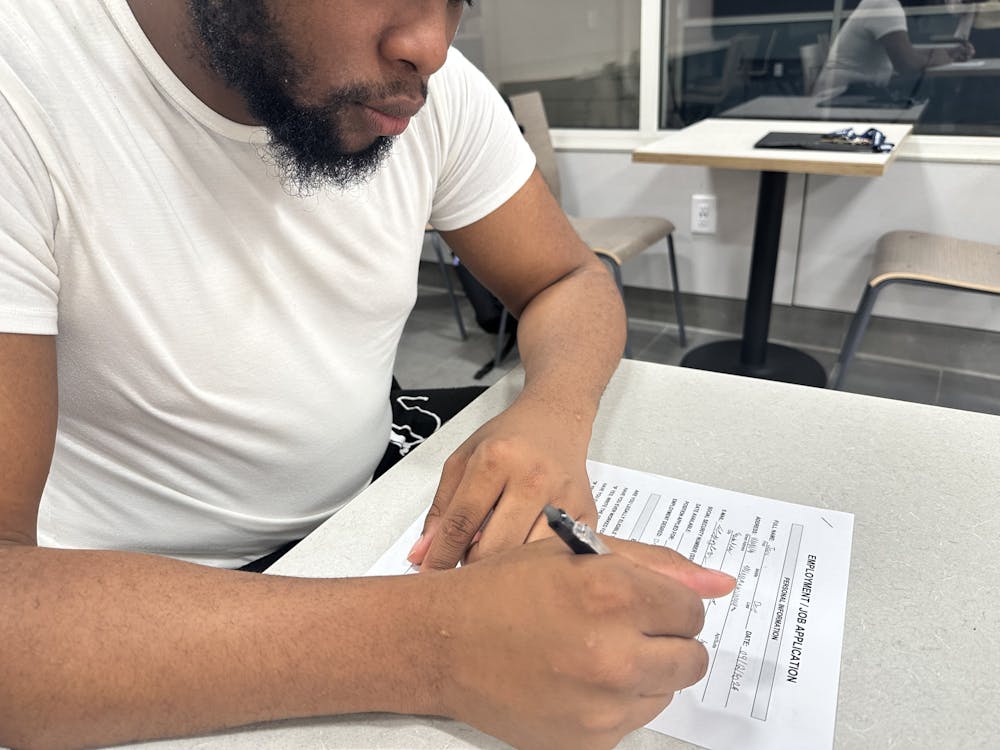
Seton Hall seniors face fears of unemployment as they compete against strategic hiring and artificial intelligence (AI) application screening, with many considering part-time jobs as a safety net after graduation to cope with the current grim job market.
The expectation that entry-level jobs will launch early careers for recent graduates is dwindling as the unemployment rate for college graduates soars, with last year’s rate reaching 5.6%, according to an analysis from the Federal Reserve Bank of New York. Meanwhile, more than 40% of graduates are working jobs that do not require college degrees—the highest level since 2020.
As the job market tightens, students are questioning their futures and the stability of their chosen fields. For many, that uncertainty is beginning to shape major life decisions.
Joy Gerges, a math and secondary education major, said she is considering graduate school because the education field feels increasingly uncertain.
“I was told since I was a kid that you're forever gonna have [teachers], no matter what technology advances to, and it’s not even guaranteed anymore,” Gerges said. “It doesn't even give me job security whatsoever.”
Gerges pointed to AI as a growing concern in classrooms, saying the role of teachers is changing.
“I know there's a school somewhere in Jersey that's opening that is gonna let AI be the teacher,” Gerges said. “Which is crazy.”
Originally planning to work before pursuing a master’s degree, Gerges said her priorities have shifted.
“I thought if I did graduate school, it would be after a couple years of working,” Gerges said. “But it feels like even now, jobs, they want you to have 5 years of experience. How am I gonna get experience if you guys won't hire me?”
Gerges’s frustrations reflect the feelings of other seniors at SHU.
Paige Ciancimino, a communications major, said staying motivated has been difficult after receiving just two interviews from 50 applications this year.
“I guess getting an interview at all is good…that makes me feel a little bit better than no response at all,” Ciancimino said. “But doing the interview, I get my hopes up and then once a couple weeks goes by with no response, that dwindles.”
While Ciancimino acknowledged that AI makes the hiring process more difficult, she said the volume of applicants is the bigger challenge.
“Even if there's no AI, it's still hard because there's just too many people applying for the same things,” Ciancimino said.
To cope with the uncertainty, she is searching for a part-time job for the summer.
“I didn't really ever have a super specific plan, but I was hopeful that I would have something ready by at least the summer,” Ciancimino said. “Now…I am leaning more towards that not happening. So I'm more looking for some sort of part-time job in the summer just to have some things to do.”
Echoing Ciancimino’s sentiment, Maya Tejada, a communications major with a fine and digital arts minor, said she also plans to pursue a part-time job this summer because the industry feels “very cut-throat.”
“I'm graduating in a month and I still haven't even heard back…for an interview,” Tejada said. “I'm a communications major, so I'm realizing now that I want to do something like marketing or digital media and that's a very cutthroat field to be in.”
Tejada has applied to 35 jobs through LinkedIn without success, but credits her mom for keeping her motivated.
“It's such a sucky feeling, but my mom, she's been my number one supporter,” Tejada said. “She says, just keep on applying, keep on networking. So I'm not giving up on it.”
Looking back, Tejada said earlier preparation would have helped.
“I wish I [had started] very early on, maybe my junior, even sophomore year,” she said. “Once your senior year hits, it's game time.”
While some students are just beginning to feel the pressure, others are already expanding their search beyond the U.S.
Jiaqian Shen, a marketing and management major with a minor in graphic design and advertising, said she has expanded her job search internationally, where she sees greater reliance on AI in hiring.
“They use AI more than in the U.S. They also post [jobs] externally to students,” she said. “Sometimes, I will apply for it. I want to give it a try no matter what.”
Shen has submitted 50 job applications this year and believes AI programs are replacing entry-level positions.
“Some of the ‘basic’ jobs, well, AI can generate it for us, and [companies] just don't think they actually need you. Especially for those entry-level jobs, where people make a lot of mistakes,” Shen said. “So the company just doesn't really want to spend time and waste money on those things; they can just use the AI and generate whatever they need.”
Alongside that, she said networking remains one of her biggest challenges.
She said she feels she’s missing out on the useful connections her friends have.
“Those people already have been working abroad and their backgrounds are really different. Their families have a lot of connections towards things like that, but I'm only by myself,” Shen said. “It’s just pretty challenging to be honest.”
The diminishing human element in hiring is also shaping how students view the process itself.
Michael Molnar, a wealth management and finance major, said AI has made the interview process feel impersonal.
“It's just demotivating, with an interview, at least you talk to a person, you talk with a human,” Molnar said. “With this, you just sort of send them out, you send out maybe 20, maybe 30, maybe 40, 50 [applications] a day, and you get nothing.”
Molnar has submitted up to 150 applications on LinkedIn this year and said internships have been especially competitive.
Reflecting on his college experience, Molnar emphasized early career-building.
“It's very important to get your internships early,” Molnar said. “It's just about building yourself up and getting that two to three years of experience by the time you graduate.”
Still, some students have found success in the process.
Sara Roja, a psychology student, said her confidence guided her through the tough interview process in the healthcare industry.
“I do feel intimidated by the competitiveness of finding a job,” Roja said. “I feel that by refocusing on my strengths and experiences during interviews has helped me learn how to be confident.”
Roja has applied to four jobs and said the market has not changed her long-term plans.
“I want to get a job as soon as I can in order to help pay for my undergraduate loans and for graduate school,” she said. “But I’m excited to be in a new job environment that is focused on what I have studied. That’s a motivating aspect for me.”
Even with rejection, she said she has learned resilience.
“Facing rejection from job applications and learning how to manage these feelings are important,” Roja said. “But I like to say, rejection is redirection.”
Ameila Mead, a finance, marketing and wealth management major, said she was able to secure opportunities after months of searching thanks to mentors.
“I have been looking for a job for about eight months, it was very challenging and time-consuming,” Mead said. “However, through the help of the many mentors in my life I was offered two positions.”
Mead encouraged other students to use the resources available at SHU while also networking and making valuable connections.
“It has been a satisfying journey, making my own connections and learning how to endure,” Mead said. “I would advise other seniors to not give up, and use the resources at SHU. A lot of times, there are programs and mentorship opportunities that aren't utilized.”
Despite student concerns, Justin Krass, associate director of the Career Center, said overall job outcomes at SHU have remained steady.
“We're talking just [getting] jobs…it’s going to take about three to six months,” Krass said. “And that hasn't necessarily changed.”
He noted a minor shift in students pursuing adjacent fields due to changing industries, but said most still find work aligned with their goals.
“For the most part, what we hear from students is that they're still doing things that are further towards their career goals,” Krass said. “It's not that we're hearing that people can't pursue the things they want to do.”
As a final piece of advice, Krass urged students to stay proactive.
“I think ultimately, my recommendation would be to stay focused and just take it one step at a time,” Krass said. “Make sure you network and make sure you're utilizing your connections. Do informational interviews. Support the Career Center faculty. Use all those tools available.”
Michela DiLorenzo is a writer for The Setonian’s News section. She can be reached at michela.dilorenzo@student.shu.edu.