Over 50 years ago, Title IX became law, preventing any educational program from discriminating based on sex—and thereby allowing female athletes to argue that schools should take women’s athletics as seriously as they did men’s.
Since then, women’s sports have exploded. Leagues like the Women’s National Basketball Association (WNBA), National Women’s Soccer League (NWSL) and Professional Women’s Hockey League (PWHL) are driving viewership, sales, and sponsorships—and the data backs it up. A March Bank of America report projects 250% revenue growth in U.S. women's sports by 2030.
LeonardDeLuca, an instructor in the Center for Sport Management at Seton Hall and the associate director of the Seton Hall Sports Poll, believes this growth is the “culmination of the buy-in of advertisers, media companies, and now private equity.
“You are seeing what has happened now when the marketplace and smart people within the ecosystem of sports—namely people who own rights, people who have sponsors and organizers—realize that there is an incredible audience for competitive women’s sports,” DeLuca said. “It’s not new. It’s only legitimized by people recognizing what we always saw.”
DeLuca also drew on his experience working in senior roles in programming at companies like ESPN, CBS Sports and IMG to speak on a major advancement in the world of women’s sports:the new WNBA Collective Bargaining Agreement (CBA).
On March 24, after 17 months of negotiations and a final eight-day, 100+ hour bargaining session, the WNBA and the Women's National Basketball Player’s Association (WNBPA) officially ratified a new seven-year CBA, securing first-of-its-kind revenue sharing, salary increases, expanded bonuses and much more.
“It’s not only the money, but it was also about, for them, facilities, housing and transportation. It was these other things to make sure that the overall system works,” DeLuca said. “And when Breanna Stewart, who had derided the union leadership three months ago, says this is transformational, her words, this is a big deal.”
Few leagues have shaped the women’s sports business more than the WNBA. According to the Bank of America report, regular season viewership of the league more than quadrupled from 2020 to 2025 for nationally televised games and over 75 million Americans consider themselves fans.
That impact influenced college athletics as well. After basketball player Sedona Prince went viral in 2021 for showing the disparity between the men’s and women’s NCAA Tournaments on TikTok, a firestorm of criticism invoked a subsequent external gender equity review that started to bring about change. The women’s tournament now carries the same “March Madness” branding as the men’s and spending gaps have narrowed.
“It all trickles down: As women’s pro basketball grew in popularity, so did women’s college basketball and TV networks started jumping on that bandwagon, too,” said Ralph Vacchiano, NFL reporter for FOX Sports and Adjunct Professor of Sports Reporting at SHU. “Then colleges started putting more money into those programs. And as more girls got excited about basketball, money poured in for better training, nicer facilities and equipment and more organization on the youth level.”
With another women’s basketball season in the books at SHU, Bryan Felt, Director of Athletics and Recreational Services, said that the popularity of women’s sports “is being felt here at Seton Hall every single day.”
“We recently celebrated 50 years of women’s athletics here at Seton Hall—an event that brought together generations of our alumni and reinforced that Seton Hall has built not just teams, but a legacy,” Felt said. “Women’s sports have been thriving here for decades and we’re excited to build on that foundation.”
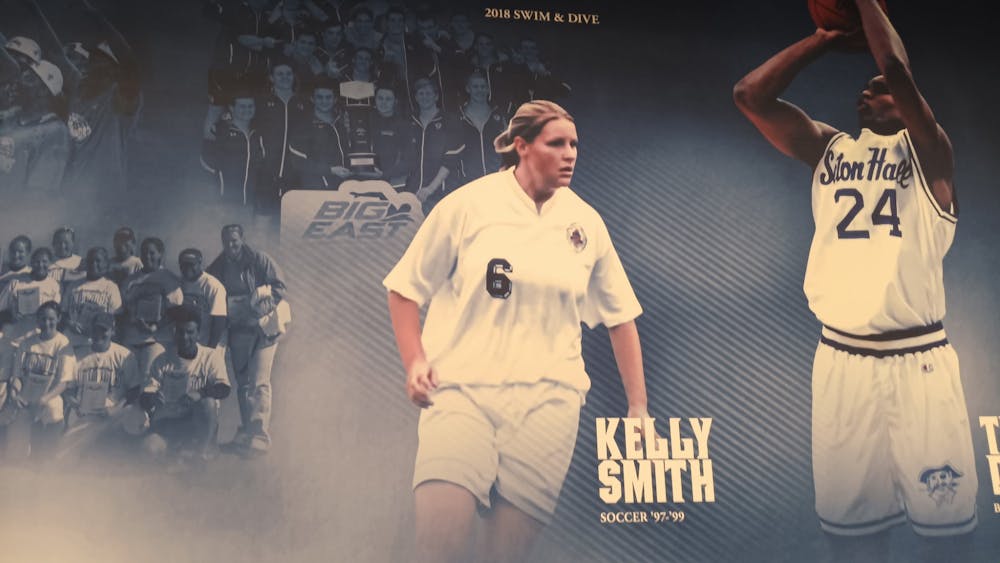
Kelly Smith, widely regarded as the greatest women’s soccer player in Pirates history, is one of England’s all-time leading scorers and now serves as an assistant coach for Arsenal Women in the Barclays Women's Super League (WSL). It was her time at SHU that led to her future career.
“I moved to the U.S. to become a professional soccer player because that wasn’t something available to me in the U.K. at the time,” Smith said. “How female athletes were supported and celebrated in the U.S. when I went to Seton Hall was bigger than I'd dreamed of as a kid growing up in England.”
Smith added that since her playing days, the game has skyrocketed in England. So, she’s able to “tell young players they don't have to move away from England to follow their dreams anymore.”
“To see the growth of women's football here in England since I retired, and the players getting respect and appreciation, is definitely something to celebrate,” she said. “With so many more opportunities for girls to be involved, on and off the pitch, I'm excited to see where the next generation will take the game in terms of coaching, nutrition, injury prevention and everything else that makes our sport so special.”
Stateside, the NWSL and the United States women's national soccer team (USWNT) have produced notable names like Trinity Rodman, Alex Morgan and Megan Rapinoe. Current players, like Rodman and international star Sam Kerr, will help drive a global increase of 300 million fans by 2030, according to Bank of America.
For former ESPN anchor and SHU Center for Sports Media founder Bob Ley, covering the USWNT was a “career highlight.”
In particular, Ley described working with Brandi Chastain as “joyous.” A member of the famed “’99ers,” Chastain delivered one of the most iconic moments in American sports history with her iconic ripped jersey moment. Before they worked together, Ley said he asked Chastain to sign copies of her famous Sports Illustrated cover for his two daughters, who hung them in their bedrooms.
One of Ley and Chastain’s most notable moments together came in 2011, when they hosted the Women's World Cup quarterfinals in Germany for ESPN in-studio.
“That included the remarkable knockout match when the USA met Brazil, down a player (red card), in extra time, down a goal, facing elimination, then Megan Rapinoe sent a 45-yard ball to Abby Wambach, who scored in the 122nd minute, forcing a shootout that the USA won,” Ley said. “Still the most amazing sporting event I've ever been associated with.”
Now, women’s soccer continues to create memorable moments. Just this March, the NWSL’s Denver Summit set the league’s single-game attendance record in its inaugural home game with 63,004 fans packing the stands. Chastain was in attendance.
With the next FIFA Women’s World Cup coming in 2027 and the Men’s World Cup coming even sooner in June, Vacchiano said that FOX now has the rights to the women’s Cup because “it recognized it could make money—that the tournament was thrilling, the soccer was brilliant enough to attract an audience and advertisers, and that as people saw it more, it would continue to grow.”
Vacchiano added that the FIFA Women’s World Cup is his favorite women’s sporting event.
“I am so much more invested emotionally in that than I am in the men’s World Cup,” he said. “I guess maybe that’s because the American women are better than the American men. Not just more successful, but the quality of their play, the passion they play with, their teamwork. It’s all just better. It sometimes looks like they know the world is finally paying attention and they’re determined to give it everything they have. And it shows.”
Amy Rosenfeld, a professional in residence at SHU this fall and Senior Vice President of Olympics and Paralympics Production for NBC Sports, agreed about the quality of play in women’s sports, saying that “the level of competition” has “accelerated over the last decade.”
“That has led to a greater amount of exposure and accessibility for viewers as many more networks and streaming partners have picked up the rights to these events,” Rosenfeld said. “Then the momentum carries—we saw that with the Paris Olympics, where women’s sports were a huge force behind NBC’s ratings growth.”
Beyond the 2024 Paris Olympics, the 2026 Milan Cortina Olympics were arguably led by female athletes. On Team USA, athletes like Hilary Knight, Alysa Liu and Breezy Johnson accounted for 8-of-12 gold medals. Overall, women accounted for over 60% of all medals won by the United States.
A highlight of the Games was the United States women’s hockey team winning the gold, led by Knight and MVP Caroline “KK” Harvey. That victory against Canada “brought major visibility to the sport,” according to Andrea DiCristoforo, ESPN PR Communications Manager for the NHL and men’s and women’s college hockey.
“This fueled the momentum that pushed USA Hockey past 100,000 female members,” DiCristoforo said. “At the same time, expanded access has played a big role. With women’s college games now widely available on ESPN+, fans can follow their favorite teams throughout the season, culminating in the NCAA Women’s Frozen Four and Championship.”
Another way fans have been able to follow their favorite women’s hockey players is by watching the PWHL. This month, the New York Sirens faced off against the Seattle Torrent in front of a sold-out crowd of 18,006 fans at Madison Square Garden, setting a U.S. attendance record for women’s hockey in the process.
Jane McManus, an academic who teaches a Language and Gender class at Columbia and Organizations in Sports at NYU, discussed the development of the league. She also wrote a book called “The Fast Track: Inside the Surging Business of Women’s Sports.”
“I mean, [the PWHL is] in its third year and now you're seeing these kinds of attendance numbers,” McManus said. “That’s rapid growth—when you look at the trajectory of all the major men’s leagues, it was decades. And we’re talking about three years and you have a sellout at Madison Square Garden.”
McManus also discussed the fan bases that have come out of leagues like the PWHL.
“If you like women’s sports, show up because it’s an incredible community,” she said. “To see a full community of women like that, of fathers like that, of gay people like that—you know, it’s total acceptance, like people of all stripes, who I think would have to fear for their safety if they went to some stadiums for some events. [For women’s sports], you are more than welcome.”
Though the PWHL is a great display of the rise of women’s sports leagues, there is still work to be done. This month, for example, Quinnipiac University—Olympian and influencer Ilona Maher’s alma mater—announced it would cut its varsity women’s rugby team, turn it into a club sport and replace it with a men’s distance track team. Maher called out the decision, and since then, a petition to reinstate the team has over 22,000 signatures at the time of writing.
Vacchiano provided context as to why these problems still occur.
“Advertising takes money. And media exposure is getting increasingly difficult in a shrinking media world,” he said. “[Media companies] won’t have the resources to cover a new women’s pro league, even if they felt it was worthwhile. Those leagues will have to get creative to get attention, to make sure people know they exist.”
“Maybe social media is the key. Maybe it’s something else. But it’s going to be a challenge,” Vacchiano added.
McManus said that there has been a “reluctance” surrounding the coverage of women’s sports, but that has led to “DIY innovation.”
“Athletes themselves take to their own platforms,” she said. “People who play women’s sports are incredible advocates and spokespeople for their sports. So I think you’re seeing a lot of platforming enthusiasm, and even if broadcast television isn’t recognizing the value, the value is being recognized in many other ways.”
Other qualities of these athletes have contributed to the increasing prominence of women’s sports, according to Christine Calcagno. Calcagno is an ESPN PR Sr. Publicist for Tennis, College Tennis, the Premier Lacrosse League (PLL), Women’s Lacrosse League (WLL), College Lacrosse and more.
“My favorite part of watching all of them is that each brings something distinct: resilience, raw power or tactical brilliance,” Calcagno said. “Women’s sports gives you this incredible spectrum of styles and stories, and that’s what keeps me coming back.”
Calcagno also spoke on the emergence of tennis stars like Coco Gauff, Amanda Anisimova and Aryna Sabalenka—all who bring their unique brand and persona to the game, she said.
Needless to say, women’s sports isn’t a moment—it’s a movement. Since the CBA was implemented, players like A’ja Wilson are getting paid at an unprecedented rate; she will bring in $5 million over three seasons. NWSL player Trinity Rodman was the first to sign a contract under the new High-Impact Player (HIP) Rule in January, which allows teams to spend up to $1 million over the salary cap on star players. And the first nationally broadcast PWHL game premiered on March 28 on ION.
So, to ensure historic moments like this continue to happen, Vacchiano has a few suggestions on how to uplift women’s sports.
“Find creative ways to promote and advertise,” he said. “Convince the people who run the media that it’s worth their time and investment to devote resources to cover [women’s sports]. Give people a reason to come see your product, get them in the building, show them a good time while they’re watching, make them feel like it was totally worth their time and expense, and they’ll probably want more. That takes money, maybe the willingness to lose a little money at the beginning.”
Vacchiano added, “Women’s sports are just beginning to flex their financial muscle. The stronger they get, the more everybody is going to want in.”
McManus expanded on the idea of giving women’s sports what it needs to shine, saying it’s all about “building that fan base” and recognizing that this is a “real, sustained trend of growth.”
“It’s not a one-off, it’s not a novelty.”
Jacqueline Litowinsky is a copy editor and the assistant editor for The Setonian’s Social Media. She can be reached at jacqueline.litowinsky@student.shu.edu.