
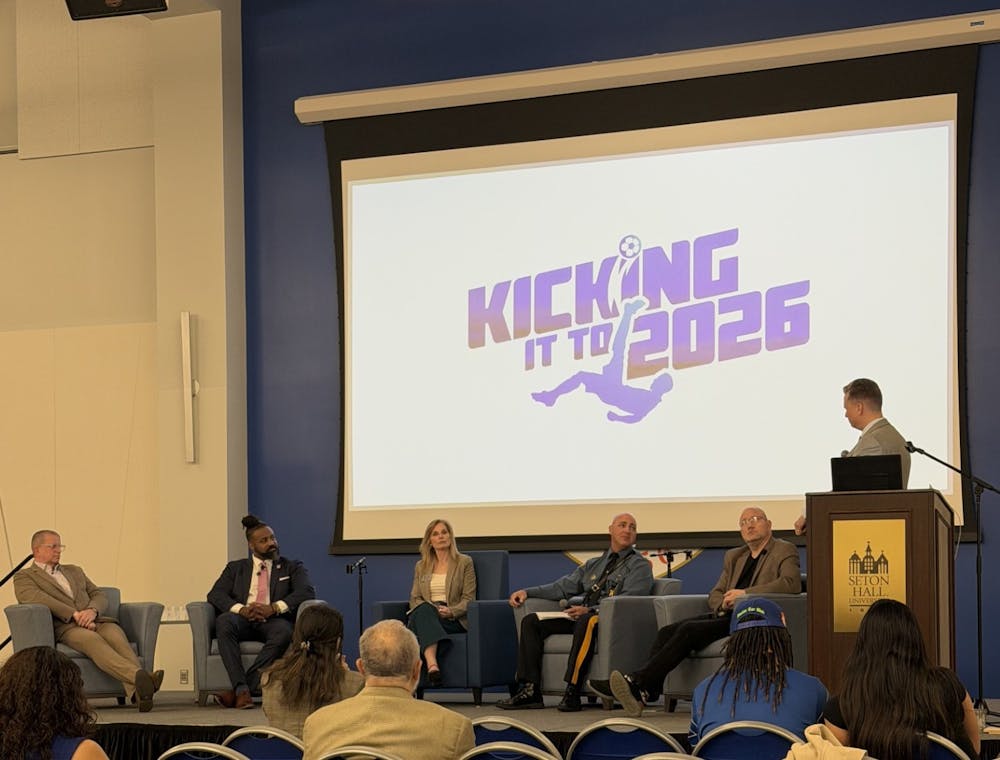
With New Jersey set to host matches for the 2026 FIFA World Cup, including the final at MetLife Stadium, Seton Hall’s Joseph A. Unanue Latino Institute hosted a panel on Wednesday addressing safety, crowd management and community impact surrounding the global event.
The event, “Keeping the Peace,” brought together experts in security, crowd psychology and event planning to discuss preparations for an international tournament expected to draw massive crowds.
Opening remarks emphasized the World Cup’s significance as both a sporting and cultural event, highlighting the need to balance celebration with safety as New Jersey prepares to welcome a global audience.
R. Frank Pannell, vice president of security for the U.S. Soccer Federation, discussed how security in sports has evolved. Drawing on experience in the Secret Service, CIA and private sector, he said modern operations must be proactive and adaptable.
“We are looking to neutralize threats, so we have to evolve the way we think,” Pannell said.
Pannell outlined key priorities for event security, including building strong relationships, planning for the future and ensuring security takes a leadership role. He added that poor intelligence can lead to dangerous outcomes, while proper crowd flow and coordination can help prevent crises.
Clifford Stott, a professor at Keele University in Keele, England, specializing in crowd psychology, addressed how misunderstandings about crowds can lead to failure in event planning. Stott referenced the 2022 Champions League final, where overcrowding and poor planning left thousands of fans stranded outside the stadium.
Stott explained that crowds are often viewed as chaotic but are typically structured and influenced by how they are managed. Issues arise when systems such as ticketing, checkpoints and entry points become overwhelmed.
“When those systems fail, the risk increases,” Stott said.
He also pointed to historical events such as the Haymarket affair to show that crowd issues are not new, emphasizing that education, communication and cultural awareness are essential to preventing escalation.
New Jersey officials are preparing through coordinated planning. Erik Stover, CEO of the New York Cosmos, said the state has designated a lead agency for World Cup security and created 15 working groups focused on transportation, communication and crowd control.
“This is about planning ahead, not reacting at the last minute,” Stover said.
Stover added that officials will engage directly with fans by assigning officers who speak different languages and connecting with supporters at hotels and gathering areas to guide behavior early.
“Different fan bases celebrate in different ways,” he said. “We want to allow that, but with boundaries.”
Speakers also discussed early intervention in fan zones, where alcohol consumption and rivalries can sometimes create tension. Panelists emphasized that timing and communication, rather than heavy enforcement, are key to preventing small issues from escalating.
Another major topic was FIFA’s decision to prohibit tailgating. While some fans have expressed frustration, panelists said the policy is driven by security concerns and limited space within secured perimeters.
At the same time, they noted that removing tailgating may present logistical challenges, as more fans could arrive at stadiums at the same time, increasing pressure on transportation systems and security while potentially spilling into nearby areas.
“Tailgating helps spread people out,” the speakers said.
The panel also examined the event’s potential impact on local communities. Kelly Brozyna, CEO and state director of the New Jersey Small Business Development Center (NJSBDC), said businesses could face increased demand, staffing challenges and supply disruptions, but may also benefit from opportunities to serve a global audience.
“New Jersey is already a very diverse state, which can help it handle a global event like this,” Brozyna said.
Throughout the discussion, speakers emphasized that hosting the World Cup will require coordination beyond the stadium, including transportation, law enforcement and community planning.
The event concluded with a question-and-answer session, where students asked speakers about fan behavior, safety strategies and event planning.
As the 2026 World Cup approaches, the panel said successful preparation will depend on communication, cultural awareness and coordination at every level.
Colin Comerford is a writer for The Setonian’s News section. He can be reached at colin.comerford@student.shu.edu.


