
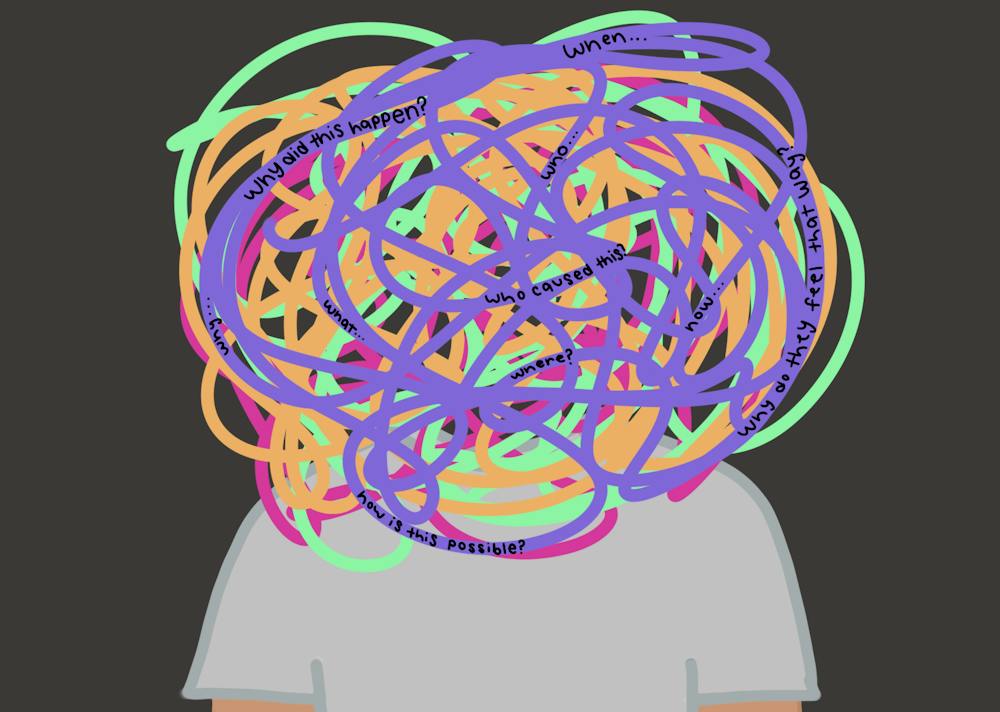
What if the reason you can’t stop overthinking an unanswered question isn’t because you don’t know the answer, but because you’re afraid you never will?
Sometimes, the more we search for understanding, the more questions arise. We replay conversations, analyze someone’s behavior and search for meaning where they may truly be none . We convince ourselves that if we think about it just a little longer, we will finally find that missing piece.
But what happens when the missing piece does not exist?
We tend to treat uncertainty as a problem that needs to be solved. When we don’t understand why something happened, why someone acted the way they did or what something meant, we feel compelled to create explanations before we have enough information to know whether they are true. Learning to recognize that difference and accept uncertainty when no answer is available can be more beneficial than forcing a conclusion simply to feel certain.
Psychologists have studied why uncertainty can be so difficult to sit with for years. In a review published in the Journal of Anxiety Disorders, psychologist R. Nicholas Carleton describes intolerance of uncertainty as difficulty coping with a lack of information. His review highlights something that is easy to recognize in our own lives: sometimes, uncertainty can be so distressing that we would rather have an answer we cannot verify than none at all.
This can become prominent within relationships, when we care deeply about understanding what another person is thinking, feeling or intending.
In my life, I have had connections and relationships with people that have left me with more questions than answers. Instead of accepting that I did not have, and was not going to get, the information that I was looking for, I found myself trying to piece together explanations, replaying conversations and searching for hidden meaning.
Eventually, I realized how easy it is to cross the line between wondering and assuming.
Think about how easy it is to go from “I don’t know why they did that,” to “maybe it’s because,” to “I know exactly why.”
A 2022 study by psychologists Annalisa Theodorou and Stefano Livi examined 315 heterosexual couples and concluded that people with a higher need for cognitive closure were more likely to assume that their partner felt similarly to them, and were less accurate about how their partner actually felt.
That finding reflects something we experience outside of romantic relationships, too. If someone does not respond to a text, we assume they are upset with us. If someone acts differently, we convince ourselves we know why.
The story might be true. But it might not be. And when we desperately want an answer, “might be” can start to feel like “must be.”
This is where overthinking can become less about finding the truth and more about relieving discomfort.
Think about a situation you have been trying so hard to understand. The conversation you keep replaying in your head. The people whose intentions you still question.
Have you ever considered that the answer might not be as simple as you wish?
We often want life to give us clean answers, especially when emotionally involved. We want to know who was right and who was wrong, who cared and who did not, what went wrong and what we could have done differently to prevent it.
However, people are complicated, and so are our relationships with them. We have to accept that most things in life are not black and white—they fall into this gray area, where it is possible for two truths to exist at the same time, even when they seem to contradict each other.
Someone can care about you and still hurt you. You can make a mistake and still be a good person. You can love someone deeply and still recognize that a relationship with them is not meant for you. Something can hurt without it being anyone’s fault.
When we force complicated situations into simple categories, we risk leaving out part of what actually happened. Not every situation involves someone being right, someone being wrong or a single clear reason for what happened.
So what do we do when we cannot find the answer we are seeking?
A 2023 meta-analysis and systematic review analyzed 91 studies involving 30,239 participants and found significant association between intolerance of uncertainty and difficulties with emotional regulation.
This makes sense when we consider how uncertainty can affect us emotionally. When we do not know what happened, what someone or something meant or what will happen next, it is difficult to let the question exist peacefully.
We replay the situation, searching for the explanation that will make us finally feel at peace. At that point, the search for certainty becomes part of the problem. Continuing to search can keep us stuck in the loop of ambiguity we are trying to escape, rather than bringing us closer to closure.
Maybe some things are simply unfinishable. We can spend hours, days, months, even years trying to understand why someone acted the way they did, what their true intentions were or what we could have done differently—but sometimes there is no answer that will satisfy our need for closure.
That does not mean we need to like what happened or pretend it did not hurt. Acceptance can simply mean recognizing the limits of what we know and choosing not to fill those gaps with assumptions. Sometimes closure, and freedom, comes with saying “I don’t know,” and being okay with that.
Maybe emotional intelligence is not always about finding the answer, but about learning to move forward without one.
But the question is, can you accept that?
Hailey Zaborowski is a writer for The Setonian’s Opinion section. She can be reached at hailey.zaborowski@student.shu.edu.


