
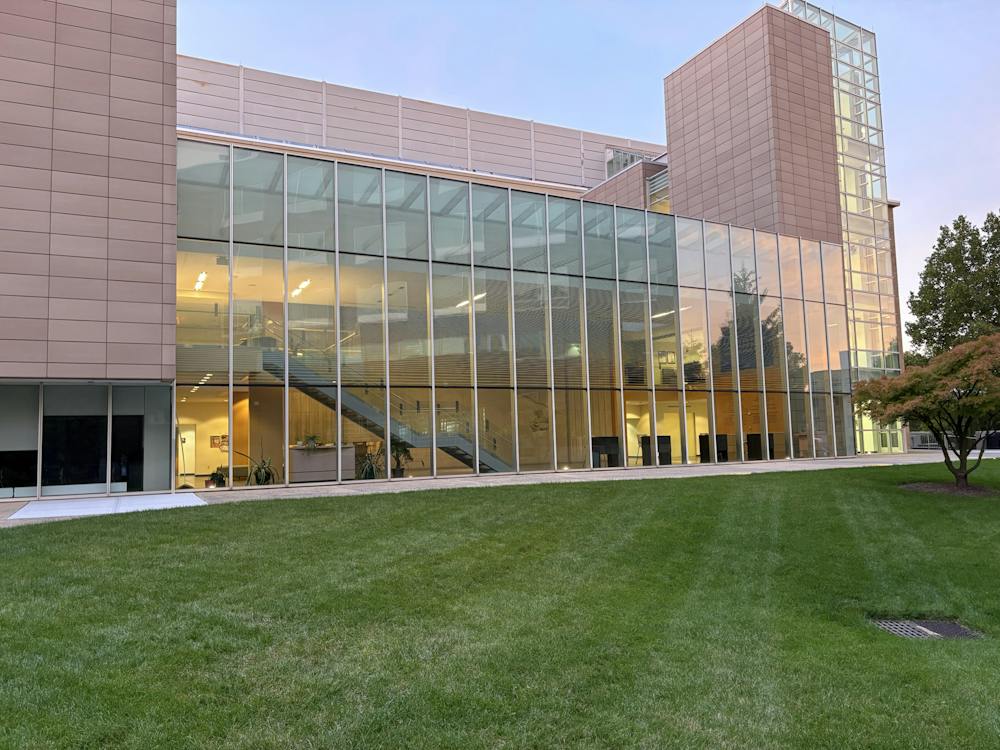
Seton Hall is expanding its research and instructional laboratories in McNulty and Corrigan Halls, aligning with Pillar 3 of its strategic plan, “Inspiring Great Minds to Greater Purpose,” which promotes research and innovation. The multi-phase project aims to accommodate rising STEM enrollment and broaden hands-on research opportunities across disciplines.
The lab expansion comes as SHU continues to emphasize research opportunities and build on its 2025 recognition as an R2 institution, a classification indicating “high research activity” by the Carnegie Foundation and American Council on Education.
Andrew Misura, director of media and marketing strategy for University Relations, said the expansion builds on SHU’s R2 status and reflects the university’s commitment to “cutting-edge research, teaching and collaboration.”
Echoing Misura’s sentiment, Michael Soupios, executive director of the Teaching, Learning & Technology Center, said infrastructure improvements are essential to supporting student research and expanding academic programs.
“As a recognized R2 ‘high research activity’ institution, Seton Hall has a responsibility to provide students with meaningful research experiences,” Soupios said. “Modernizing these facilities is a key step in delivering on that commitment.”
Expansions in McNulty Hall
The initial phase of renovations targets McNulty Hall, which houses the university’s core wet lab space for physics, chemistry and biology.
Jeffrey Togman, associate dean for academic affairs and political science and film professor, told The Setonian that updating the building’s infrastructure is a priority because it has not been renovated in 20 years. McNulty’s electrical and exhaust systems are at capacity, Togman said.
“It’s not broken, it’s not failing, but we’re at the limit of what we can do given the current infrastructure,” he said.
Expanding these utility systems will allow for more equipment usage across departments.
The project will also create a dedicated preparation space for biology teaching labs in the former computer science space, Room 222. Togman said the committee has worked with chemistry and biology faculty to assess lab needs, and plans to finalize the assessment with physics faculty prior to commissioning an architectural and engineering study.
The improvements will support broader education, provide students access to research equipment and broaden their skill set, Togman said.
Jonathan Farina, dean of the College of Arts and Sciences, said the McNulty 222 renovations will occur in two phases.
“The first phase will just require the purchase of some lab benches to make the preparation room functional and that will be done this year,” Farina said. “It'll be in operation to serve students by spring.”
Longer-term improvements could take up to a couple of years, Farina said.
The renovations come as some STEM programs at SHU have seen enrollment growth. Farina said biology remains SHU’s largest major, while physics and engineering have also experienced growth. Students in biology take courses in chemistry, biochemistry and physics, placing additional demand on those departments and their laboratory spaces.
“All nursing undergraduates are required to take many science courses, physics and biochemistry are also popular majors, and all B.S. students in Arts and Sciences take laboratory sequences in biology, chemistry, or physics, so we have a large volume of students to teach and that puts a lot of pressure on all the science labs,” Farina added.
Togman said that growing interest in research extends beyond traditional STEM programs.
“We have so many programs that are increasingly drawing on the sciences,” Togman said.
He pointed to computer science, data science, psychology and fields such as anthropology. Occupational therapy and physical therapy also draw on the sciences, he said.
Undergraduate research is a priority for the College of Arts and Sciences, Togman said, because it gives students an experience that cannot be replicated entirely in a classroom. While Togman acknowledged that classroom learning remains central to a university education, he said research provides students with hands-on experience.
“Nothing teaches you about the rigors of research and why research is done the way it is, unless you do it yourself,” Togman said.
The infrastructure improvements are ultimately intended to expand students’ ability to participate in that work, Togman said.
“We’re not just improving the electrical or exhaust or providing a bioprep space for their own sake,” he said. “It’s all meant to serve the discovery of knowledge and the dissemination of knowledge.”
Soupios emphasized that infrastructure improvements are necessary to offer more academic programs and research initiatives in the future.
“What excites me most about this effort is what it unlocks down the road,” Soupios said. “Once we've improved the infrastructure and built that capacity, our departments and faculty will be in a much stronger position to pursue new technologies and expand what's possible in those spaces.”
Renovations in Corrigan Hall
Alongside the McNulty renovations, an expansion on Corrigan’s first floor is underway. The project includes new instructional laboratories and student collaboration areas.
“The University is expanding its facilities on the first floor of Corrigan Hall by opening new semiconductor processing, optics and laser and flexible instructional laboratories, in addition to student collaboration areas and remodeled faculty offices,” Misura said.
Farina said the University also expects to introduce new anatomy and physiology teaching models within the next several years, as well as additional equipment for microbiology, microscopy, physics and chemistry, including a Fluorescence Activated Cell Sorter (FACS), new Scanning Electron Microscope (SEM), and Liquid Chromatography Mass Spectrometer (LC-MS), as funding permits.
“We have no science instrumentation at the university that is exclusive to faculty research,” Farina said. “The goal is that every tenure-track and tenured faculty member have undergraduates and graduate students working with them in their labs on their studies. So, a lot of students should benefit from these investments.”
The renovations in Corrigan will also create new opportunities for academic programs and research initiatives, Farina said.
“Increasing the scale of undergraduate hands-on research is number one…then expanding the kind of areas of education we offer,” Farina said. “I’d like to open up a bachelor of science in environmental biology…and a bachelor of science in engineering.”
The first phase of the Corrigan project is largely complete, Farina said. The space is expected to open for classes and laboratory work in the spring, with equipment expected to be installed by November.
Elizabeth Maria Churchill is the assistant editor of The Setonian’s News section. She can be reached at elizabethmaria.churchill@student.shu.edu.


