
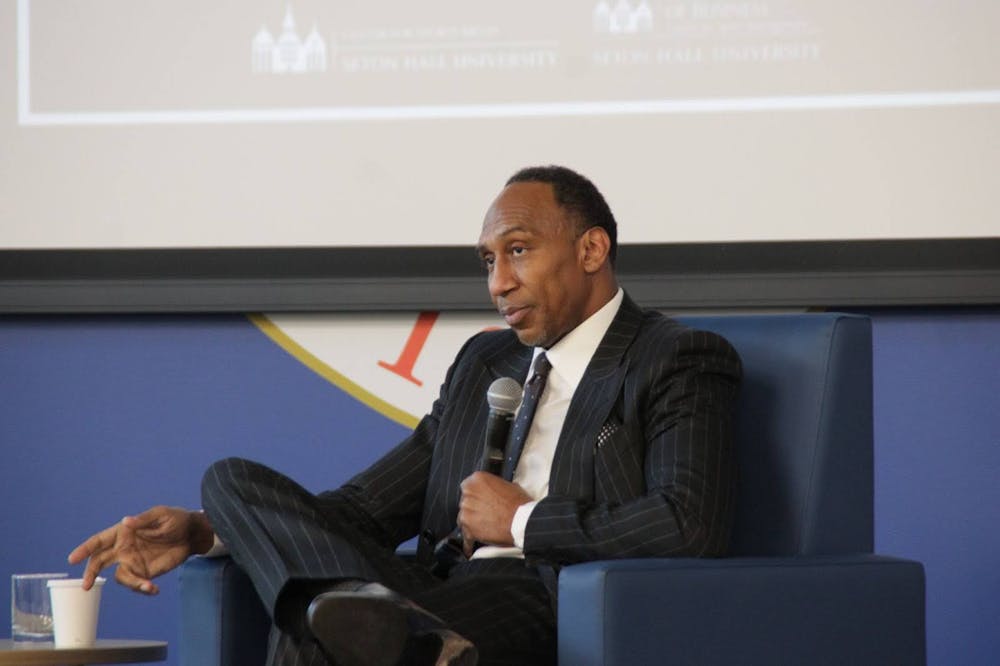
As one of the hardest-working figures in sports media, Stephen A. Smith’s workday rarely ends when he’s off the air—especially when given the chance to pay it forward.
After broadcasting ESPN’s “First Take” from 10 a.m. to noon, followed by his radio show from 1 to 3 p.m, both live from Seton Hall’s University Center (UC), Smith stayed on campus for an exclusive Q&A session, in which students had the opportunity to pick Smith’s brain on all things sports media.
Joined by his friend and Center for Sport Management Director Charlie Grantham, before getting into students’ questions, Smith was first asked to give an opening monologue about his career and rise in the sports media industry.
“Sports saved my life,” Smith said. “Growing up in the streets of Hollis, Queens, and getting left back in the fourth grade because I had a first grade reading level, suffered from dyslexia and all of that.”
Because of this, Smith suffered the ridicule of his peers, which he remembers almost 50 years later and still uses as motivation.
“And the reason why I bring that up is because everybody has a source of motivation that inspires them and propels them to certain heights,” Smith added. “I wanted to position myself where nobody could ever look at me and call me a dummy, and to this very day, I hold on to stuff like that.”
Smith was first asked by a student what advice he has for students who want to stand out in the sports media and sports management industry.
His answer: a mix of authenticity, but also consistency.
“My authenticity is what got me to where I am,” Smith said. “Everybody talks about ‘keeping it real,’ but they leave out the word ‘consistent.’”
“When you are consistently who you are, you are telling an audience they can trust you to be what they see, what they hear, what you project,” Smith added. “And so for me, that’s incredibly, incredibly important.”
Also in his opening monologue, Smith doubled down on his ambitions to run for president in 2028, placing the most emphasis on “calling out” problematic politicians in the Democratic and / or Presidential Debate come election time.
“Just the opportunity to call them out for what they’ve done to us as a country is an opportunity that I would relish,” Smith said. “And you can pick my greatest moments in the history of my sports career—it is nothing compared to how ready I would be for that night if I had an opportunity to be onstage against these damn politicians that I think have caused us a lot of problems.”
Naturally, this reporter asked Smith how he sees his debate and argumentative skills preparing him for the responsibilities of being the president, particularly for things like negotiation and decision-making.
“I’m considered one of the best negotiators in journalism,” Smith said. “So some of the things I’ve accomplished, I think it speaks for itself.”
“But for the purpose of politics, no politician is in a position to talk to me about [negotiation],” Smith added. “Our [national] debt is over $39 trillion dollars—who the hell is anybody in politics or Capitol Hill to talk to me about a budget, or about anything negotiating?”
Other students asked Smith about how shows like First Take will evolve with the emergence of shows that offer a similar mix of analysis and entertainment—a sports reporting style he helped revolutionize.
“I want to put a contest out there where I am recruiting youngsters to come on First Take and debate me,” Smith said, an idea similar to Jubilee’s "Surrounded” series on YouTube.
Smith also said he plans on “feeding the beast” that is his young audience, while also “keeping himself around young people”—advice he gained from (ironically) Dallas Cowboys owner Jerry Jones.
“I walk into the show every day thinking about what y’all want to see, not what I want to see,” Smith said, addressing the students in attendance. “And as a result, I think that I’m pretty good at recognizing what you want and giving it to you, and I think that is what has made me successful, and I think that is what will continue to make me successful–I will never abandon my viewers.”
“I’m gonna always be about what y’all want to see first—as long as it doesn’t compromise me as a man or professional,” Smith added. “I’m not gonna do some ratchet shit that other people do: I’m not gonna be twerking on camera, I’m not gonna be doing some of the other stuff that these people be doing just to get clicks, I’m not doing that.”
For the very last question of the session, Smith was asked about a belief that has gotten him to where he is today.
“It sounds bland, it sounds very, very predictable, but I’ll always lean on hard work,” Smith said. “And the reason why hard work matters is because it breeds a multitude of results.”
“But most importantly, it breeds faith, because you’re somebody who really cares about what they are doing,” Smith added. “And when you show that you care, that goes a long way towards people in a position to give opportunities to people who do.”
Zachary Mawby is the head editor of The Setonian’s Sports section. He can be reached at zachary.mawby@student.shu.edu.


