
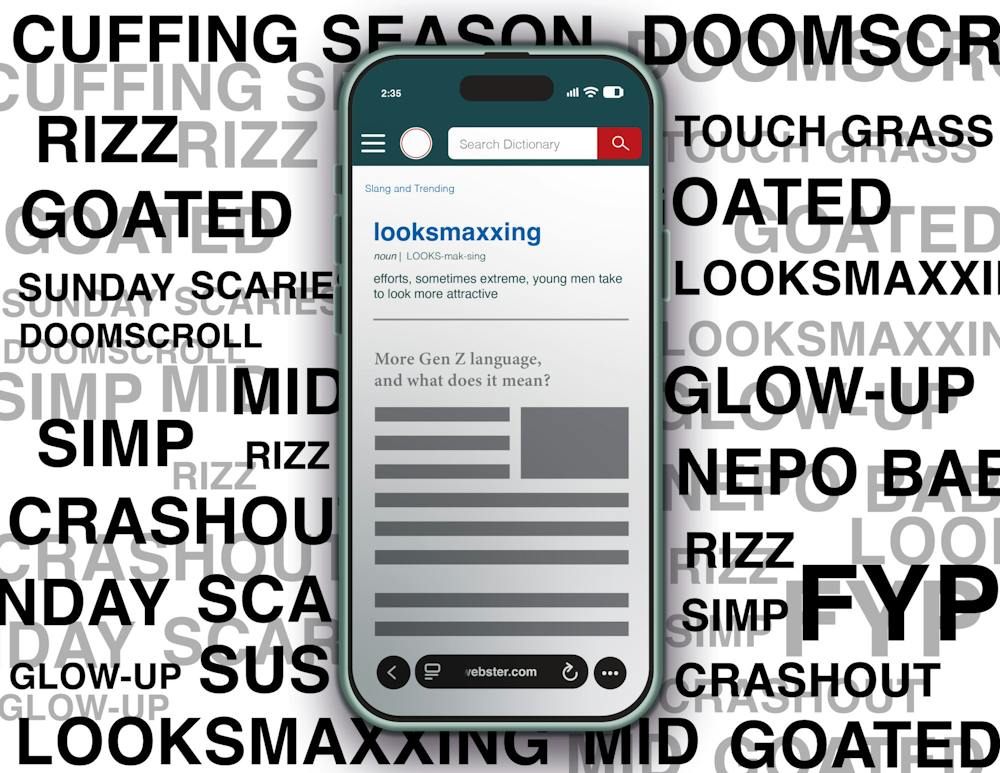
Parasocial doomscrolling during the Sunday scaries always leads to a crashout.
While this sentence may sound insane to many, these words are just a few of the more than 1,400 words Merriam-Webster added to its online dictionary last month—many of which were coined by Generation (Gen) Z.
“Doomscroll” is a popular term used to describe the urge to aimlessly scroll online. “Crash out” is another, describing an uncontrollable emotional outburst.
But while many of these terms may feel distinctly Gen Z, the generation is far from the first to use slang. It has always existed, evolving alongside the fads of the moment.
“Slang has been around for centuries; even Chaucer used a slang word for dice in ‘The Canterbury Tales,’” Dr. Gail Vignola, a lecturer and coordinator of second language writing, said.
Vignola has “lived through multiple iterations of slang.” However, she noted that Gen Z is “the first generation unable to remember a world without smartphones, social media and constant digital connectivity,” and has a particular familiarity with emerging slang.
Although slang is nothing new, the digital landscape in which Gen Z encounters it is. Since Gen Z spends so much time on platforms like TikTok and Instagram, much of its communication happens online, blurring the line between slang and the English language.
Sila “Zeyrep” Aydin, a junior in the 3+3 law program, believes words like “rickroll” and “looksmaxxing” do not belong in the dictionary.
“I just don't feel like those are significant,” Aydin said. “Like the first one, I don't even know what it means.”
For some students, the question is whether certain expressions carry enough meaning to deserve a place in the dictionary.
“I think some modern-day slang definitely belongs in the dictionary, especially for old heads. Like, for them to understand what we're saying,” Brandon Castillo, a sophomore nursing major, said.
Vanessa Marks, a junior biology major, suggested the words should be in an alternative dictionary.
“Urban Dictionary, definitely,” Marks said. “Maybe not in an Oxford dictionary.”
While some question whether these words belong in traditional dictionaries, there is no denying their cultural impact.
Castillo said slang is “already a huge part of our language.”
Slang is also “a kind of code-switching that comes from culture,” Vignola said. “By including slang from marginalized communities—ethnic, linguistic, racial and other sub-communities such as LGBTQ+, artists, etc.—slang grows and these factors can both introduce new slang and shape how it’s used.”
The influence of culture on slang is especially apparent in communities where languages intersect. Vignola pointed to “Spanglish,” a blend of Spanish and English common in places like Miami, as an example of slang that is used among younger generations but less appreciated by older people.
Despite the cultural connections that slang creates, it can draw criticism, particularly when expressions are misunderstood. The consequences range from harmless misunderstandings when millennials can’t keep up with Gen Z slang, to more serious effects like “social stigma, suggesting a lack of professionalism,” Vignola said.
Despite the potential for miscommunication, slang continues to shape how Gen Z communicates. Even when certain terms fall out of fashion, they are usually still remembered and used by the generations that created them.
Vignola pointed to terms like “cool” and the well-known phrase “YOLO,” which some still use jokingly today.
Aida Antenor, a freshman nursing major, associates slang with humor.
She said people use slang “because it's funny, and it's what you say to make people laugh.”
Although many Gen Z students recognize slang as providing a shared source of humor and connection, not everyone uses it in the same way or to the same extent.
Jackson Smith, a freshman in the 3+2 dual-degree Applied Artificial Intelligence Engineering program, said his everyday language is largely influenced by social media, estimating that 80% comes from online platforms.
Other students estimated that social media accounts for anywhere from 20% to 70% of their vocabulary.
While the internet may heavily influence the way Gen Z speaks to each other, many students agreed that popularity online doesn’t guarantee a term’s place in the English language.
“I think…there's a lot of nuance to it. Like, if [slang] becomes so centralized, then, yes, it will become part of the English language,” Marks said. “I guess once it's been around long enough to the point where everybody knows it, but… it can [still] kind of fade in and out… and become obsolete."
This potential for slang to fade is worsened by the fragmented nature of the internet. Aydin proposed differences in social media algorithms as a reason for “mismatches” in the use of slang.
“What people see online really just depends on who they are,” Aydin said. “Like, yes, there might be a lot of things that match between what university students see. But it still doesn't mean that every college student is going to see the same thing.”
Nevertheless, even if algorithms isolate different groups, one thing social media has undoubtedly changed is the speed at which slang spreads.
“They travel literally at the speed of light,” Vignola said.
That rapid spread has also helped slang become a shared language among Gen Z, giving young people a way to connect through their online experiences.
“I feel like a lot of our generation has grown up on social media and it's been such a big part of our entertainment and what we do for fun,” Aydin said.
Still, not everyone embraces the latest additions to Gen Z’s vocabulary.
“Huzz” and “looksmaxxing,” along with the “skibidi toilet” and “6-7,” were among the terms students volunteered for the chopping block.
Although slang itself may often be unserious, it can provide social and psychological benefits. Whether through a shared laugh or a sense of belonging and identity, Gen Z’s language can help foster communication and connection.
Castillo admitted that, dictionary definition or not, “there's a lot of stuff we say online that, realistically, outside of online, has no meaning to it. But we give it meaning.”
Despite Gen Z’s “lax” communication style, Vignola is not worried that students could return to linguistic norms when necessary.
“My own students show how aware they really are about a language formality that is
subject to both global and local linguistic norms,” she said. “I remain optimistic, even when my students—in their forgetful moments—refer to me as ‘bro.’”
Liani Raymond is a writer for The Setonian’s Features section. She can be reached at liani.raymond@student.shu.edu.


