Since his brief yet successful stint as a Golden State Warrior, Kevin Durant’s basketball legacy has been debated by fans and former players alike.
His legacy as a “keyboard warrior,” though, is undeniable—and has gotten him in trouble several times, but now more than ever, bringing to light the dangers of obscurity online.
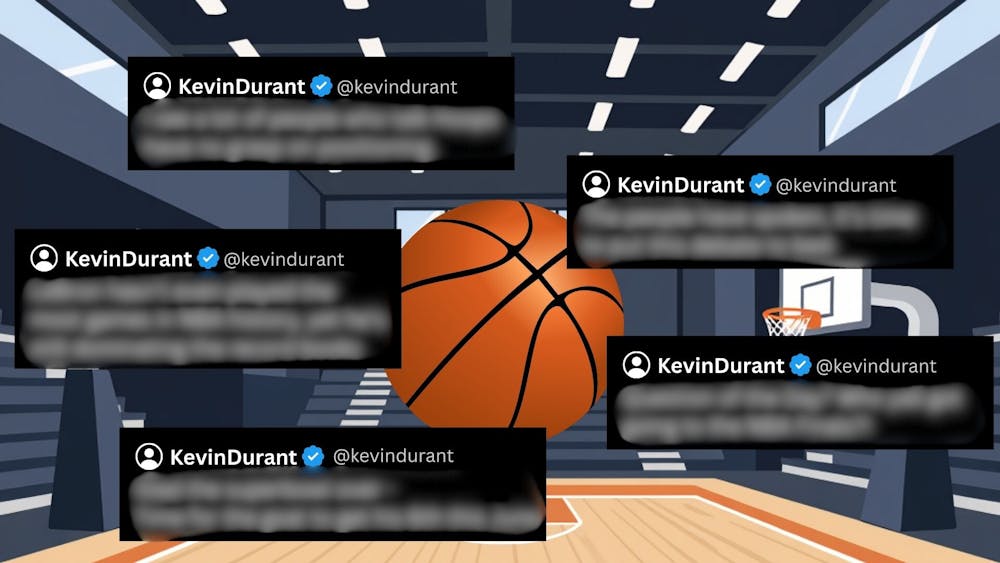
This year’s All-Star Weekend was anything but for Durant: a few hours before he was getting ready to suit up for the 16th All-Star Game of his career on Feb. 15, Durant was going viral on X (formerly Twitter) for all the wrong reasons after an alleged burner account of his was exposed.
Durant, however, is known for being a chronically online X user and has even admitted to the existence of such an account several times before. Something especially difficult for him to hide after his infamous slip-up in 2017, when he referred to himself in the third person to explain why he left the OKC Thunder for Golden State, suggesting that he forgot to switch from his main account to his burner. So the “exposure” of his alleged burner, @gethigher77, was hardly a surprise (not even the first time it's happened, although the first on X).
But the awful things the account said in the messages that leaked most definitely were, especially if it is indeed Durant’s.
Leaked in what fans have since dubbed “The KD Files” are messages from private group chats where the alleged account makes several disparaging comments about former and current teammates of the four-time scoring champ, from Russell Westbrook, James Harden and Kyrie Irving, to Alperen Sengun and Jabari Smith Jr.
The frequent mention of Durant’s teammates, past and present, was one of the many signifiers to speculate that it really might be KD. Other signs include the fact that only Durant’s mutual followers on his main account follow the burner; the many replies from said followers lining up with specific events in KD’s life, like birthdays and injuries; and Durant posting the same exact picture of an owl that his alleged burner uses as its header onto his main account a few weeks after the former was created.
In one of these leaked messages, the alleged account even went so far as to compare Durant’s former Phoenix Suns teammate and head coach, Devin Booker and Frank Vogel, to “Stalin and Hitler” (as well as “Mussolini and Kim Jong-Un”).
If the account indeed belongs to Durant, the unfortunate irony here is that the one comparing his former colleagues in basketball to the orchestrators of mass genocides is the same person not only indirectly funding one himself—something he shares in common with another former-teammate Steph Curry—but then also having the audacity to joke about it.
Back in 2020, Durant invested in Skydio, a surveillance drone company that has since sold stock to the Israel Defense Forces (IDF) during their military occupation of Gaza that has leveled the territory and resulted in the death of over 75,000 Palestinians and counting. Rather than distance himself from the company, the alleged burner of the 2013-14 MVP said in the worst of these leaked messages that “If they [as in the IDF] need drones!! We got ya.”
Jokes about genocide are always super funny, especially when you are a celebrity thousands of miles away from the situation and with the money, power, and influence to help in some way, potentially saving thousands of lives. Maybe KD’s “Next Chapter” after basketball should be a career as a comedian!
A genuine moment of comedic genius came when clips of Durant, seemingly glued to his phone at the All-Star Game, started to circulate online following the news. This lends itself to even more layers of irony, especially considering how Durant called out ESPN NBA Insider Shams Charania for being on his phone while playing in the All-Star Celebrity Game just a few days before.
Even funnier was Durant’s attempt at damage control: after the Rockets’ first practice since All-Star break on Wednesday, the Houston Chronicle’s Varun Shankar asked KD about the account—to which Durant refused to get “into the Twitter nonsense,” instead saying he is “just here to focus on the season, [and] keep it pushing.”
But this isn’t meant to be a “hate piece” of Durant by any means—it’s meant to serve as a reminder that saying things online behind the protection of anonymity is not cool, whether you’re an NBA superstar like KD or far from it.
The sad reality is that many of us, Durant included, unfortunately live a twofold, dichotomous life in our digital age: one away from screens, and another behind them, with the latter often granting people the luxury to say what they never would in the former because they know they won’t face consequences for it.
As such, the more time we spend in this latter life of digital anonymity, the more we become like the screens and platforms we hide behind; in other words, the more we become anonymous, unsympathetic, faceless, lifeless, and emotionless ourselves and in our lives away from screens.
The more we become detached from reality, the more we lend ourselves to a disregard for membership and or participation in civil society itself. When I can log into my X account and make jokes about the genocide going on in Gaza with my friends online without fear of backlash, but can’t say the same for interactions with people in real life, why would I ever choose the latter? Why would I care about what happens in society when I have a perfectly curated society on my phone with no rules or need for social etiquette?
Couple this with the ever-increasing existential threat that is artificial intelligence, and we have the recipe for a future where people are not equipped to give serious thought to real issues that happen in real life to real people because they can’t conceive of or don’t care to conceive of anything outside of their perfectly anonymous, consequence-free existence online.
But nothing is ever really “consequence-free”—it might be punishment-free, but one will suffer psychological and moral consequences after such behavior nonetheless.
And now to get Biblical (we go to a Catholic institution, after all). In the New King James Version of Luke 12:2-3, it says: “For there is nothing covered that will not be revealed, nor hidden that will not be known. Therefore, whatever you have spoken in the dark will be heard in the light, and what you have spoken in the ear in inner rooms will be proclaimed on the housetops.”
In other words, “what happens in the dark always comes to light,” as the proverbial version goes, and although you may not get caught for what you do or say, you always “reap what you sow” (to use another proverbial phrase).
This is not to say that all anonymity online is bad—it serves several important functions like offering privacy, protecting survivors of abuse and or trauma, and so forth—but there are too many examples of misuse, and that shouldn’t be the case.
Zachary Mawby is the head editor of The Setonian’s Sports section. He can be reached at zachary.mawby@student.shu.edu.