As early voting approaches for the midterm elections, some Seton Hall students are expressing concerns about election integrity, political polarization and their confidence in the democratic process.
Concerns about election integrity are widespread among young Americans. A spring 2026 Harvard youth poll found that only 33% of young Americans trust that the 2026 elections will be conducted fairly, while 43% do not and 23% are unsure.
The midterm elections will determine the balance of power in Congress and serve as a national test of President Donald Trump’s administration. As of Oct. 14, President Trump’s approval ratings stood at 34%, with 61% disapproving and 4% unsure.
With control of both chambers at stake, debates over election security, voter access and the role of federal authorities have added to concerns about public confidence in the democratic process.
Concerns about federal authority and voter safety
Discussions among some Republican leaders about the potential deployment of U.S. Immigration and Customs Enforcement (ICE) agents to polling locations have raised concerns about voter intimidation and the possibility of influencing election outcomes.
The Department of Homeland Security has said it has no plans to deploy ICE to polling places, dismissing concerns as “fearmongering.”
However, the issue has continued to draw attention from political leaders.
Attorney General Todd Blanche responded to concerns by asking, “Why are there objections to sending ICE officers to polling places? Illegals can’t vote.”
Contrastingly, Democratic leaders filed a lawsuit against the Trump administration in September seeking to block armed federal agents from polling places. The lawsuit, filed by Senate Minority Leader Chuck Schumer and House Minority Leader Hakeem Jeffries alongside Democratic campaign organizations, alleges that deploying federal agents to voting locations could intimidate voters and violate federal law.
For SHU students, the discussion raises questions about the relationship between government authority, voter safety and public trust.
David Gomez, a junior creative writing major, said he believes the possibility of deploying ICE agents to polling stations could be an attempt by the federal government to influence the midterm election outcomes.
“I think the presence of any type of government agency, legal or otherwise, aside from those specifically running in elections, being in elections office, even if it's unintentional or even if it's claimed to be innocent, is inherently having an influence on how people vote,” Gomez said.
Gomez added that increased ICE presence, combined with heightened political tensions, has made it difficult to trust party leaders.
“It’s one thing to say that a place feels safe enough or unsafe enough to the place to warrant law enforcement [presence],” Gomez said, “but to be placing law enforcement in an election booth or in an election place is already a statement of how much you trust that things are being done reliably. It's all about an issue of trust.”
For Gomez, that distrust also reflects a disconnect between national political debates and students’ everyday concerns.
“I know as a student on the day-to-day, I'm thinking of things like, how am I going to pay off tuition, where am I going to be looking at for job prices, especially after college,” Gomez said. “The thought of political volunteering or activism or even consideration for candidates is just something that is too distant from my day-to-day to even really consider.”
Despite these concerns, Gomez said events over the past year have motivated him to vote.
“I think the last year as a whole and the overall response to it is a big reason why I’m going to vote,” Gomez said. “And while I don’t think that one vote will necessarily contribute all that much to solving these issues, I do think that neglecting that vote is certainly one further contributing thing.”
Political polarization complicates participation
While Gomez said political developments have motivated him to vote, other students said the increasingly polarized political climate has made participation more difficult.
Liam Philhower, a junior biology major, said he is considering abstaining because he does not feel sufficiently informed about current political events to cast a vote.
“We’re in a very rapidly changing environment politically, and as such, because I haven’t kept track, I don’t feel like I can make an informed choice, so I’d rather not make a choice at all,” Philhower said.
Philhower also said political polarization has made it harder for Americans to engage with people who hold opposing viewpoints, contributing to distrust among young voters.
“This distrust reflects the wider deterioration of the ability to have a conversation with someone that has a different opinion without it resulting in ad hominem attacks,” Philhower said. “We no longer have the ability, as Americans, to disagree with each other.”
Keiri Shuyama, a junior philosophy and theology major, expressed similar concerns, saying divisive political rhetoric has made it difficult for young voters to determine whom to trust.
“There’s definitely been a lot of ‘us vs. them’ rhetoric, whether it’s people vs. government or even people vs. other people,” Shuyama said. “What usually ends up happening as a result is that the other people you’re against stop becoming people. They’re just seen as the enemy.”
John Paul Hart, a junior theology and philosophy major, said the volume of political discussion has become too overwhelming to follow.
“I haven’t really been aware of a lot of political dialogue going on these days,” Hart said. “There are some things that I feel strongly about that I would need to lend my voice towards. But other than that, I’m not educated enough to make that decision.”
Past controversies contribute to distrust
Some students, like Collin Sardinha, a junior English major, said skepticism about the electoral process also stems from controversies surrounding previous elections.
Sardinha said confidence in the electoral process is essential to ensuring voters believe their participation matters.
“If people can’t trust their government, then it is automatically going to make that government weaker,” Sardinha said. “If we can’t trust that the people we’re trying to elect are the ones who are actually chosen for government positions, then how can we ensure our voices are actually being heard?”
Jenna Root, a junior history major, said doubts about election integrity can extend beyond individual races and undermine confidence in democratic institutions as a whole.
“If one thing can be wrong in our system, who knows what else can be wrong?” Root said. “Certain politicians will say that something [is] rigged or not, and if they’re thinking that it’s wrong, then how can anybody trust the rest of the system?”
Local efforts encourage voter participation
While students expressed differing levels of confidence in the electoral process, local advocacy groups have encouraged residents to participate in the upcoming election.
SOMA Action said approximately 350 people attended its “No Kings: Vote Early” event on Saturday, Oct. 17, lining South Orange Avenue with banners and signs promoting voting.
“We know Donald Trump is scared of losing this election,” Allison Posner, co-president of SOMA Action, said. “He has told us over and over that he’s going to try everything he can think of to cause chaos and try to create a pretext for overturning the results. That’s why it’s so important to get out and vote as soon as you can. We need overwhelming turnout and margins of victory that are too big to challenge. Early voting is key to that because if there are problems, voters have extra time to get the problem fixed.”
SOMA Action co-president Erika Malinoski also urged voters experiencing difficulties at the polls to exercise their right to cast a provisional ballot.
“Essex County’s election officials are committed to making sure all eligible voters and the process goes smoothly, but if there are any issues, don’t leave without casting a provisional ballot,” Malinoski said. “Voters can also contact the Election Protection Hotline at 866-687-8683.”
How to vote in New Jersey
New Jersey’s early-voting period is scheduled for Oct. 24 through Nov. 1. In-person early-voting locations will be open from 10 a.m. to 8 p.m. Monday through Saturday and from 10 a.m. to 6 p.m. Sunday. Voters can find locations on the New Jersey Division of Elections website.
The closest early-voting sites to South Orange and Maplewood are the Berson Education Center at the Turtleback Zoo and the Irvington Municipal Building. Voters may vote at any early voting site in Essex County.
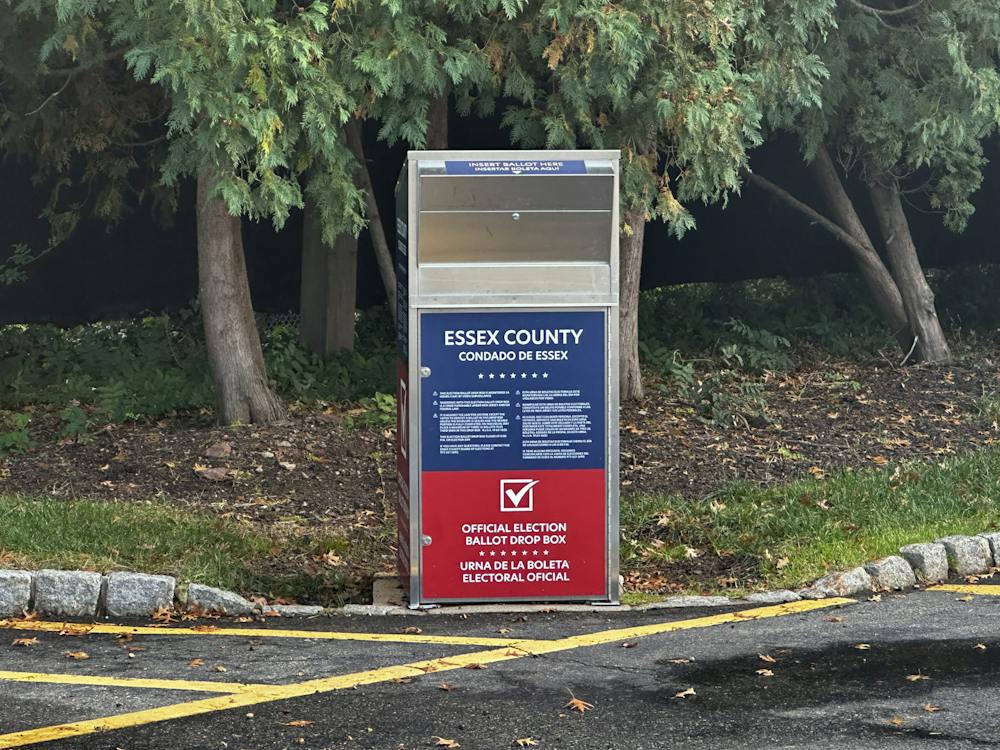
Students can drop off their mail-in ballots at the drop box in the parking lot across from Bethany Hall. SOMA Action said there are also drop boxes under the gazebo at the South Orange Train Station or at the Hilton Library Branch on Springfield Ave in Maplewood.
Election Day is Tuesday, Nov. 3, from 6 a.m. to 8 p.m. Voters can find their assigned voting location through the New Jersey voter information portal.
Carmine Sortino is a writer for The Setonian’s News section. He can be reached at carmine.sortino@student.shu.edu.
Megan Pitt is the Editor-in-Chief of The Setonian. She can be reached at megan.pitt@student.shu.edu.