
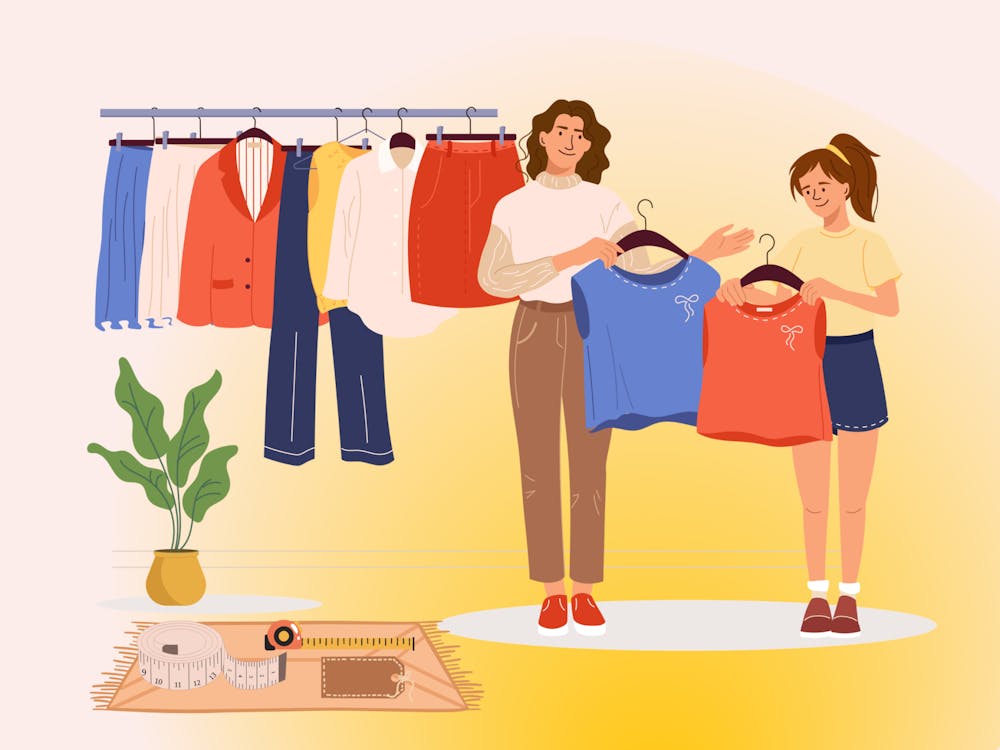
For many young girls, shopping and retail therapy are quite common; however, it has become increasingly difficult for girls to find their sizes without clothes being too small or too big.
Often, these clothes never truly fit to size, and it has become a rising problem in many brands. Sadly, the customer is the one who takes the blame. It’s time for people to really start confronting the issue: the companies.
On early Saturday mornings, malls are jam-packed with teenage girls trying on the latest clothes from Hollister or American Eagle. And if they're not at the mall, they’re shopping online for the newest collection dropped by their favorite stores and shown off by their favorite influencers on social media.
But for women and young girls, sizing has become one of the largest problems in fashion. Sizing in the fashion industry has simply become out of control.
Many girls don’t know if they're a size two or a size six or a size M or L. So many girls question if they are the problem. They become the blame when they express their sizing issue. There are often common phrases in this issue that women and girls hear like “Well, maybe you should lose a few pounds” or “You should put some meat on those bones.”
It has become one of the most unnecessarily difficult parts of girls' and women's lives. Who would believe that finding clothes that actually fit in such a fast-paced and vast fashion industry, with endless options, prices and styles, would still be a problem for girls and women.
It's time to address the real issue of companies having inconsistent sizing. It’s time that we confront the fashion industry for their sizing problems and stop blaming and forcing harmful bodily images and thoughts on young girls.
The rise of department stores and clothing companies was the start of independent forms of clothing. Companies began developing their own ways and standards of sizing what an S or L was. According to Time Magazine, as early as the 1940s, major companies had started their own “sizing standards” in how they measured the fitting of their clothes.
Yet the rise in sizing climbed to its peak in the 1970s and 1980s with the rise of vanity sizing. Vanity sizing was a sales tactic created by companies to boost sales. These companies would alter the sizes of clothing, often adding inches to them and labelling them as a smaller size, in an attempt to make customers feel more comfortable.
Fit Analytics reports that “A size eight would often be expanded by up to six inches” as both a psychological and sales tactic for the companies to profit on.
Vanity sizing has grown to impact people of all sizes and shapes and has severely damaged people's outlook on shopping.
Sophomore Alyssa Aromando, a fine arts major with a concentration in fashion said, “Everyone thinks that ‘Oh when you're a size zero it’s easy to find your sizing, but a size zero is not everyone’s sizing.’”
Aromando added that it’s ironic that stores instruct customers to shop online to find larger or smaller sizes like 4x or 000.
“These brands are putting out clothes that aren’t really made to fit a human body,” she said. “It’s fit to fit a mannequin.”
No matter one's size on the scale, big or small, the struggle to find clothes has become apparent in many clothing stores due to the change that vanity sizing has created in clothing.
From a sales perspective, Aromando reflected on how “putting the narrative that small is bad or that big is bad, makes you not want to shop there.”
“If this store doesn’t carry my size, I’m probably not going to have good luck finding it anywhere else,” she said.
“I definitely think that when you go to a store and you don’t see your size it is discomforting,” Aromando added.
The enforcement of these sizing ideals on girls, telling them to size down or up, or to even go online because their size isn’t in stores, creates this narrative that the person's body is the problem when it is really the store's enforcement of sizing ideologies.
Marina Bresler, head designer and design director at the evening wear company Betsy and Adam, said that “Fashion changes what women look like.”
“Women were all kinds of sizes [in history],” Bresler said. “All kinds of sizes were considered in fashion at different times.”
As a designer, she believes, “It’s very hard for somebody who is not in the industry, who is just a consumer buying. I think it’s probably hard for them to understand how it works.”
Vanity sizing has become heavily normalized in fashion, and yet, the tactic is so psychologically brilliant that the everyday shopper falls victim to it because of how well it works.
Designers like Bresler understand that when designing and fitting women's clothing, sizes, especially, depending on the type and style of garment, can alter how it is sized and fitted.
In addition to the dominant standards of vanity sizing across clothing brands, brands further add to the effect of sizing on girls through the ways in which the brands market and portray themselves in advertisements.
“The fashion industry has a problem with exposure in general,” Aromando said. “We are still in that All-American girl, super skinny, like collar-bone being shown [idea].”
Aromando further touches on brands and companies' fear of changing because she believes that they “don’t want to be labeled as something in a certain way.”
“It's super easy to label someone as encouraging them to have an eating disorder or encouraging someone to be unhealthy,” Aromando adds.
It continues to harm the female body image, as Aromando believes, because “if you identify as a woman, you automatically are going to be sexualized [as well]” in the representation that stores put out in ads or in marketing campaigns.
She further adds how it is “very detrimental to young girls” for brands to put up sizing standards and to lack representation of every single body type.
“We're letting women down. How can we call ourselves a fashion company but we can’t even be honest about what we are selling?”
Brands seem to disregard the problems of false sizing, clothing sexualization, and discomfort that they create, because to them, it has become only about profit.
“It’ll always be a money thing,” where companies are willing to profit off of it, Armondo said.
While brands' priority has mainly become about profit and sales, other brands are quite intentional about who they create and sell clothes to, to earn the most sales and profit.
Bresler says that “Brands figure out who their customer is and sell that way and sometimes it's really garment specific.”
She further mentioned, “I think they also look at what sizes are the most popular. I think the way that brands decide [what sells most] is to look at the sizes that they sell most [and] their most popular garments.”
“For instance, with us, I won’t even cut a [size] two in certain dresses. And in other dresses, I won’t cut a [size] 14,” Bresler said.
She understands how the everyday shopper struggles, while also seeing that certain brands will choose to create certain clothes fit for certain people.
Today’s culture is highly prone to cancelling brands or people over the slightest of issues. Brands might not want to ruin their image and are willing to pay the price of sizing to keep their image and profits. Companies are willing to alter sizes to hold onto popularity, to keep up profits, to continue to draw in a certain target demographic, and to sell as much as possible.
And although vanity sizing has spread to nearly all forms of clothing for all ages, women are the ones who are mainly the target of this tactic. They are the ones who suffer the most at the hands of these brands.
Time Magazine further writes that “it is a much more sweeping issue for women” as they face constant unfair gender standards in different settings or occasions, such as in sports, job interviews, and even in marriage. Women not only face society's large number of standards and expectations, but also must deal with clothing brands' amplification of these ideals.
It is like a battlefield in some stores. Hunting for the perfect pair of jeans while ensuring that the front doesn’t show your tummy, but also making sure the back doesn’t have a gap that your phone could fall through. Finding the perfect dress to wear to your cousin's wedding, while also making sure you don’t look too slutty, or even look like you might upstage the bride.
These are the battles vanity sizing creates, and most of the time, they are battles where women wave the white flag of surrender and defeat.
So the million-dollar question is: how can this issue be fixed or remedied?
Our current society lives with the world at our fingertips. With access to knowledge of all kinds. We are able to connect with those from across the globe with the click of a button. Social media fuels the idea of influence and connection in the world of fashion.
Bresler believes one way brands can solve this issue is by using these vast amounts of resources and internet access and connecting with people.
“I think they could ask,” Bresler said. “Everyone has a website. Everyone has TikTok. Everyone has a way to reach their customers. They could hear what actual people have to say.”
Bresler added that at her company, Betsy and Adam always keep in mind “who’s wearing it.”
“We will sacrifice fashion for fit,” Bresler said.
Aromado emphasizes "presence" as matters most for a company to improve sizing.
Companies need to work on, as she said, making sizes “more accessible and not so expensive” as well as eliminating the agenda of “white skinny girls’ with “flat-chests.”
“It is up to the next generation of fashion designers to truly change this, and to change the [fashion] climate that we’re in.”
Ashley Smith is an assistant editor for The Setonian’s Opinion section. She can be reached at ashley.smith1@student.shu.edu.


