
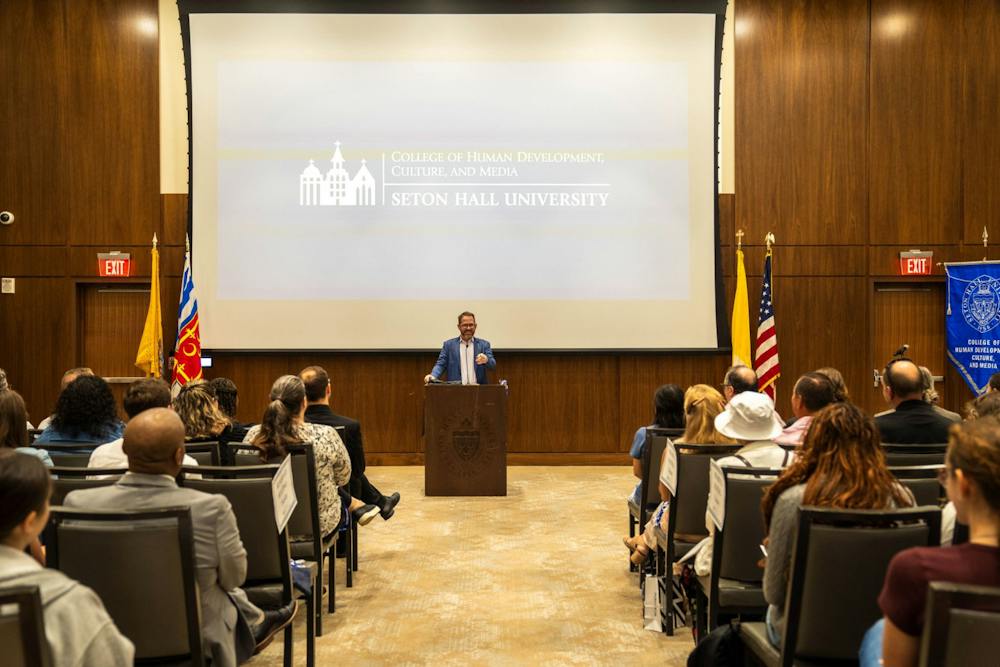
As universities throughout the country consider how to deal with AI, Seton Hall’s College of Human Development, Culture and Media (CHDCM) is integrating it and other cutting-edge technologies such as Adobe Creative Cloud into its programs.
The goal is to ensure students are familiar with tools they may encounter in their future careers. Some students, however, have expressed concerns about AI’s role in many areas, including art and design—a major focus of CHDCM’s academic programs. Those conversations intensified after CHDCM hosted its annual convocation on Sept. 10, when attendees were offered stickers that some students believed contained AI-generated images.
“I don’t like it,” said Paige Hunsicker, a junior visual and sound media major who noted that the students on the stickers have misplaced limbs and unnatural features, a typical characteristic of AI-generated images. “It doesn’t look like us at all.”
Bryan Crable, founding dean of CHDCM, said the integration of emerging technologies was partly inspired by concerns from SHU alumni about how the college is preparing students for a workforce that increasingly incorporates AI.
“One of the questions that I am continually asked by alums working in industry is how we’re preparing our students to engage effectively with AI and related tools in their future careers,” Crable said. “This is why I’m pleased to say that our faculty and administrators are emerging leaders on and off campus in discussing the opportunities, limitations and ethical implications of contemporary communication technologies.”
In the creation of promotional materials like the laptop stickers, Crable said, “We draw from several resources, including retaining professional designers who support our events, programming, and co-curricular experiences…as well as emerging technology tools incorporated across the University (for example, Adobe Creative Cloud applications and Microsoft Copilot).”
The stickers are part of a series that students can collect at CHDCM events throughout the year to earn a prize from the dean.
Crable said the introduction of AI and other tools is not intended to replace creative design skills, but rather to modernize academic experiences.
“The CHDCM recognizes that contemporary software can support ideation, design development, and production processes, but the College does not consider these tools to be a substitute for human creativity, artistic judgment, or original student (or designers’) work—and our Office’s practices reflect that commitment,” Crable said. “The CHDCM will continue to best prepare students for an evolving career landscape, including training in the areas of content creation and professional, ethical, and responsible use of digital tools.”
Faculty in CHDCM’s Art, Design and Interactive Multimedia (ADIM) program echoed Crable’s points about the importance of familiarizing students with AI tools while continuing to emphasize ethical creativity.
Michael Buckley, an assistant professor in the ADIM program, said he wants students to be prepared to enter industries where AI may be used.
“I'm coming from the industry, where I know they're using [AI] heavily,” he explained. “So it would be in our best interest, and we would be doing a disservice, if we didn’t show [students] the ropes a little bit—without undermining their creativity, without undermining their self-reflection.”
Buckley noted that many aspects of design and production can be aided by generative technology without losing creative input.
“For example,” he said, “I teach classes focused on user experience, interface design, and I have students using it for some research.”
Still, he emphasized that students should develop critical skills before relying on AI and acknowledged that some students have reservations about using it.
“We should respect everybody's opinion about whether or how AI is used in the creative process, because there are different forms of creative processes,” Buckley said. “Some of it requires less technological use and others require using that technology to help brainstorm.”
Another ADIM faculty member, associate professor Christine Lhowe, also stressed AI’s usefulness as a tool for brainstorming.
“AI is really great for inspiration,” she said. “It is great at creating mood boards and helping students get inspired and see what else is out there.”
Lhowe said she believes students should use AI for mundane tasks in the design process, such as background removal or page marking, so that they can focus on learning theory and growing their portfolio. She views it as another new tool that graphic designers will learn to use ethically, emphasizing that it will not replace the human aspect of the art.
“We're not the first people to be in this situation,” Lhowe noted. “If you think of it from a historical perspective, there are people who are still designers that were designers before computers came around and they thought the industry was going to explode and there'd be no need for designers because everybody could be a designer.”
“So, I see AI as kind of similar in that I am educating students on it as being a tool,” Lhowe added.
Regarding the laptop stickers, Lhowe said, “I think it’s something fun and it helps build community…it’s a way to bring us together.”
The ADIM program was not involved with the creation of the stickers, she said.
Some students had a less positive take.
Kelsey Wright, a sophomore visual and sound media major, described her reaction as “immediate disappointment.” She believed that the sticker image was AI-generated and considered that a sign of “complete disrespect to all of the media and arts students.”
Landis Cramer, a junior interactive design and multimedia major, said he believes generative AI is harmful to graphic design students because it removes the personality and character from art and contradicts what art is supposed to be: self-expression.
“[The sticker] just feels how all AI feels: incredibly lazy. And in this case, kind of a bit of a spit in the face. It’s something I neither understand nor like,” Cramer said.
To be sure, many students enjoy collecting the stickers and the sense of community they are meant to encourage. Some have no problem with AI being used to create promotional images like these. Charlotte Segreto, a sophomore biology student, said she believes graphic design can benefit from AI because it expands creative opportunities by streamlining mundane, time-consuming work.
“I also think that it will shift the role of professional designers, placing greater emphasis on creative direction and strategy rather than purely manual production,” Segreto said. “I think that AI will have a significant impact on the future of graphic design by creating more opportunities to have people participate in the creative process regardless of their technical skill level.”
On balance, however, the students who spoke with The Setonian were mostly critical of what they deemed to be an AI-generated sticker. Several suggested that the College could have enlisted its own design majors to create the images, as an opportunity for extra credit or to build their portfolio.
Following the convocation, Crable announced in an email to the CHDCM community on Sept. 14 that the CHDCM Sticker Series will continue throughout the academic year at events hosted by the college. He also noted that CHDCM will be holding a student sticker design contest this year.
Michela DiLorenzo is the head editor of The Setonian’s News section. She can be reached at michela.dilorenzo@student.shu.edu.


