Hands move. Faces tell a story. Meaning is created without speech.
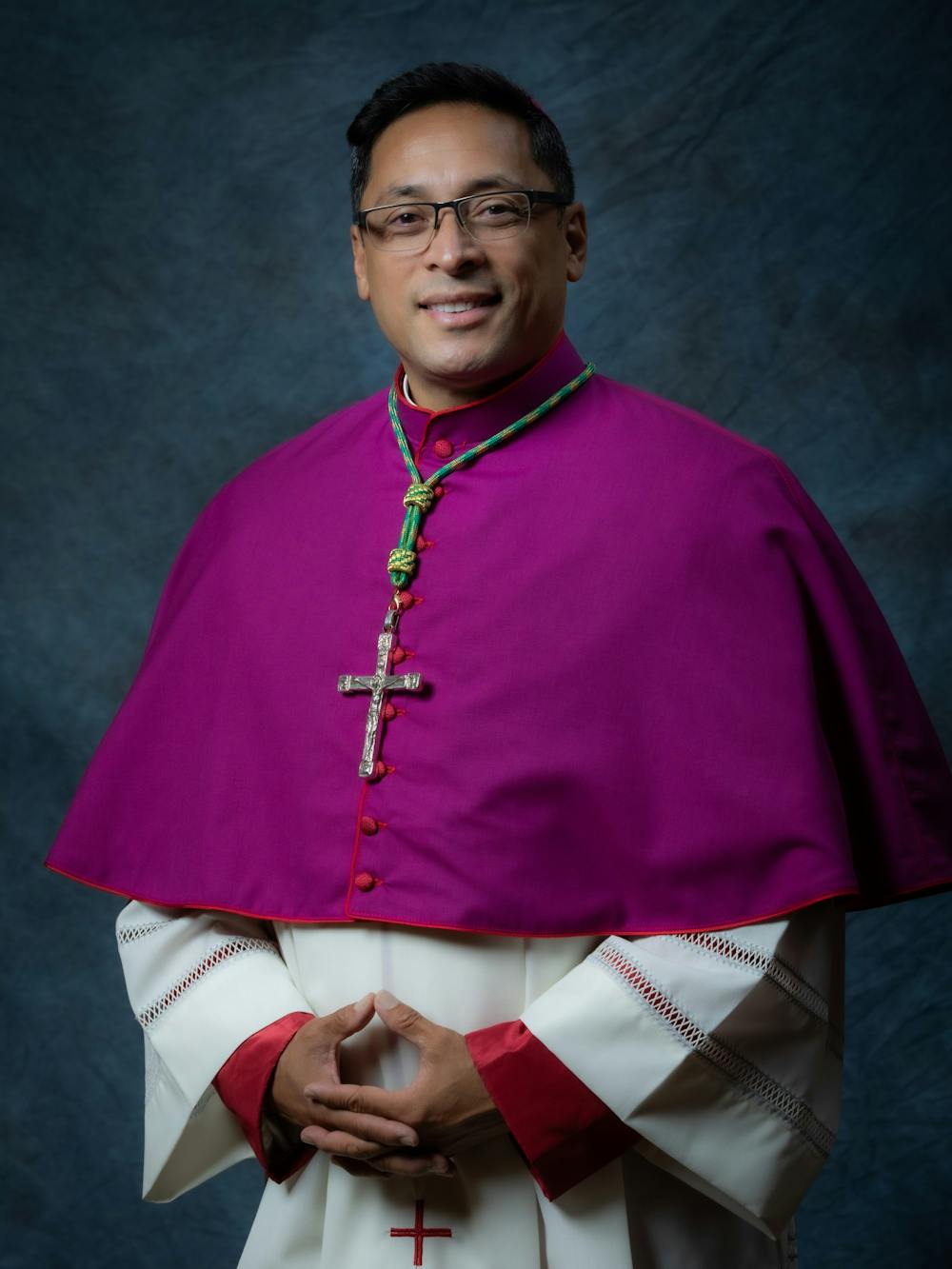
For Bishop Pedro Bismarck Chau, auxiliary bishop of Newark and Seton Hall alumnus, American Sign Language (ASL) is how he connects with the Deaf Catholics he serves.
“It’s more alive,” Chau said.
ASL is more than just communication for Chau—it is an integral part of his vocation, connecting him with the Deaf community.
Those movements hold deep value in his ministry. Chau views sign language as an incarnation of the word of God.
“The word of God becomes truly alive and become[s] flesh,” he said. “In the signing through my hands, the word of God comes alive to the people.”
ASL is essential in Chau’s work today, but his journey with sign language began many years ago in his native country of Nicaragua with his sister.
Chau is hearing, while his sister is deaf. Her experiences navigating communication have been a large source of inspiration for his work in Deaf ministry.
Chau recalled that growing up in Nicaragua, the country did not have an official sign language, creating systemic barriers to communication for his sister and other deaf people.
However, these barriers extended beyond Nicaragua. Chau and his sister faced many of the same issues when his family moved to the United States.
“Even going to the hospitals, I had to go with her to interpret for her,” Chau said. “Here in the United States, she learned American Sign Language.”
What struck Chau the most was how these challenges interfered with his sister’s access to Catholic teaching.
“When she began going to a Baptist church, that's when I was like, wait a minute, no, no, no, no. I want my sister to remain Catholic,” he said. “But unfortunately, at the church where I was attending with her, there was no interpreting. There was no accessibility, basically. That was the biggest problem.”
From there, Chau started to dedicate time to learning ASL for her and the greater Catholic community.
“It was her who [inspired me to learn ASL],” Chau said. “Her need, my desire for her to really be able to fully understand the faith and really be able to communicate.”
This work ultimately shaped the priest Chau would become.
“I always wanted my priesthood to be of service to the poor, to the people. And I want my episcopate to be the same way,” Chau said. “I want to be a bishop who serves and cares for his people, including the deaf. But in general, all people, just like Jesus, right?”
During his time at SHU, Chau went on a mission trip to Haiti. While he did not directly work with deaf Catholics, it gave him direction in his vocation.
“The experience of mission that Seton Hall allowed me to have…gave me that perspective that that's where God was calling me,” he said. “I want to be a servant.”
He recalled a specific moment that further solidified the need to continue his work in ASL ministry.
“I remember walking into a hospital or a nursing home,” Chau said. “Somebody called me that this woman needed the last rite[s], right? The anointing of the sick. And she was deaf.”
He recalled signing his name and saying hello. He described the woman’s face lighting up with recognition that she was finally being understood.
“You have no idea how that image stayed with me,” Chau said. “To me, that was the moment that I said, ‘God is calling me to do this,’ and I know that God is calling me to advocate for this community as well, that it is important.”
Taking on this kind of activism in his ministry is not always easy, though. For one, Chau pointed to the challenge of the invisibility of deafness.
“Why do I say invisible? It's because deafness is not visible until they start using their hands…they might be there in their parishes, but we just don't know,” Chau explained.
Even when parishes are aware of deaf people in their communities, financial constraints can limit the availability of accessible services, Chau said.
“I go to a parish, and there's deaf individuals at that parish, and I said, ‘Father, you need to offer accessibility. You need to offer an interpreter for this family that [has] a child who is deaf or this man who is deaf,’” Chau said. “And then the first thing [he] says, ‘But sorry, Father, I don't have the money to pay an interpreter.’”
For Chau, the solution starts with making accessibility part of a priest’s education. He hopes ASL can be incorporated into seminary education, just as priests learn other languages like Spanish.
“I think we need to bring that back into our seminaries because there is a need in the same way that a lot of priests learn Spanish and they are sent abroad to learn Spanish,” Chau said. “I think that we should do the same for our priests and seminarians, giving them the opportunity that this is a community that sometimes is invisible.”
According to Chau, that education can make a significant difference in the lives of Deaf Catholics.
After working with Deaf Catholics for many years, Chau sees the positive impact of ASL in ministry. Recently, Chau attended a conference for the Deaf in the United States, where he celebrated the opening Mass.
“I couldn't believe that some of them said, ‘this is my first time attending a Mass fully in ASL,’” Chau said. “I was like, ‘what?’ And they've been active leaders in the Deaf community, in the Catholic deaf community.”
This lack of accessibility in the community is what continues to drive Chau, especially in his work as a bishop.
“We cannot forget this population,” Chau said. “And I feel that God is calling me for that, you know? I think I feel the responsibility to advocate more for, to create awareness, you know, in dioceses, because many dioceses do not have a pastoral office for the deaf.”
“I would love to see that all churches, that all dioceses, but in local churches, really become aware of the need for accessibility,” he continued. “That to go beyond a care [for] finance, to go beyond that, God will provide. You know, the thing is that the person may feel welcomed, may feel that they belong in that community.”
For Chau, a better future begins with changing society’s response to deafness.
“I would like for people to understand that deaf people, they don't consider themselves disabled,” Chau said. “So when you see a deaf person…don't have, oh, pity. No. They're able to do anything a hearing person can. The only thing that they cannot do is hear.”
He knows that this work cannot be done overnight. Yet, he looks toward the possibility for a more accessible future for all within the Catholic Church.
“If we can start to create community for them and [create] accessibility, having access to all the programs that the church offers will be amazing,” Chau said. “But slowly, right? Slowly. It can be done.”
Kaelyn Blizard is the head editor of The Setonian’s Features section. She can be reached at kaelyn.blizard@student.shu.edu.