
Back in high school, I thought times were tough. AP classes, clubs, friends, family, sports and graduation—-it seemed impossible to handle. But I did. Something that helped me through the stresses and ups and downs of high school life were dogs. Not just my rottweiler back home to calm me down after a long day or cheer me up after a tough day, but at school, we had a therapy dog.
Every day, a golden lab sat in the chaplain’s office with a smile on her face, waiting for the next student to stop by and spend some time with her.
Cedar is a member of the Student Support and Wellness Department at Punahou School in Hawaii, and the community has nothing but rave reviews about her. For me, this was a moment of not knowing what I had until I lost it—even more so with no dog on campus or at home waiting for me.
Dogs serve as a way to regulate emotions, both positive and negative, and are a reliable source of support. For many who left their family companions at home in exchange for living on campus, this support system is stripped. Therapy dogs benefit students in a multitude of ways, especially when it comes to anxiety and depression, two significant mental health issues for college students.
In Feb. 2025, Washington State University conducted a study about the effect regular and long-term interactions with therapy dogs have on the mental health of students by allowing students to freely drop in to interact with therapy dogs for up to two hours. The researchers found that students who routinely interacted with therapy dogs had significantly lower rates of depression, stress and worry compared to those who did not. There was also a noticeable increase in emotional regulation and overall well-being.
“This is a relatively easy, low-cost way to support student well-being,” Patricia Pendry, a WSU professor of human development who helped lead the study, said.
“You don’t need a structured curriculum — just an inviting space where students can interact with the dogs and their handlers on their own terms in a way that ensures animal welfare and participant safety.”
Universities across the nation noticed similar results of therapy dogs and took the steps towards implementing permanent pups around campus.
Cardinal News highlighted campus therapy dogs at Roanoke College, Bluefield University, and Virginia Tech in April 2023.
“They’re part of a growing movement as colleges look to supplement their mental health programs for students and staff alike.”
Each dog brings its unique purpose to serving their college community: Milo at Roanoke primarily plays with student athletes, Hazel at Bluefield serves in the Center for Counseling and Wellness, and Virginia Tech has four dogs designated to sessions with students. At Virginia Tech, each dog has around 1,000 group and individual therapy sessions each year, with around 50 events on campus and in the local community.
“The goal for the dogs is to increase connection and reduce stigma around mental health,” the Cardinal article said. “Feedback has shown that the dogs increase interaction and well-being among students and foster a sense of community”—-the Virginia Tech therapy dogs have more than 20,000 followers on Instagram.
Even as locally as in New Jersey, Montclair State University (MSU) brought in therapy dogs, which are now an integral part of university life, promoting well-being, belonging and mental health.
“For students and staff alike, these animals aren’t just companions—they’re essential partners in creating an inclusive university community,” an MSU press release said.
The two most well-known four-legged friends around campus are Pebbles, the official “pupscot,” and Charley, an assistant coach for the women’s basketball team. Pebbles has built a devoted following within the MSU community, helping students “ease homesickness” and “deepen their sense of belonging.”
While Charley began as emotional support solely for the women’s basketball team, she quickly became a campus celebrity.
“Her presence changes the energy in a room,” said Courtney Cunningham-Jones, assistant dean for Student Services in the College of Humanities and Social Sciences. “It’s hard to be upset, anxious or overwhelmed when a golden retriever is running toward you.”
The two dogs are beloved around campus, with students flocking for a chance to hug them and receive positive vibes and calming energy. Senior Associate Provost Joanne Cote-Bonanno said that with therapy dogs consistently around campus, the stigmas around service animals and emotional struggles dissipate.
“Sometimes a student just sits with a dog and pets them for a while, because that’s what they need at that moment.”
However, Seton Hall is no stranger when it comes to bringing in dogs as comfort for students.
In 2022, The Setonian covered a Student Activities Board event that featured puppy yoga hosted by Doggy Noses and Yoga Poses with puppies from One Step Closer Animal Rescue
The coverage noted the positive reaction from students, being around the pups and having an outlet to destress.
While not covered, SAB has continued to host puppy yoga events. I remember it being one of the first events I attended during the Week of Welcome my freshman year at Seton Hall. I also remember crying over FaceTime with my family because I missed my dog back home.
More prominently, though, are the pet therapy events hosted by Dare to Care. Anthony Turon, the assistant dean of students, said the events are monthly during the academic year with more frequent visits around high-stress times like finals. These events are sponsored by Dare to Care as they believe in the positive impact it leaves students.
“In addition to peer-reviewed empirical research that supports the positive benefits of pet therapy, student feedback consistently rates the pet therapy sessions highly,” Turon said.
There are upcoming events on April 13 and May 5, and students can sign up on Engage. While these events are a great implementation of therapy dogs to help with the stress college students carry, Turon said the dogs that come in are not always the same. For me, this is a place in which the university can improve.
Just like people, there is a difference between excitement and support from someone you can consistently reach and get to know on a deeper level than monthly visitors. Not to say the monthly sessions are not beneficial, I think there is a step further that other institutions have taken to develop this endeavor and its benefits.
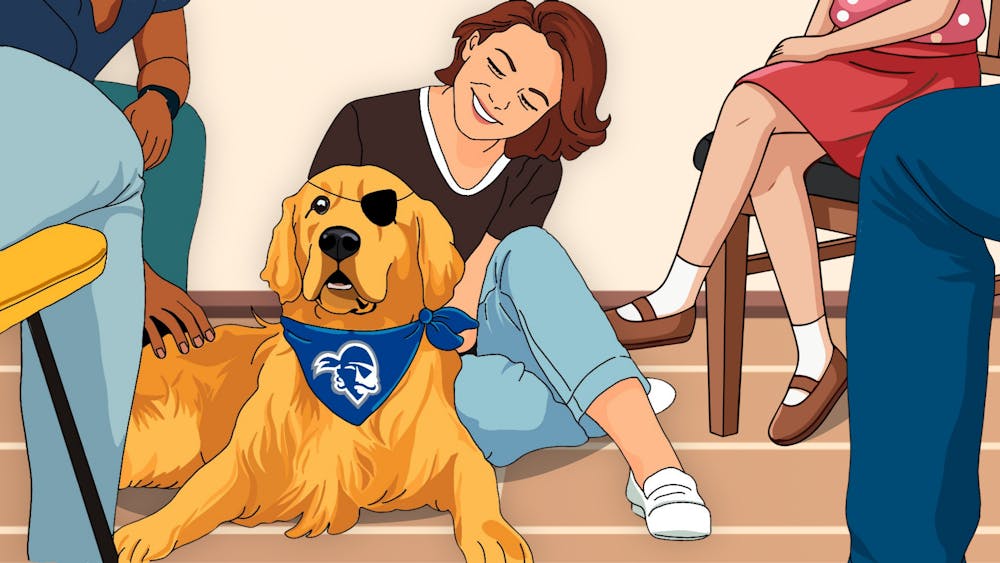
I fully believe that a permanent on-campus therapy dog would help boost community morale in a multitude of ways: from reducing stress, anxiety, and depression levels in students, to alleviating some of the heartache of being separated from our four-legged friends back home, and even giving the community another unique tradition to rally around.
But, this is not something I imagined many other students at SHU had thought of before—not everyone had the experience and privilege of having an on-campus therapy dog. Many seemed keen on the idea of having a permanent service dog on campus.
Sunday Collins, a sophomore finance major, said that while she never went to the Dare to Care pet therapy event, she attended SAB puppy yoga events and had fun.
Collins said, “a thousand times over, yes,” to the idea of a permanent on-campus therapy dog.
“I’ve worked with therapy dogs before, and I think it would be extremely helpful for college students, especially for college students who are far away from home,” Collins said.
“Since our dogs back home are such calming remedies, I think it would help students out a lot with stress and anxiety while also giving them something to do during their downtime on campus,” she added.
Scarlett Humphrey, a freshman political science major, said she attended a few of the Dare to Care pet therapy events over the school year, but would rather have a permanent on-campus therapy dog.
“As an out-of-state student who has a pet at home, pet therapy helps me not feel homesick and find that comfort through loving on the cute dogs,” Humphrey said.
Even for in-state students, like Chris Holl, a junior finance and marketing major, he said an on-campus therapy dog would be a welcome benefit.
“I know the pet therapy events get a lot of traction, but I just don’t have the time to stop by,” Holl said. “If I knew a dog would always be there, I’d be much more incentivized to stop by during my free time.”
Furthermore, Holl said he does not see any downsides to the idea.
“As long as there is a professional taking care of it, I feel like it’d be super beneficial to have,” Holl said.
Naarah Smith, a senior criminal justice major, said she would benefit from a therapy dog session right now.
“Therapy dogs definitely could help with anxiety and stress that students face, and the whole semester is stressful and sometimes it never lets up, so it’s hard to wait for an event once a month,” Smith said.
“In my opinion, I don’t think there is any downside to an on-campus therapy dog.”
Based on this, it can be said that I am not the only one who would welcome a permanent Pirate Pet with open arms. Sadly, the reality of a permanent on-campus therapy dog for the entire Seton Hall community is not a bright one.
I reached out to Counseling and Psychological Services (CAPS) about the possibility of a permanent on-campus therapy dog at Seton Hall. CAPS said they have partnered with local organizations to bring certified therapy dogs to campus for midterms, finals and wellness fairs.
“While therapy animals can complement CAPS’ mission by offering a calming presence for students seeking stress relief, participation must remain optional and inclusive of students who may have allergies, fears, or cultural reasons for preferring distance from animals,” CAPS said. “CAPS continues to explore ways to support student well-being, but a permanent therapy dog program would require specialized training, certification, insurance and coordination with leadership in the Division of Student Services.”
So, while the university sees the potential benefits of a permanent therapy dog, it is not something that they see as a necessary change. I still believe that this is a worthwhile endeavor and proposition to help improve the morale at Seton Hall, increasing student engagement with CAPS, which in turn can reduce feelings of stress and anxiety throughout the school year.
Solomon Lee is the advertising manager for The Setonian. He can be reached at solomon.lee@student.shu.edu.


