
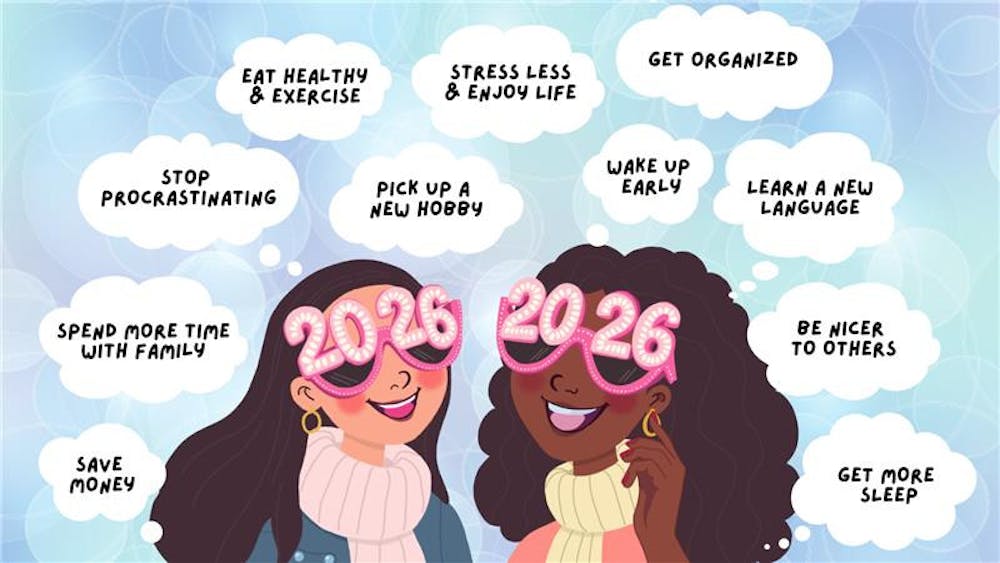
New year, new me. I’ve said it one too many times.
Santa is back at the North Pole, and countdown parties are beginning, and bold 2026 glasses are in the making.
The final hurrah of the holiday season continues the aura of forgiveness, generosity, and kindness. These are motifs carried into the new year through the tradition of resolutions.
Even though Strava, an athlete social network’s, 2019 data set off a cultural phenomenon dubbed “Quitter’s Day,” finding that people are more likely to quit their resolutions the second Friday of January, resolutions reinforce the idea of goal-setting and self-improvement.
Not every New Year’s resolution I have made came to fruition; In fact, I have failed at upholding my goals most years. From trying to read my Bible every day to setting time for a gym session, other priorities shove the goals onto the back burner of my mind.
However, this truth doesn’t bother me. The simple act of making a New Year’s Resolution demonstrates my internal desire to be the best version of myself. Self-motivation and hope, curated from taking the time to make a resolution is one of the beautiful parts of humanity.
People have been writing resolutions and celebrating the new year for 4,000 years. The Ancient Babylonians started the trend as a way to express their loyalty to their king and make promises of favor to their gods.
This idea of hope is seeded in the Babylonians’ rituals and has been woven across religions, regions, and cultures throughout the years. Julius Caesar moved the mid-March Babylonian celebrations to January 1 as the mark for the new year, and Christians, specifically Protestants, hold a watch night service to pray and make resolutions.
As resolutions have been seen throughout history, the modern celebrations of New Year's, though different, still resemble the same process of reviewing the past and starting the new year off right.
A Pew Research survey found that 3 out of 10 people made at least one resolution in 2024. While the survey concluded that 56% of people, who did not make a resolution, didn’t make one because they don’t like making them, the majority of people who made a resolution, about 87%, kept at least some of them.
A barrier to success in goals goes beyond the fear of failure to inaction. Those who took the time to write a resolution, regardless of whether they kept them through the whole year, have an advantage.
New Year’s Resolutions tend to fall under the same types of categories, including being healthy and working out more. They demonstrate ideas of self-improvement, but resolutions have adapted beyond just improvement to self-acceptance.
A study conducted on how social media has impacted resolutions found that these resolutions focus on loving yourself unconditionally and pushing against the societal pressure to change. Social media created a new side of resolutions, forming different ideas on what a good life is.
Now, I may still not achieve my resolutions this year, but I know I will take the time out of my day to sit down and write one.
That’s enough for me.
Calla Patino is the head editor of The Setonian’s Opinion section. She can be reached at calla.patino@student.shu.edu.


