
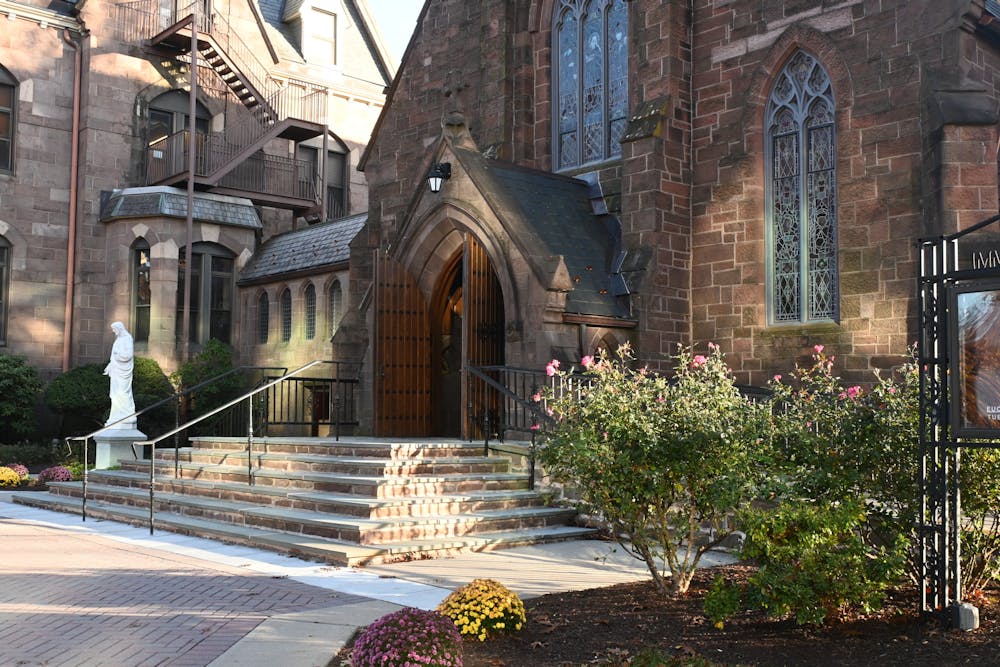
The number of New Jersey residents affiliated with organized religion is decreasing, according to a recent study conducted by the Pew Research Center.
Despite 80% of New Jersey residents saying they believe in a spiritual being, 27% of the population identify as completely unaffiliated with religion, which is 9% higher than in 2014.
Nationally, the number of Americans who identify as agnostic, atheist, or religiously unaffiliated has been steadily increasing until the past few years, the Pew Research Center found.
Younger generations lead the shift
C. Lynn Carr, a sociology professor at Seton Hall, noted a widening age gap in religious affiliation.
“People born in the first six years of the 21st century are 43% likely to be religiously unaffiliated, while those born in 1949 or earlier are only 13% likely to be religiously unaffiliated,” Carr said. “Although the percentage of religious ‘nones’ (atheists, agnostics, claim no god) has risen over time in all age groups, it is most striking among young adults.”
Carr said that being unaffiliated does not necessarily mean disconnected from spirituality.
“Many religiously unaffiliated people believe in God or spirituality. In fact, according to the same survey I mentioned earlier, large majorities of people born between 2000 and 2006 believed in God or a universal spirit, that people have souls, and in an afterlife,” Carr said.
She added that younger adults are more likely to view organized religion as “too focused on money or on controlling people.”
Carr said scholars have long debated whether society is secularizing or if religious expression is simply evolving.
“People are increasingly expressing religion today in individualist manners, such as in what they buy, what media they consume, how they volunteer, or in their meditation or yoga classes, then we might undercount the amount of religion happening,” she said.
Carr said sociological theorists have pointed to “large societal forces” as the cause of religious shifts, such as “rising pluralism, consumerism, neoliberalism, new communication technologies, globalization, or the increase of uncertainty in people’s lives in late modern society.”
However, others argue that these same forces can draw people toward religion, Carr explained. She cited sociologist Christian Smith’s 1998 argument that the “bureaucratic sterility, materialism, and reduction of local community networks” in modern life may increase religion’s appeal.
Citing a 2023 Pew Research Center survey, Carr said unaffiliated respondents said they had doubts regarding religious teachings and “didn’t feel that religion was necessary or they didn’t have time for it in their lives.”
“There are some who see all religious faith as being unreasonable, and there are some who feel that their religious beliefs should be impressed on the nation, even on those who believe differently from them,” Carr said. “Then there is the larger middle ground…[who] believe religious practice is something that people should do voluntarily. In effect, this has made religious involvement up to the individual.”
Carr said she’s noticed societal factors at SHU that may be pulling students away from organized religion.
“I have noticed a time crunch,” she said, pointing to the university’s flat tuition rate that pushes students to cram their schedules. “This may leave little room for religious pursuit, or much of anything not course related.”
Faith on campus: SHU students and ministry
At SHU, a “significant number” of incoming students opt out of identifying their religion on applications, University Relations (UR) told The Setonian in an email.
“For students who did respond to the question from this year’s class, around 44% identified as Roman Catholic, with the remainder spread out across Protestant, Muslim, Orthodox Christian, Hindu, Jewish and other faiths,” UR wrote.
Rev. Nicholas Sertich, director of Campus Ministry, said he has seen increased religious engagement in recent years, surpassing pre-pandemic numbers.
“Since the pandemic, our numbers of student engagement with campus ministry, DOVE [the Division of Volunteer Efforts] and with students coming to mass on Sunday is actually higher than it was before the pandemic,” he said. “We saw a real resurgence in eyes and ears, which is something nice to see…it’s certainly a sign of hope.”
Sertich said rising attendance at campus ministry events and local parishes indicates that people are searching for meaning.
“People are looking for something reliable, something to remind them that they’re loved, that life is beautiful, that there are people out there who care about others and that we’re called to something much more,” he said. “We can’t do it alone, we need God who created us and the people he created to be by our side.”
While New Jersey has seen a rise in unaffiliated residents, Sertich said Catholic populations are growing in other regions, including the South, West and Midwest.
For believers who feel discouraged by the rising numbers of religiously unaffiliated individuals in the state, Sertich urged them to look for opportunities to show God to others.
“We live in such a dismissive world…it doesn’t matter if it’s religion or politics, we get so caught up in our own little world and think we have the answers to everything,” he said. “We’re social beings, meaning we connect to others and we make relationships…and it’s important to keep an open mind to see where God is speaking to us through [those around us].”
Sertich said non-believers typically approach him seeking guidance rather than for philosophical “life” questions. Oftentimes, it’s when a family member has passed away, they are struggling with class or going through a breakup, he said.
“It becomes an opportunity to engage students in a deeper conversation about spirituality, about God, about faith,” Sertich said. “It’s when we feel like we have hit rock bottom that religion becomes important—that faith is the biggest resource we have.”
Several SHU students said faith plays a central role in their lives.
Aaron Lawrence, a senior economics major, said he identifies as a Christian.
“I usually go back to reading the Bible, hearing from the word and using that in my own life,” he said. “It helps me build confidence and accomplish things, but also gives me knowledge on what I’m doing and what I want to do in the future.”
Noemi Cerqueira, a junior secondary education major, said her Christian faith is “the biggest part of [her] life” and “keeps [her] grounded.”
“Knowing everything I do has a purpose, I feel like is the whole point of believing in something higher, believing in God,” Cerqueira said. “Knowing that what I go through is for a reason guides me a lot and helps me deal with the stress or anxiety I have when it comes to classes.”
Lawrence said he has noticed fewer peers identifying with organized religion, attributing part of the shift to social media.
“People don’t want to do the hard, extensive research, and they want to get [the meaning] as fast as possible,” he said.
Donovan Thomas, a graduate marketing and business administration major, said he often finds religious posts on social media inspiring.
“Sometimes I’ll get inspired to go help people based on something I see on social media or, you know, maybe you’re in a bad mood, then you see a Bible verse, it’ll make you feel better about whatever is going on,” Thomas said.
Cerqueira said she notices a broader cultural trend away from religion.
“As a society, I feel like people have strayed away from that whole religious aspect,” she said. “In our generation, people don’t really believe in anything or they don’t have a grounded faith…people kind of follow whatever trend people are following nowadays.”
Cerqueira said she feels that some people do not partake in Christianity because they feel the lifestyle is too restrictive.
“I tell people that Christianity is more of a relationship rather than religion,” Cerqueira said. “Religion is more of a set of rules you have to follow and accept, where Christianity is more of choosing to follow the life of Jesus and trying to represent him the way you can.”
Cerqueria added that scandals and controversies within the Church can push people away.
Finding meaning outside of organized religion
While Cerqueria remains devoted to her faith, other students spoke of stepping away from religion entirely.
One student, who requested anonymity for privacy, said they distanced themselves from Catholicism as they matured.
“I don’t identify with any religion [now],” the student said. “I was raised Catholic….but personally pulled away from religion in high school.”
After growing up surrounded by the Catholic faith, the student began to question the religion, which led the student to find faults, especially with incidents in the Roman Catholic church.”
“I just found myself struggling to believe in the ideas in religion,” the student said. “While everyone else seemed to believe this happened or that was said, I just couldn’t seem to grasp that.”
The student said they now find meaning through friends, family, hobbies and interests, which “helped [them] grow as a person.”
“I think our life has more meaning when we can find things around us to do or create or speak about or be involved in,” they said.
Despite not practicing religion in their own life, the student said religion still matters in society, calling it a "guiding factor” for many individuals.
“In a way of love, I can support religion, but as a force pushing people toward their actions or words, I’m not sure,” the student said. “I’ve always believed that religion should be a part of life, not a way of life, and I think that’s where it can get messy with people sometimes.”
Another anonymous student, who identifies as spiritual but not religious, said they do not believe religion is necessary to finding community.
“When I’ve made friendships…it’s always been through common interests like music, movies, games, etc.,” the student said. “I find meaning or purpose through what I decide is important to me and whether or not I’m acting in accordance with that.”
The student practiced Christianity as a child, but dealt with anxiety during their time with the religion.
“I was always worrying about being a good Christian and thinking about all the things that I couldn’t have,” the student said. “On top of that…I didn’t understand why a higher power who is all things good would allow such pain and horrible things in the world.”
Navigating faith and identity
The student said they feel a small amount of pressure from their family to identify with a religion.
“To me, I feel like being spiritual, atheist, agnostic, etc., is still a little taboo, especially to older generations,” the student said. “I come from a family that is religious and I don’t think it’s far-fetched to say that I’m the only one who has different beliefs in this regard.”
Nevertheless, the student said the SHU community makes them feel comfortable being religiously unaffiliated at a Catholic university.
“We all respect each other’s beliefs and don’t think to question another person for what they may or may not believe in,” the student said.
Cerqueira said she experiences pressure from the opposite direction, worrying whether to be open about her Christianity.
“In college, it’s always that pressure of ‘Do I say… that I’m a Christian?’ because a lot of people will sometimes judge you for your religion,” Cerqueira said. “But I always grew up standing in my faith and not letting other people get to me…once you’re rooted and grounded in what you believe in, it’s not hard to tell people openly about your faith.”
As a Catholic university, SHU’s mission is to serve all students regardless of religious affiliation, Sertich said.
“We welcome all students,” he said. “We’re a home for the mind, the heart and the spirit.”
In an email to The Setonian, UR said, “Seton Hall understands its Catholicism as an enabling vision that calls us to discover all that is best and authentically human in God’s abundant creation. We welcome other Christians, other believers, and other persons of goodwill in a shared journey to God.”
Sertich said the University aims to ensure that non-religious students feel respected.
“It doesn’t matter where they’re from or what they believe, they’re made in the image and likeness of God,” he said. “We want to help them explore that inner sense of spirituality and connect with God.”
Lakyn Austin is the head editor of The Setonian’s Features section. She can be reached at lakyn.austin@student.shu.edu.


