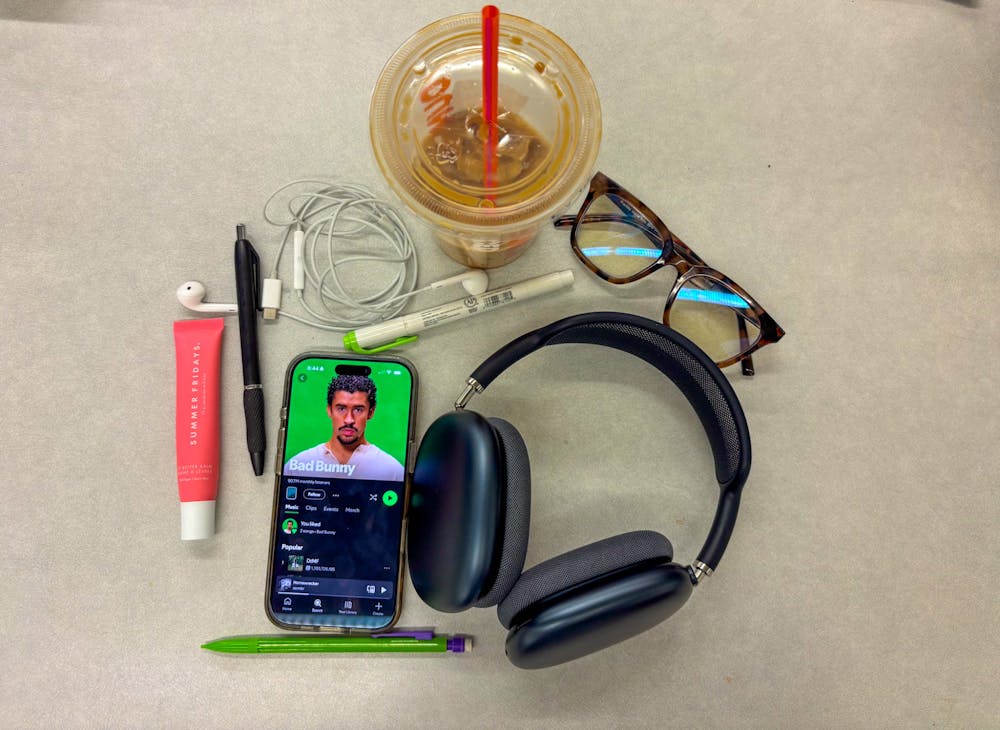
“Why would the Super Bowl halftime show host an artist who is not even a U.S. citizen?” Wrong. Since the announcement of his halftime show performance back in late September, the world has had quite a lot to say about Bad Bunny—much of it not so positive.
The Latin trap artist finally “made the world dance” at the 2026 Super Bowl Halftime Show on Sunday night after a rocky lead-up to the performance.
Political Pressure and False Narratives
After the initial announcement, many politicized the matter, claiming Bad Bunny is not a U.S. citizen despite the fact that he was born in Puerto Rico.
Daniella Tabarez, a junior graphic design major, said when she saw this notion online, she thought it was "disrespectful."
“There's nothing wrong for you not to like his music, but just saying you're not gonna look forward to it or look at it because he's not American enough is just weird,” Tabarez said. “I don't understand why we can't just appreciate people's culture without being lowkey disrespectful.”
Others agree, like Avery Kachmarsky, a sophomore diplomacy and international relations major.
“It’s interesting how people run with a narrative and stick with it even when it doesn’t make sense,” Kachmarksy said.
Jalen Pierre, a junior management and accounting major, said he believes these false narratives are a result of ignorance and “not realizing how much of a global impact Bad Bunny has on the music industry in general.”
Bad Bunny has indeed had a massive impact on the music industry. From racking up six Grammys to over 110 billion streams on Spotify alone, Bad Bunny is impossible to ignore in terms of global impact on the music industry.
That reach has translated into more than just musical success.
Last Sunday at the Grammy Awards, Bad Bunny made a statement against the U.S. Immigration and Customs Enforcement (ICE).
“Before I say thanks to God, I’m going to say ICE out,” the best música urbana album award-winner said during his acceptance speech. “We’re not savage, we're not animals, we're not aliens. We are humans, and we are Americans.”
Some believe that having Bad Bunny standing up against ICE is “empowering” to the Hispanic community, as Shane Stevenson, a sophomore psychology major, put it.
“I think it was definitely his way of reassuring and comforting them like, ‘Hey, I see this, and I see you, and I see what you're struggling with, and I see what you're going through,’” Stevenson said. “This is [his] reminder that [he’s] here for you and rooting for you…an ambassador for your existence.”
Initial Reactions and Expectations
Americans were looking forward to his performance, despite the critics. According to a Seton Hall Sports Poll, over a third (38%) of Americans were looking forward to his performance and the percentage was higher among the younger population and sports fans.
SHU students reflected this data. Pierre is a self-proclaimed Bad Bunny enthusiast whose top artist on Spotify has been Bad Bunny for the past five years. Pierre said he was surprised when the global superstar was announced to perform.
“I’ve been listening to Bad Bunny since I was 13… I never thought my favorite artist for so many years running would make it to this moment,” Pierre said. “I was very pleasantly surprised that the urbana genre is getting given a global stage.”
Pierre was particularly excited because of his personal connection to the cultural aspect of Bad Bunny’s performance.
“My friends, my family, we're excited for the fact that a Latin artist is being given this platform, and it's a celebration of our culture and representation,” Pierre said.
As for the vibe of the show, Pierre expected a similar feel to the Shakira and Jennifer Lopez Super Bowl performance back in 2020, where people can “have a good time…even for people who don't understand his music.”
Similar to Pierre, Tabarez was “screaming” when she found out about Bad Bunny’s performance, not only because she is a “major” Bad Bunny fan but also because she is Hispanic.
“I was so happy…I showed my parents, and we're all super excited about it…knowing that there's an artist that, like, it's just fully Spanish,” Tabarez said. “In a way, it's just like, you're kind of full of pride.”
As a casual fan, Stevenson “feel[s] obligated to be a fan” to “support a fellow Puerto Rican.”
“He's kind of on a breakout year right now, so I could see why they picked him,” Stevenson said. “I definitely knew there's gonna be some controversy, especially with politics.”
Stevenson also pointed out that Bad Bunny is very “enthusiastic,”
“He likes to put out flair and all that,” Stevenson said. “I'm a person who likes presentations more than anything.”
Kachmarsky, who considered himself “more than a medium-ish fan,” says he has been listening to Bad Bunny for years and was looking forward to a “show with a deeper social meaning and with top songs.”
Lo and behold, he got his wishes.
What “Ate” and What They Hate
Despite looking forward to and appreciating the messages Bad Bunny conveyed during his performance, Kachmarsky’s favorite part of the performance was the set design.
“When he climbed up the electrical poles on the set, I just thought that was an interesting aspect to the design,” Kachmarsky said.
Stevenson said that the show “did meet [his] expectations,” adding that Bad Bunny’s “God Bless America” moment—paired with shoutouts to different nations—stood out the most.
Not only did the show meet Pierre’s expectations, but it also surpassed them.
“I was out with friends and I did not expect to be on my feet dancing and cheering the entire time,” Pierre said. “I was also proud he did not water down his lyrics or social critiques.”
That authenticity was reflected not just in the music, but in the moments unfolding onstage.
What looked like just another staged scene to display love, the two individuals were actually legally married on the set during “BAILE INoLVIDABLE.”
The couple had invited Bad Bunny to their wedding, who, in return, invited them to wed during his performance, according to The Hollywood Reporter.
“I loved the wedding scene,” Pierre said. “Having a wedding at his Super Bowl performance is such an outward display of love amidst all the animosity in our country right now.”
After reviewing the show with a critical eye, even then each student struggled to find a least favorite part of the show, with Stevenson noting “[he] was vibing to all” and Tabarez stating “[she] had no least favorite moment to be honest.”
The only issue Kachmarsky had with the performance was the shortened length of the songs, but he still “can’t really complain about it because [he does] agree that the more songs that were featured, the better.”
Besides being disappointed Bad Bunny didn’t perform “LA MuDANZA,” Pierre wished there were “some English subtitles for [his] non Spanish-speaking peers.”
Sharing the Spotlight
With Bad Bunny being a guest during the 2020 Shakira and Lopez set, many fans were hoping to see him bring out other artists during his own show.
Pierre hoped to see artists like Cardi B and Daddy Yankee, but also give smaller Latin artists the chance to shine.
“Last year, he was very adamant about bringing artists like Chuwi and Los Pleneros de la Cresta de la Crista from his last album onto his shows,” Pierre said. “I think that bringing on a band like Los Pleneros to perform their song with him would be an amazing way to represent their work.”
Cardi B was present on set; however, she did not perform. She danced alongside stars from many differing backgrounds like Karol G, Alix Earle, Pedro Pascal, Ronald Acuna, Jr. and Jessica Alba in “la casita.”
While Pierre’s prediction didn’t hit the mark, Tabarez was partially right. She disagreed with Pierre, saying she expected Bad Bunny to bring out smaller artists rather than Cardi B.
Kachmarsky, however, hit the nail right on the head just three hours before Bad Bunny took the stage.
“I heard that Lady Gaga might make an appearance,” Kachmarsky said before the show. “Some artists in the past have invited other artists to perform who have not collabed together.”
Right after Gaga appeared on stage, Kachmarsky said, “I just predicted this.”
Stevenson was “really surprised” to see Gaga on the stage with the star performer, but said Bad Bunny “nailed it” with bringing out Ricky Martin.
“I thought all the guests were going to be Latinos, so [Gaga] I did not expect,” Stevenson said. “Ricky Martin, he's obviously Latino, he's Puerto Rican…but I would have had more niche and popular Latino artists like Rosalia and Peso Pluma.”
Pierre was also surprised to see the “Puerto Rico icon” on the stage and believed it was a powerful statement.
“I am glad he brought [Ricky Martin] out to sing ‘Lo que Paso a Hawaii,’ an anthem of resistance against modern colonization,” Pierre said.
Additionally, Pierre said, “the ‘Die with a Smile’ salsa mix was an unexpected, beautiful surprise.”
Opening Number
With every Super Bowl performance, there is always intense speculation over which song will be the opening number.
For Tabarez, “LA MuDANZA” seemed to be the obvious choice for Bad Bunny.
“He says, ‘No one can move me,’ and then he starts saying ‘I’m from [Puerto Rico],” Tabarez said. “It's just a nice thing, because everyone could relate, especially right now. No one's moving from here, like, I was from here, my parents, my grandparents…we’re not moving no matter what.”
Unfortunately for Tabarez, Bad Bunny did not perform the song at all.
Both Tabarez and Stevenson predicted “BAILE INoLVIDABLE” as being a likely choice for the opening song. While he did not open the show with the song, it did make the setlist.
However, for Kachmarsky, it was difficult to guess the opening song.
“I’m not sure, but I’m hoping it’s one that’s upbeat to set the tempo, or some shorter part of a song, maybe even part of the NUEVAYoL music video to set the theme,” Kachmarsky said.
While Bad Bunny did not play a music video to open the show, he began with a clip from a Puerto Rican sugar cane plantation, transitioning into his set, which modeled a traditional Puerto Rican village.
Pierre was hoping to see an opening track that would “bring back that nostalgic Puerto Rico feeling.”
“I know he's very prideful for being from Puerto Rico, so I hope that he plays those songs to pay homage to where he comes from in his community,” Pierre said.
Music with a Message
This was a message more than a performance, according to Stevenson.
“It was powerful, just because he's trying to express that…, ‘If I can do it, anybody can do it,’” Stevenson said. “It looks great like entertainment, but this was genuinely trying to send a message…it was poetic, that's the word. It was very poetic.”
Tabarez reiterated Stevenson’s analysis, calling the performance “powerful,” saying that “when he mentioned all the countries and said ‘together, we are America,’” that stood out to her the most.
Ultimately, Pierre hoped “that this show brings people together for a moment of unity,” and, to him, it did just that, and more.
Some believe Bad Bunny has a bigger responsibility than just bringing people together, like Tabarez, who, before the show, believed Bad Bunny was going to make a political statement during his performance.
“I think if he doesn't, it's not gonna look bad, but it's gonna be like, dang, you had that moment, and you're kind of, like, wasting it, but I feel like he is gonna do it regardless,” Tabarez said. “He’s the voice of everyone that can't really say much, you know.”
While not making a direct political statement, Bad Bunny did send a clear message: “The only thing more powerful than hate is love.” This statement was displayed on screens throughout the stadium as the conclusion of the performance drew near.
Additionally, at the very end of the show, Bad Bunny began listing countries in the Americas after saying “God Bless America” in English. Finally, he flipped around the football he had been wielding throughout the performance and the audience found it to read "Together, We Are America.”
After watching the performance, Stevenson described the show as "captivating" and “passionate” due to Bad Bunny’s message of unity.
“There was so much symbolism within his performance and he highlighted so many cultures that you know, aren't his own,” Stevenson said. “It was his way of, you know, trying to unite all the different Spanish-speaking countries.”
Not only did Bad Bunny’s performance point to unity, it also had more specific messages sprinkled throughout, some of which Stevenson keenly picked up on.
“I think the most powerful aspect of it was definitely the intro, when he had all of them…working the farm,” Stevenson said. “As he was walking…kind of [explaining] that his people have contributed a lot to society…showing that we’re diverse, versatile.”
Another moment that impacted Stevenson was when two parents and a toddler were watching Bad Bunny’s Grammy acceptance speech on a small television as Bad Bunny handed the child a Grammy award.
“[This scene was] talking about how, like, anybody can do it,” Stevenson said. ”I thought that was really cute.”
Bop or Flop?
Impressed by the show, all of the fans' expectations were met—some even exceeded. Tabarez is “still processing everything.”
“I honestly think that this might be the best Super Bowl halftime performance I’ve seen,” Tabarez said. “I’m just grateful he spoke up for our people.”
Before the performance, Stevenson strongly expected Bad Bunny to “pay homage to and make references to his culture and all other people's culture,” and, according to Stevenson, “he definitely did that.”
Kacharsky also had high praise for the Bad Bunny performance.
“I’d put it as tied with Kendrick Lamar’s performance last year for my favorite halftime performance,” Kachmarsky said.
Similarly, Pierre said this show was one of the best in recent years and “definitely in [his] top five of all time.”
Despite positive reactions from students, U.S. President Donald Trump called the show “a slap in the face” on Truth Social, his alternative platform to X.
“The Super Bowl Halftime Show is absolutely terrible, one of the worst, EVER!” Trump wrote. “There is nothing inspirational about this mess of a Halftime Show…because they haven’t got a clue of what is going on in the REAL WORLD.”
These students disagree, like Pierre, who called Bad Bunny’s show "authentic" and “American.”
“What a better way to show that than to perform on the biggest stage in the country, show appreciation to the entire American continent, and display that ‘the only thing more powerful than hate is love,’” Pierre said.
Lakyn Austin works for the Seton Hall Sports Poll, whose data is cited in this article.
Lakyn Austin is the Head Features Editor for The Setonian. She can be reached at lakyn.austin@student.shu.edu.