Lunar New Year is here, and every year I spend the New Year away from Little Saigon, unable to celebrate the same way I did as a kid. I reflect on my traditions and my culture, along with who and what I want to bring into the new year.
I come from a predominantly Vietnamese community in Southern California, affectionately called Little Saigon. It’s located in Orange County, established shortly after the Vietnam War and the Fall of Saigon, when a majority of Southern Vietnamese immigrants sought refuge and community in America.
Lunar New Year, more commonly known as “Chinese” New Year in the U.S., is the only major holiday that all of Vietnam celebrates, Tết.
Every year since birth, I was given a new áo dài, a traditional Vietnamese dress, from my bà ngoại, my maternal grandmother. We ate traditional meals, not phở, but vịt quay and thịt kho.
However, since coming to New Jersey, I’ve had to adjust my traditions. A holiday that used to be centered around family and tradition has shifted to center around new traditions and welcoming new friends.
Living on campus, my traditions have changed. They have become harder to follow since I am physically disconnected from my Vietnamese community.
Instead of waiting for my bà ngoại to magically make our traditional thịt kho, a fatty broth served over rice made from braised pork belly and hard-boiled eggs that requires well over six hours of simmering to create the rich flavor in the pork. I called her for her recipe and made thịt kho for my friends in their apartment, greatly underestimating the time it needed, but still getting it done.
Instead of buying my new áo dài, the traditional style I always preferred with silk pants under a split cut, patterned dress that was a different color every year, the weekend before Tết, I bought it a month before, during winter break.
I also brought extras back to New Jersey for my friends who were willing to share my culture with me. Old áo dàis my family had worn before, like my yellow áo dài with birds patterned across the dress, accompanied by pink pants to watch the flowers laced through the design. Or my cousin’s white áo dài patterned with colorful flowers and made from softer material, paired with red pants.
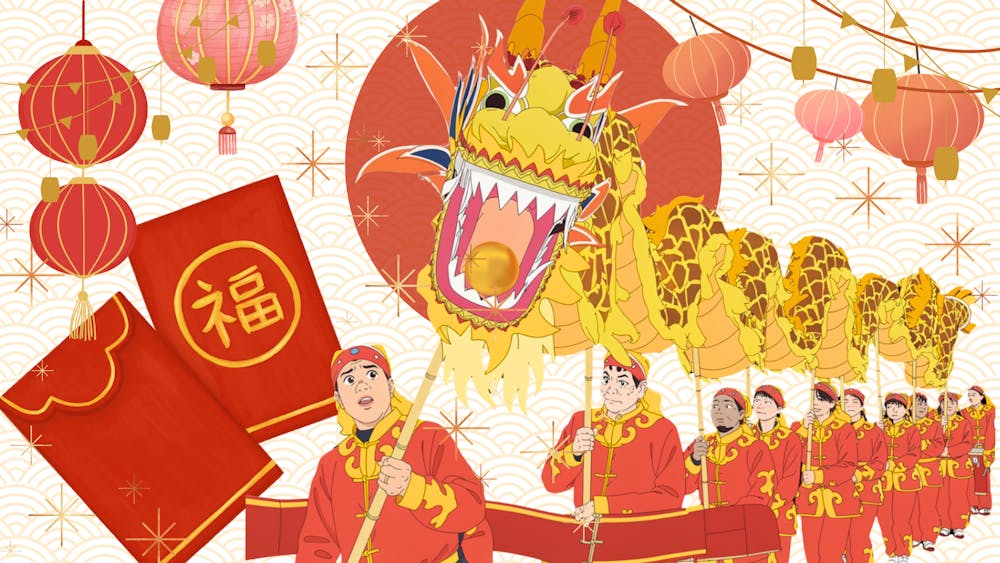
Receiving lì xì, or lucky money delivered in red envelopes, is a tradition found across cultures that celebrate, which can be called different names like the transfer of blessings and luck from older generations to younger ones. This exchange of traditional phrases wishing each other good health, wealth, and happiness can’t be replicated exactly, but I can buy lì xì for my own friends and teach them my phrases.
There are many traditions I hold dear that I can’t bring with me to New Jersey. Traditions that require a larger community than just the friends I’ve made here.
I’m not capable of performing or teaching lion dances, let alone knowing where to get the costumes. I don’t know where to get firecrackers and drums to ward off evil spirits before the new year.
Missing these traditions hurts, and it’s not something I considered before moving across the country. It’s not something I even realized I would have to do until my second night after Freshman year move-in, when I realized that I am truly disconnected from the culture I used to be surrounded by.
Holding onto the small bits of tradition that I can bring with me to my friends, who aren’t Vietnamese and don’t celebrate Lunar New Year, makes me miss my family and culture a little less.
Not everyone holds onto their culture as I do, and I’m well aware of it. But for a second-generation immigrant who visits the motherland and whose mother remembers fleeing the country she loves, it’s hard not to hold onto that culture until your knuckles turn white.
Kaitlyn Campeau is a writer for The Setonian’s Opinion section. She can be reached at kaitlyn.campeau@student.shu.edu