
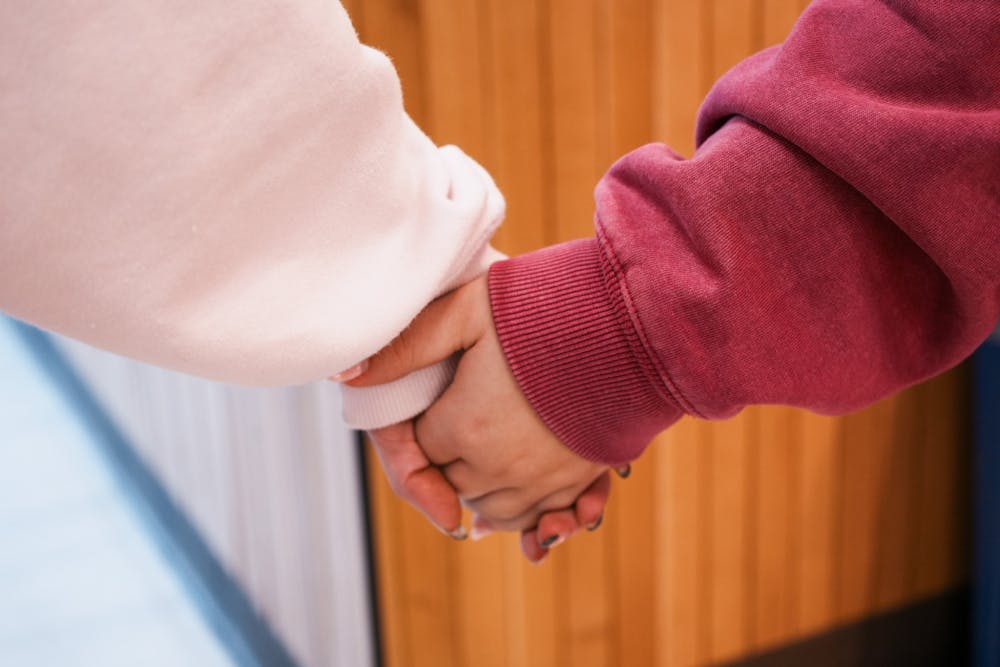
Love is in the air, pirates!
Valentine’s Day is around the corner, and some SHU students can’t help but gush over the coming holiday.
“I just love love,” Brianna Monroy, a senior communications major who is single, said.
To Monroy, public displays of affection (PDA) are often cute. Beyond a simple peck or hug, she appreciates the many ways that she’s seen couples show affection to each other on campus.
Monroy named secret handshakes, sitting on a partner’s lap, and even “a little tap on the butt” as sweet ways for couples to show intimacy when they’re out and about.
Monroy is not the only single to take notice of PDA. Amya McKnight, a junior visual and sound media major, sees “little things” like pecks, hugs or a hand on the waist as “normal” for couples in public.
What’s Acceptable PDA?
While PDA is a given in many relationships, couples have their own boundaries surrounding acceptable physical intimacy in shared spaces. SHU students tend to keep things chaste.
“I’m okay with holding hands or maybe a peck,” Andrew Gonzalez, a senior finance and marketing major, said. “Anything more than that, I’m kind of hesitant to do.”
Similarly conscious of their surroundings is Raven Knopf, a senior biology major who's in a relationship.
“I would hate to be the person where somebody comes out and they’re like, ‘Ew, what’s going on over there?’” Knopf said.
Ronnie Carbajal, a senior finance and accounting major, is also careful not to “push any barriers or lines” when it comes to PDA.
For singles and couples alike, that line looks like spit.
“No tongue,” Monroy said. “I don’t want to see saliva exchanged.”
Knopf agreed. While she thinks “kissing is okay,” she draws the line at “make out sessions.”
Although partnered students might be hesitant to go beyond the classic handhold or peck, they still maintain the importance of PDA in a romantic relationship.
“You still want to show that you have love for her and that you care about her, even when you step outside,” said Carbajal on his choice to engage in PDA with his girlfriend.
Authenticity and Social Media
While a show of appreciation is often the assumed reason behind PDA, McKnight expressed skepticism about the intentions behind PDA, especially among college students.
In a post-high school environment where most people would have learned how to “tone down” their PDA impulses, PDA can seem “fake,” McKnight said. The desire to project an image or inspire jealousy are other possible motivations, according to McKnight.
Singles also question the role of social media in PDA.
“With social media, I feel like people lose their authentic selves,” McKnight said. “If people see a bunch of relationships, they’re going to want to push themselves to have one.”
Students might engage in PDA to reflect social media ideals of what a romantic relationship looks like. Social media trends can also affect the types of PDA couples practice. Monroy pointed to the trend of men making bouquets for their girlfriends as an example.
Beyond influencing the way people express PDA, McKnight identified social media and smartphone capabilities as providing possible alternatives to PDA. While an in-person interaction might yield PDA, the decision to message someone online, “even if you’re seeing them every single day,” changes the way people interact in relationships, McKnight said.
Cute or Cringe?
Most see PDA as either neutral or cute—with some caveats.
“I’m kind of, like, desensitized to it,” Gonzalez said. “Some things should be done in private, but honestly, I don’t really get uncomfortable with PDA.”
Carbajal is similarly unaffected. Despite occasionally laughing at uncomfortable PDA moments, he would rather avoid placing “too much judgment on other people.”
For more avid PDA supporters like Monroy, the cuteness is accompanied by the occasional “cringe” moment.
Even Monroy admitted that excessive PDA can become “cringe.” She highlighted mushy nicknames like “Smoochie Poochie” as an example of PDA gone too far, while also respecting the choice to use them.
“If they dig it, they dig it,” Monroy said.
Lianna Cruz is the assistant photographer for The Setonian. She can be reached at lianna.cruz@student.shu.edu.


