There’s nothing like going about your day, walking around campus, viewing sunsets, and taking part in your favorite activities with friends or a club.
That is, until you get injured.
Suddenly, my weekly routine of endless activities came to a halt. My semester of constant adventures and side quests began to slow down, almost shutting down completely. Everything I adjusted to in life since arriving here at Seton Hall has changed.
The National Institute of Health (NIH) said in a study: “...injuries appear to be common among university-level athletes, with an average of over two injuries per athlete per year... Ankle, knee and shoulder injuries were the most frequently affected areas.”
A few weeks ago, I was playing intramural volleyball in the Recreation Center on campus when I got a knee sprain in which my knee temporarily dislocated, then immediately relocated, causing pain and excessive swelling. Originally, I thought it was something minor that would last ten minutes, then I’d be able to get back up and walk it off.
As soon as I was up on my feet again, once the Recreation Center was officially closed for the night, I barely took one full step on my own and immediately needed assistance. For the first time in my life, I got into an ambulance and was rushed to the hospital. Doctors said that thankfully, no ligaments were torn or fractured, so I would just need rest for a few weeks to recover from the injury.
While I was in the emergency room, it occurred to me that the next few days ahead would look different. With finals on the horizon, I knew I couldn’t give up. In the days that followed, I tried my best to attend classes and grasp the necessary information to pass exams.
With this effort, of course, came challenges I never noticed before.
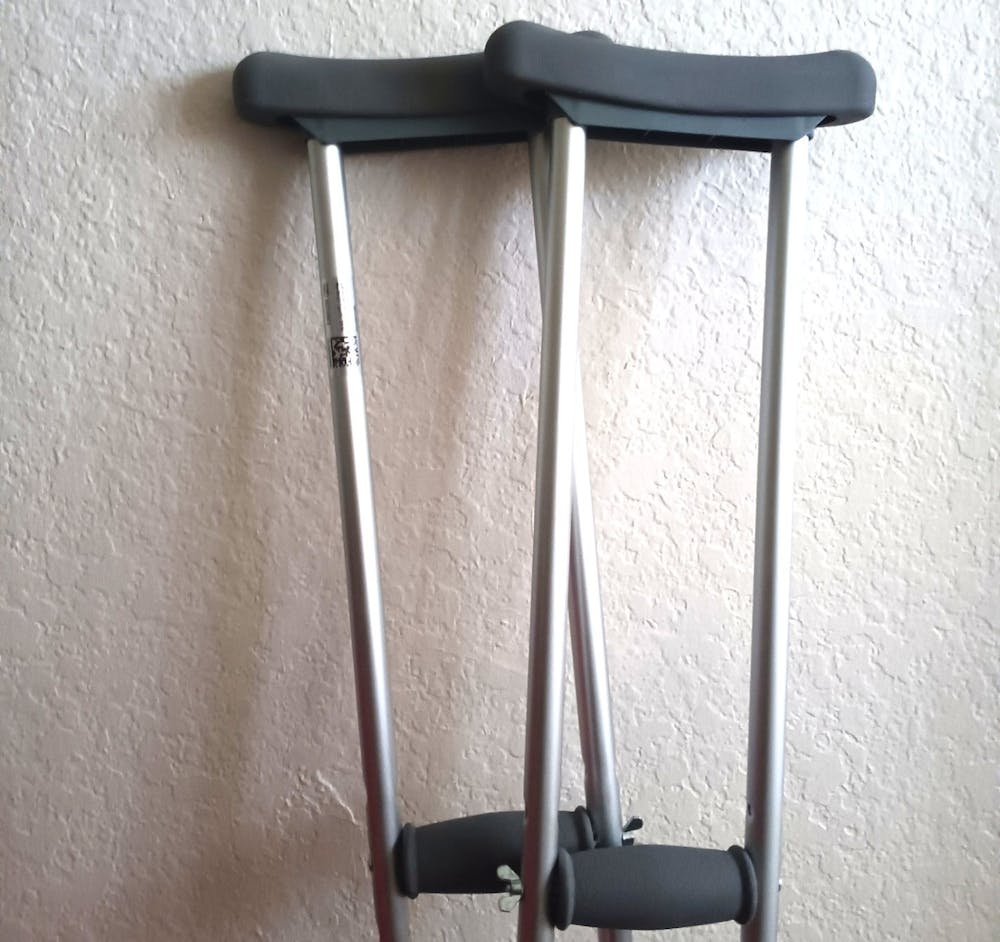
Buildings like the University Center, the Arts & Sciences Hall, and Schwartz Hall were easy to access. On the other hand, buildings such as Mooney, Corrigan and Fahy Hall were a bit difficult to access, especially as a first-year student with my newfound crutches and knee brace, which made the stairs feel unavoidable.
This caused me to ponder what happens to students who suffered more detrimental injuries or were even permanently disabled, and how they navigate campus despite the difficulties.
Through this questioning, I started to discover smoother places of access for some buildings to lessen the number of stairs or demanding distance on my recovery.
Corrigan Hall has a back entrance near the public safety building, which is accessibility friendly with a ramp leading to an elevator.
To enter the dining hall from the secondary entrance by the Arts & Sciences Hall, there’s a ramp also available near Galleon Lawn to avoid stairs.
For first-year students who need to enter Boland Hall and access the North side without stairs, using the Boland South elevator first can be helpful. From there, connecting to whichever floor you need, there are hallways connecting the South side to the North side without having to deal with any stairs.
Although it was no simple task and not every location had accessible entrances and exits, unlike the locations listed, I gradually found a way through.
Since navigating campus post-injury, staff and other students have openly shared their injury stories with me. It has reminded me that this isn’t something I have to go through alone.
Turns out, it’s more common than I assumed, and it isn’t something I melodramatically thought could stop me forever from participating in most things I loved to do. It emphasized the stories of how others had their injuries from various forms of incidents that produced motivation for perseverance.
After completing a study, Kristy Towry, a professor at Emory University, stated that experiential learning can limit us because we are basing life on our personal experiences only. But through vicarious learning, we learn from the experiences of others and, as a result, it causes us to “have a broadened perspective.”
Because of this, it’s important to know that no matter the experience a person has, knowing they aren’t alone in it and may even have a support system is essential.
Rickiya Coulton is a writer for The Setonian’s Opinion Section. She can be reached at rickiya.coulton@student.shu.edu.