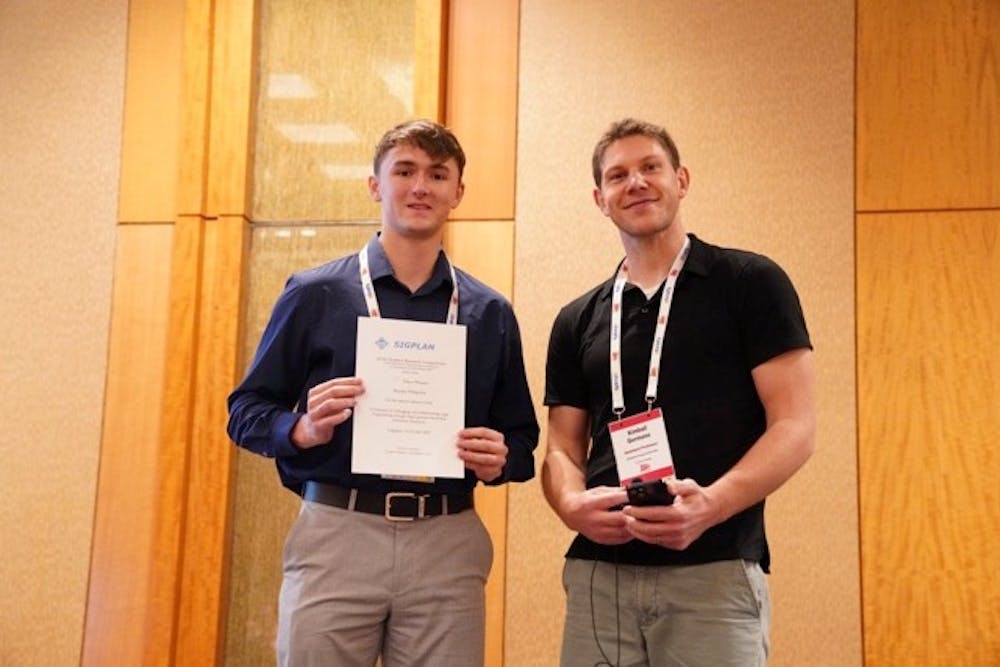
Four Seton Hall computer science students took their classroom research to the global stage.
Andrés Maldonado Garced, Brysen Pfingsten, David Anthony Fields and Sophia Turano presented their research at two international conferences in Singapore and Montevideo, Uruguay last October.
At the International Conference on Functional Programming (ICFP) in Singapore, the students participated in the Student Research Competition, SPLASH-E 2025 and Scheme 2025. SPLASH-E is a symposium for software and languages researchers, including activities around computing education. The Scheme and Functional Programming Workshop is an annual meeting of programming language practitioners who value the simplicity of the Scheme language.
Andrés Maldonado Garced
Garced, a senior, presented his research on creating a domain-specific computer language, to help students more effectively test their work in the classroom.
Garced made visualizations to help students understand the topics they’re being taught in their Formal Languages and Automata Theory class. He presented his work on visualizing how computers process programming languages at SPLASH-E, the ACM Student Research Competition at ICFP, and in a joint talk with Fields at Scheme 2025.
This was not Garced's first time presenting internationally. He recalls his first time being “a little daunting.”
“I was very worried about messing it up,” Garced said.“But now that I’ve done it a significant amount of times, I don’t want to say it’s mundane. I still get worried about doing everything correctly, but it’s definitely become much more of a flow state.”
During the experience, Garced said he learned more about himself and how far he will go to pursue research ideas. He is now applying for doctoral programs and said that this work has “changed the trajectory of what I wanted my career to be.”
Brysen Pfingsten
Pfingsten, a junior, focused his research on how logic programs operate, which differ from traditional imperative languages in that they follow a declarative model. Logic programs define facts and rules to determine how conclusions are reached, whereas imperative languages require step-by-step commands.
Drawing on the experience, he encouraged students who are interested in research to “just try it.”
“It’s a great experience if you want to go really in-depth in your field, further than any class would go and you’re really interested in what you’re studying, then it’s a great thing to do,” Pfingsten said.
While Pfingsten said presenting his work internationally was frightening, he said it was a great experience that allowed him to meet other researchers and prominent figures in the field.
Pfingsten won second place at the ACM Student Research Competition at ICFP.
Sophia Turano
Turano, a sophomore, focused her research on invariant testing for finite state machines, a tool created to improve accuracy in student programming tests.
For her first conference presentation, she said she felt intimidated.
“You’re going all the way to a different country, you’re presenting to a lot of people who are very knowledgeable in the field, and as an undergraduate, you don’t have as much experience in comparison,” Turano said.
However, after the conference, Turano said she is looking forward to learning new things, going to more conferences and meeting new people.
David Anthony Fields
Fields, a junior, created visualizations for various computational models that students learn about in Formal Languages and Automata Theory. Fields made it to the finals of the ACM Student Research Competition at SPLASH.
His biggest challenge throughout the project was “trying to get everything to work together and making sure it was a smooth process for it to be suitable for other students to use, not just myself.”
Fields said his project has real-world applications for students taking the course at SHU, demonstrating that Formal Languages and Automata Theory can be understood through programming rather than solely pencil-and-paper work.
While balancing a busy schedule as a researcher, tutor and full-time student, he said the experience taught him resilience and the importance of persevering through challenges.
Faculty Support
The undergraduate researchers had faculty mentors to support them throughout their journeys. Garced, Fields and Turano were supervised by Marco Morazán, and Pfingsten was supervised by Jason Hemann.
Morazán, a computer science professor at SHU, said these students’ research stands out because “they’re doing actual innovative work.”
“They’re doing things that nobody has done before and presenting them to a knowledgeable audience,” Morazán said.
Morazán said opportunities outside the university, such as presenting at international conferences, provide students a level of scholarly engagement not always available on campus.
“They get unique feedback that they can’t get internally, because there’s only so many professors and expertise at Seton Hall,” he said. “So now when they go to an international conference, they’re getting feedback from people who are working in the same field and who are closely related to the projects they’re developing.”
He also emphasized the importance of conferences for students considering graduate school.
“A lot of the people who make decisions about admissions into graduate programs are likely to be at these conferences, and if they can associate a name with a face, and they can associate the face with some quality work, that helps them make a decision on whether or not the individual should be admitted into their program,” Morazán said.
Morazán said the SHU computer science department supports research by “allowing the professors to invest their time in advising undergraduate students.”
He added that the department allows undergraduate students to work as tutors, providing compensation that helps students “pay rent and eat every month.”
Beyond the professional opportunities these conferences provide, faculty mentors say the experience also deepens students’ connection to their research.
Hemann, an assistant professor of computer science at SHU, said the students are “focused on projects that are intended to be useful for students and novice learners.”
As a result, he said, they bring “an insight and closeness to the subject matter, not just as people that are gaining expertise in the area, but they’re also closer to the users.”
Hemann said the experience allows students to develop skills they would not gain in a traditional classroom.
“In classrooms, we have the opportunity to give students some exposure to things, but not generally in the way where they get to do a follow-up and then a follow-up on a follow-up in some narrow area,” Hemann said.
“This gives them an opportunity to dig in and gain a true mastery over some area, where they might be the leading expert in the world on something,” he added.
Gina Burtulato is a writer for The Setonian’s News section. She can be reached at gina.burtulato@student.shu.edu.