
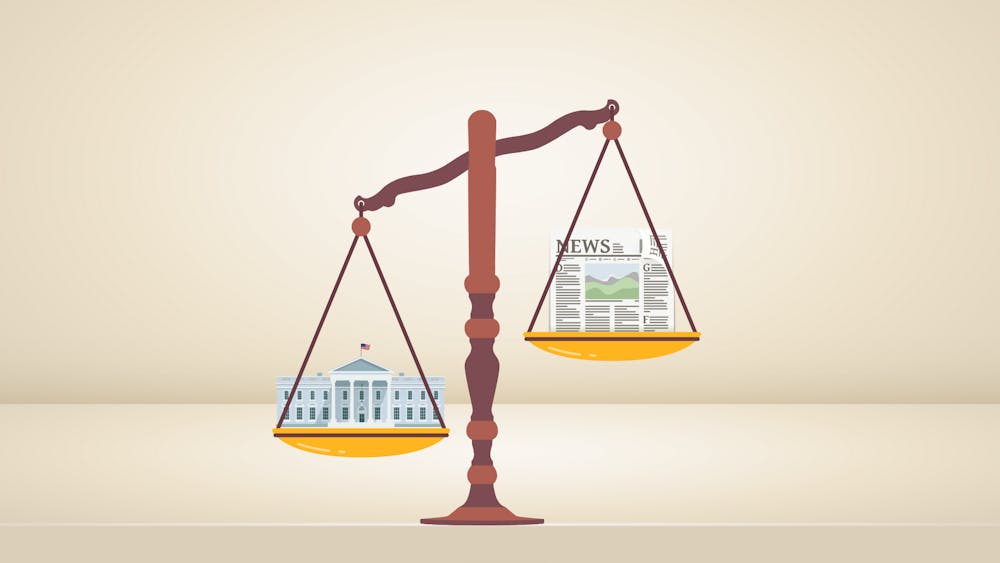
When a president builds a public database labeling journalists as “misleading,” “biased,” or “liars,” he isn’t defending truth; he’s policing dissent.
The White House’s new Media Bias Tracker, advertised as a transparency tool, functions as something far more alarming: a government-sanctioned enemies list targeting journalists, news outlets, and now entire ideological perspectives that deviate from the administration’s preferred narrative.
It operates as one of the clearest escalations in President Trump’s years-long war on the free press.
A Government-run “Hall of Shame”
The new website, found on WhiteHouse.gov, functions as both a database and a digital punishment board.
It features a rotating “Media Offender of the Week,” an “Offender Hall of Shame,” a running leaderboard tallying how many alleged “offenses” each news outlet has accumulated and even a public tip form encouraging citizens to submit journalists for investigations.
Each flagged story is listed with the publication, reporter, a summary of the supposed offense, and a category. Categories include bias, circular reporting, failure to report, false claim, left-wing lunacy, lie, malpractice, mischaracterization, misrepresentation, and omission of context.
When a user clicks on any of these categories, a blurb appears titled “The Truth,” which simply restates the administration’s own position.
There is no indication that independent fact-checkers have reviewed these statements, and the site presents its own narrative as unquestionable fact while casting journalists’ reporting as inherently suspect. There are no outside sources provided to verify or corroborate the administration’s claims.
As a quote often attributed to George Orwell says, “Journalism is printing what someone else does not want printed; everything else is public relations.”
The Media Bias Tracker does the opposite: it punishes journalism for doing its job and elevates government public relations as an unquestionable fact. By labeling legitimate reporting as “lies” while presenting its own unverified claims as truth, the administration isn’t correcting misinformation; it’s controlling the narrative.
This setup is dangerous because it positions the government as the sole arbiter of truth, a role no democratic institution should occupy.
By publicly labeling certain journalism as “lies” or “lunacy” while elevating its own unverified claims as fact, the administration creates a chilling effect; reporters may hesitate to ask hard questions for fear of being added to a government watchlist.
It blurs the line between legitimate media criticism and state-driven intimidation, undermining the free press protections that democracy depends on.
This is not media accountability. This is government-run intimidation.
A Pattern: Trump Punishes Those Who Criticize Him
The tracker is not an isolated invention, but part of a long-running pattern of publicly attacking journalists and entertainers who challenge him.
Trump has repeatedly singled out female reporters, often in explicitly gendered ways.
Here are a few of these moments:
“Quiet piggy”
When speaking to reporters on Air Force One on Nov. 14, Trump was asked about recently released emails from Jeffrey Epstein that mentioned him. A female journalist from Bloomberg News, Catherine Lucey, attempted to ask a follow-up question about Epstein, to which Trump responded, “Quiet piggy.”
Mary Bruce
On Nov. 18, President Trump met with Saudi Crown Prince Mohammed bin Salman in the Oval Office on Nov. 16. Mary Bruce of ABC News was one of many journalists let into the meeting to question the president and the prince. Bruce asked bin Salman about the death of a Washington Post columnist at the Saudi Consulate in Istanbul in 2018, which U.S. Intelligence had determined to be an attack carried out on the prince’s orders.
“Your Royal Highness, the U.S. intelligence concluded that you orchestrated the brutal murder of a journalist. 9/11 families are furious that you are here in the Oval Office. Why should Americans trust you?” she asked.
Trump then accused Bruce of embarrassing bin Salman and called Bruce “insubordinate.”
During the same meeting, Bruce inquired about the Epstein files.
“I think you are a terrible reporter,” Trump said in response.
Rachel Scott
On Dec. 8, Trump held a roundtable in the Cabinet Room in which he took questions from the press.
ABC News’ Rachel Scott asked about the recent military strike on a Venezuelan boat that was said to be carrying illegal drugs. Trump and Secretary of War Pete Hegseth have faced allegations that a second strike was aimed at killing two survivors who were floating in the ocean, meaning it could be classified as a war crime.
Scott asked if Trump planned on releasing the full video.
In response to Scott’s query, Trump said, “You are the most obnoxious reporter in the whole place.”
“You are…actually a terrible reporter,” he added.
Kaitlan Collins
On Dec. 6, Trump posted a message on his social media platform, Truth Social, calling Kaitlan Collins “stupid and nasty,” and even misspelling her name.
In his post, Trump claimed she had asked “why the new Ballroom was costing more money than originally thought one year ago,” referring to a controversial renovation project at the White House.
Later that day, Collins used her Instagram Stories to respond.
“Technically my question was about Venezuela,” she said.
Collins had asked Trump about his threats against Venezuela in connection to his recently received FIFA peace prize.
“Mr. President, what would you say to people who say that prize might conflict with your pledge to strike Venezuela?” Collins asked, as seen in footage by FOX 5 Washington, D.C.
Beyond the press: Trump targets comedians
Trump’s attacks extend beyond journalists to late-night television hosts who ridicule or critique him.
Some examples include:
Jimmy Kimmel
In September, Jimmy Kimmel’s late‑night show was temporarily suspended after he made a monologue seemingly accusing what he called the “MAGA gang” of exploiting the assassination of conservative activist Charlie Kirk. Trump and other conservative figures and media outlets criticized the comment as offensive and politically charged.
Following pressure from affiliates, the network temporarily pulled the show, which Trump celebrated on his social media.
“Great News for America,” Trump posted on Truth Social. “Congratulations to ABC for finally having the courage to do what had to be done. Kimmel has ZERO talent.”
Seth Meyers
On Nov. 15, Trump took to Truth Social to criticize late-night television host Seth Meyers.
“Meyers is suffering from an incurable case of Trump Derangement Syndrome (TDS),” the post read. “Meyers has no talent, and NBC should fire him, IMMEDIATELY!”
Meyers said he was confused as to “‘What set Trump off this time,’” according to USA Today. However, Meyers’ shows that week featured jokes about the Epstein files, Trump’s response to a collapsed guest in the Oval Office, and the president’s meeting with the Syrian president.
Trump’s strategy is clear. Whether it’s a journalist asking tough questions or a comedian telling a joke, the response is the same: discredit, demean, and delegitimize.
The Media Bias Tracker formalizes that impulse. It institutionalizes it.
Democracy or Dictatorship?
Around the world, authoritarian leaders have long used similar tools to weaken and control the press.
Since Russia invaded Ukraine on Feb. 24, 2022, the Committee to Protect Journalists (CPJ) has documented 27 journalists imprisoned on criminal charges in Russia under Vladimir Putin’s government. Nine were charged with “fake news,” 14 with terrorism or other anti-state crimes and four on undisclosed charges.
Additionally, 24 media outlets have been deemed “undesirable,” meaning they are banned from operating in Russia. More than 25,000 websites have been blocked for war reporting. 341 journalists and media outlets were branded “foreign agents,” a designation that requires them to submit reports of their activities and expenses to authorities and to list their designation on content, according to the CPJ.
In March 2022, the Russian Parliament adopted and then expanded laws criminalizing the spread of so-called “false” information about the Russian Armed Forces or state actions abroad.
These amendments made it a crime to publish reporting that “discredits” the military or state bodies abroad, contradicts government statements, or calls for foreign sanctions, giving the state sweeping control over wartime information.
A similar trend can be seen in Hungary, where Prime Minister Victor Orban’s nationalist party introduced a bill in May that would allow the government to monitor and penalize media outlets and nongovernmental organizations (NGOs) it deems a threat to “national sovereignty.” Under the proposed law, the government-run Sovereignty Protection Office could place organizations “on a list by governmental decree,” cut off their funding, and monitor their bank accounts, according to the Associated Press.
These examples illustrate how governments chip away at press freedom. They create enemies lists, label critical reporting as disinformation, and position themselves as the arbiters of truth.
Trump’s Media Bias Tracker mirrors the early stages of these systems.
While it does not carry the legal force of Russia’s criminal statutes or Hungary’s proposed blacklist, it relies on the same logic: branding journalists as offenders, elevating state-approved narratives as “truth,” and encouraging public reporting of critical voices.
The danger is not that the United States has already become Russia or Hungary, but that the tracker adopts the same playbook used by leaders who learned that controlling information begins with discrediting those who report it.
When Criticism Becomes Punishable
A democracy that cannot tolerate scrutiny or humor is not a confident democracy.
When comedians like Kimmel and Meyers become targets of the White House, and journalists like Mary Bruce face public humiliation for asking legitimate questions, it signals a leadership that views criticism as a threat rather than as part of constructive discourse.
In many ways, the Media Bias Tracker formalizes what has long characterized Trump’s thin-skinned approach: a pattern of lashing out, belittling opponents, and framing even mild questioning as a personal attack.
This tracker is not about protecting the public from misinformation. It is about shielding the administration from accountability. A government cannot serve as the arbiter of truth, a president cannot curate which journalism is “acceptable,” and a free press cannot function under the shadow of a government-maintained offender list.
This is not an attempt to “fix” journalism. It is an attempt to control the narrative by punishing anyone who challenges it.
Megan Pitt is the head editor of The Setonian’s News section. She can be reached at megan.pitt@student.shu.edu.


